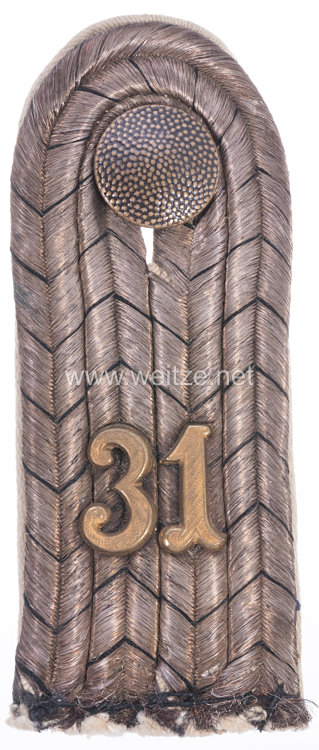
Prussia Single Shoulder Board for a Lieutenant in Infantry Regiment Graf Bose (1st Thuringian) No. 31
This shoulder strap represents a significant element of Prussian military uniform from the late Imperial period and belonged to the equipment of a Lieutenant in the Infantry Regiment Graf Bose (1st Thuringian) No. 31. This unit, stationed in Altona near Hamburg around 1910, was part of the proud military tradition of the Kingdom of Prussia and the German Empire.
The Infantry Regiment No. 31 bore the honorary name “Graf Bose” after the Saxon Field Marshal Karl Friedrich Wilhelm Count von Bose (1721-1782), who served under Frederick the Great during the Seven Years' War. It was designated as the “1st Thuringian Regiment” due to its historical connections to the Thuringia region, although it served in the Prussian army. The regimental number 31 was firmly established in the ranking order of the Prussian infantry.
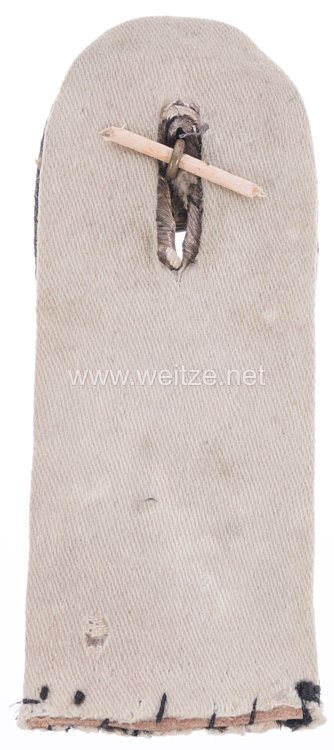
The shoulder strap itself consists of white cloth backing and was designed to be sewn into the uniform. The white color was characteristic of the branch color of the infantry in the Prussian army and served for quick identification of the service branch. This color coding was an essential component of the Prussian uniform system and enabled rapid distinction between different units and ranks even on the battlefield.
The shoulder straps or shoulder boards, as they were also called, evolved from the epaulettes of the 18th and early 19th centuries. While epaulettes originally served a practical purpose – they protected the shoulder from saber blows and prevented the shoulder strap from slipping – shoulder straps increasingly became pure rank insignia. The Prussian army standardized these insignia through various Imperial Cabinet Orders (Allerhöchste Kabinetts-Ordres, AKO) during the 19th century.
A Lieutenant was the lowest officer rank in the Prussian army. The rank corresponded to today's Lieutenant in the Bundeswehr or Second Lieutenant in Anglo-American armed forces. Lieutenants were typically young men from the nobility or upper middle class who were beginning their military careers. They had usually attended a War School or Cadet Corps and served as platoon leaders in their companies.
The identification of the officer rank on the shoulder strap was achieved through metal braiding and stars. A Lieutenant typically wore no rank stars, which distinguished him from higher officer ranks. The braiding for infantry officers was usually silver-colored, while the regimental number and specific regimental insignia indicated exact unit affiliation.
The location of Altona, today a district of Hamburg, was an important garrison town around 1910. The city, which belonged to Prussia until 1937, housed various military installations. The stationing of the 1st Thuringian Regiment in this North German city was part of the strategic distribution of Prussian troops throughout the Reich territory. This distribution served both national defense and the integration of various regional traditions into the Prussian army.
The period around 1910 was a phase of intensive military preparation in the German Empire. Under Kaiser Wilhelm II and his military advisors, the army was continuously modernized and enlarged. Naval armament under Grand Admiral von Tirpitz and growing diplomatic tensions in Europe led to an arms race that ultimately culminated in World War I.
This shoulder strap originates from an era when Prussian military tradition was still in full bloom. Detailed uniform regulations, strict hierarchy, and emphasis on discipline and honor shaped the self-understanding of officers. The Prussian officer corps saw itself as the elite of society and as bearers of military virtues such as duty, bravery, and obedience.
The condition 2 of the object indicates good preservation, which is typical for uniform parts that were not worn in field service. Many of these pieces were used for parade uniforms or garrison duty and therefore survived in better condition than field equipment.
After World War I and the end of the monarchy in 1918, these shoulder straps lost their active military function. The Reichswehr and later the Wehrmacht introduced new uniform systems. Today, such objects are important historical witnesses of the Wilhelmine era and Prussian military history. They document not only the material culture of the military but also the social structures and values of a bygone era.
For collectors and historians, such shoulder straps offer valuable insights into the uniform practices and organization of the Imperial army. They are part of a complex system of insignia and symbols that visualized the hierarchical structure and identity of the Prussian armed forces.