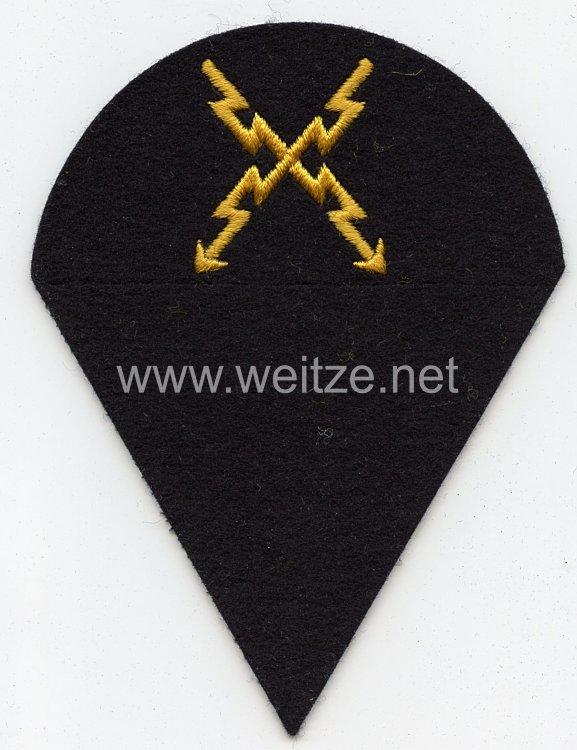
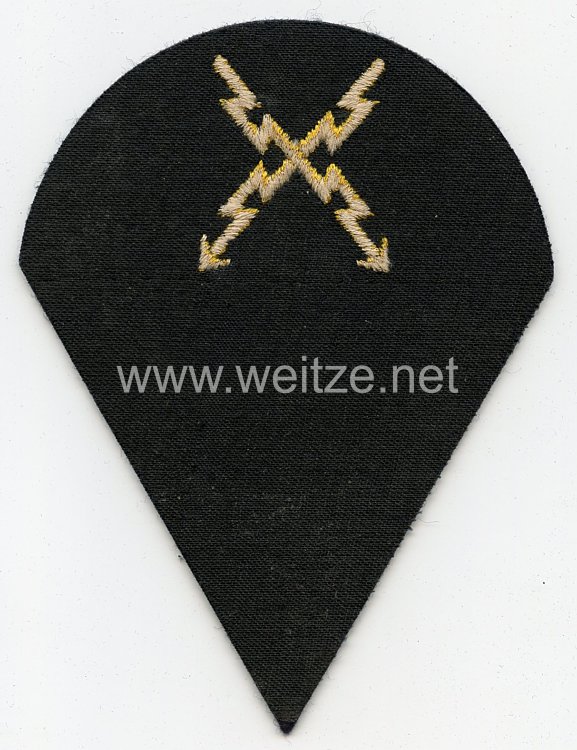
Kriegsmarine Enlisted Personnel Career Insignia Teleprinter Operator

Version for collar wear, reverse with foxing, condition 2.
376634
25,00

Kriegsmarine Enlisted Personnel Career Insignia Teleprinter Operator

The Kriegsmarine Career Badge for Enlisted Personnel in Teleprinter Service represents an important aspect of specialization and qualification identification within the German Navy during World War II. These badges were part of a comprehensive system for visually displaying the technical expertise and professional qualifications of enlisted ranks.

The Kriegsmarine introduced a differentiated system of career badges as early as the 1930s to identify the various technical and administrative specializations of its crew members. Communications technology, which included teleprinter service, played a crucial role in maritime warfare. The rapid and reliable transmission of orders, situation reports, and tactical information was essential for coordinating fleet operations.

Teleprinter specialists formed an important specialist group within the Kriegsmarine's communications divisions. They were responsible for operating, maintaining, and securely transmitting messages using teleprinter technology. This technology enabled encrypted communication between ships, submarines, and shore stations, making it a critical component of maritime operational command.

The version for Colani refers to a special fabric variant of these badges. The term “Colani” refers to a dark blue-black uniform fabric used for certain working and service uniforms of the Kriegsmarine. Unlike versions for the dark blue dress coat or white summer uniform, these badges were designed for practical use on working uniforms.

Career badges were typically worn on the right upper arm of the uniform and consisted of embroidered or woven motifs symbolizing the respective specialty. For communications specializations, these frequently included stylized representations of lightning bolts, radio waves, or technical symbols representing electronic message transmission.

The awarding of such badges was tied to appropriate training and qualification. Enlisted personnel had to complete special courses at naval schools and pass examinations before being authorized to wear the corresponding career badge. This served not only for external identification but also for recognition of acquired expertise and fostered esprit de corps within the various specializations.

The teleprinter service itself was based on electromechanical teleprinter machines that became increasingly widespread in the 1920s and 1930s. In the Kriegsmarine, these devices were used both on larger surface vessels and in coastal stations. Operation required not only technical understanding but also knowledge of encryption procedures and message protocols.

The preservation of such badges with foxing on the reverse is not unusual and indicates storage under partially humid conditions. Textile militaria from the World War II era are frequently affected by such signs of aging, which does not diminish their historical significance. These traces of use demonstrate the authenticity and age of the object.

In the context of military historical research, career badges offer important insights into the organizational structure and technical specialization of armed forces. They document the increasing mechanization of warfare and the associated necessity for highly qualified personnel for specific areas of responsibility.

After 1945, wearing such badges was prohibited with the dissolution of the Wehrmacht. Today they are exclusively collectible objects of military historical interest and serve the scholarly examination of this era. They serve as reminders of the young men who wore these badges and performed their service during one of the darkest periods in German history.