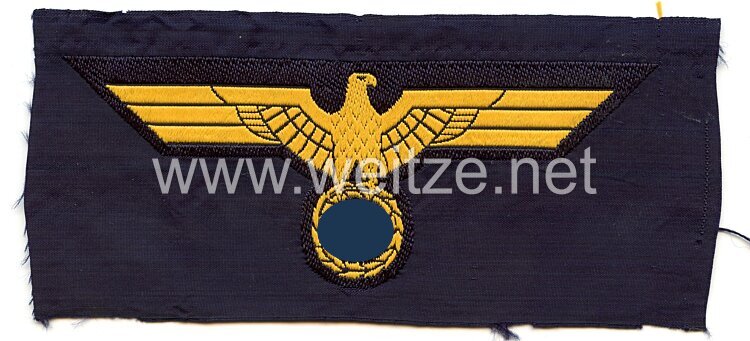
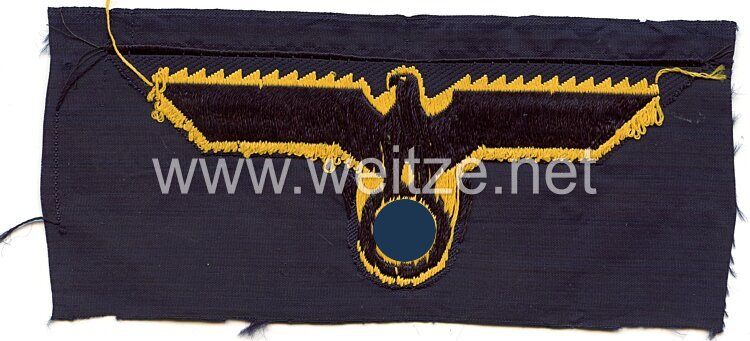
Kriegsmarine Breast Eagle for Enlisted Personnel

Bevo-woven version for the blue tunic. Unissued condition, Grade 2.
453734
75,00

Kriegsmarine Breast Eagle for Enlisted Personnel

The Kriegsmarine Breast Eagle for Enlisted Personnel represents a significant example of military uniform insignia from the Third Reich period. These breast eagles, manufactured using Bevo weaving technique, were worn on the blue work blouse by enlisted ranks of the Kriegsmarine and exemplify the standardized uniforming of German naval forces between 1935 and 1945.

The Bevo weaving technique, named after Barmer Bandweberei Ewald Vorsteher, revolutionized the production of uniform insignia in the 1930s. This machine-weaving technology enabled mass production of high-quality textile badges with fine details and precise contours. Unlike hand-embroidered versions for officers, the Bevo-woven eagles for enlisted men could be cost-effectively manufactured in large quantities.

The Kriegsmarine was officially established on June 1, 1935, after the German Reich announced rearmament in March of that year. Uniform regulations were continuously developed and standardized in the following years. The breast eagle, also called Hoheitsabzeichen (national emblem), was a central element of uniforming and had to be worn by all members of the Wehrmacht.

For enlisted ranks of the Kriegsmarine, the blue work blouse (Drillichbluse) was an essential component of service clothing. It was worn during work duties aboard ships and in harbors. The breast eagle was attached centrally on the chest, above the breast pockets. The precise placement was specified in the Dress Regulations for the Kriegsmarine (M.Dv. Nr. 52).

The design of the breast eagle followed National Socialist sovereignty symbols: a stylized eagle with outstretched wings holding a swastika in its talons. In the naval version, details were designed in reference to maritime traditions. Colors varied depending on the uniform piece - for the blue blouse, typically a lighter, often silver-gray or whitish eagle on a dark background was used to create the necessary contrast.

The production of these insignia was subject to strict quality controls. Various manufacturers produced them on behalf of the Wehrmacht, with Bevo from Wuppertal being among the best-known suppliers. Other significant manufacturers included the firms BeVo, RUM (Richard Ulbricht Militäreffekten), and various other textile suppliers. Production reached considerable volumes during the war, as constant demand from new recruits, losses, and wear was enormous.

From a collector's perspective, unworn specimens are of particular interest. Condition 2 in the collector's hierarchy denotes a very good to excellent state of preservation with minimal storage traces but without wear from use. Such pieces often survived in military depots, tailoring shops, or as remaining stock from manufacturers.

The technical execution of Bevo weaving typically shows a flat, ribbon-like structure with clearly defined contours. The woven threads were arranged to create a durable, washable insignia. The reverse side is usually flat and displays the characteristic pattern of the weaving technique. For attachment, the insignia were sewn on, with enlisted men often doing this themselves or having it done by ship's tailors.

In historical context, these insignia represent the comprehensive militarization of German society. The Kriegsmarine grew from approximately 15,000 men in 1935 to over 800,000 men by the end of the war. Accordingly, millions of such insignia were necessary. The standardized production also reflects industrial warfare and the organization of the German armaments industry.

After 1945, the use of these symbols was banned in Germany. Today, preserved specimens serve exclusively historical and museum purposes. For militaria collectors and historians, they offer important insights into material culture, manufacturing techniques, and uniforming practices of the Kriegsmarine. The collection and research of such objects takes place within the framework of historical investigation and serves to understand this era.