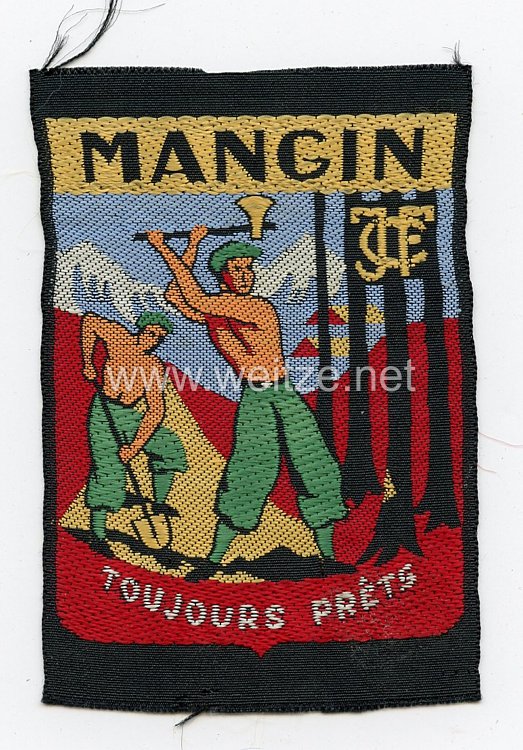
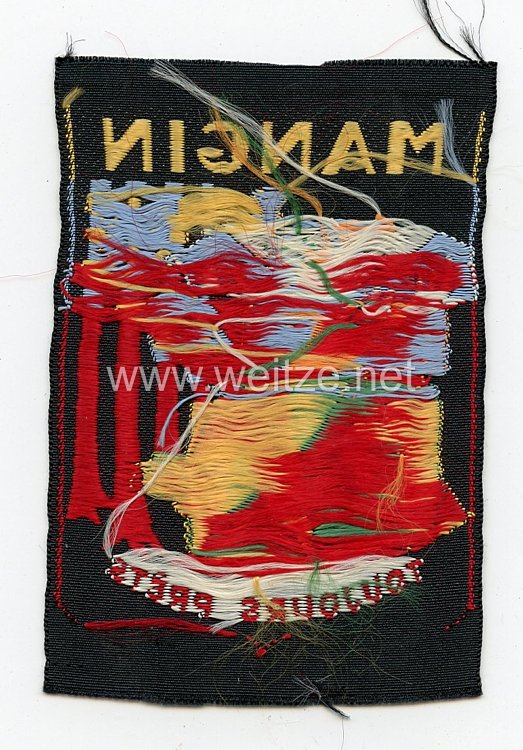
France World War II Vichy Government, Youth Organization Cloth Insignia "Chantiers de la Jeunesse, groupement 27 Foix-Ariège"
This fabric insignia of the Chantiers de la Jeunesse, specifically from Groupement 27 Foix-Ariège, represents a significant chapter in French history during World War II under the Vichy Government. This badge, manufactured using the high-quality Bevo weaving technique, documents the complex and controversial youth policy of the French State between 1940 and 1944.
The Chantiers de la Jeunesse Française (French Youth Workshops) were established by law on July 30, 1940, immediately following the French defeat and the signing of the armistice with Germany. General Joseph de La Porte du Theil was appointed as the General Commissioner of this organization. The Chantiers emerged as a direct consequence of the armistice conditions, which prohibited France from maintaining a regular army in the occupied zone. Conceived as a replacement for the abolished compulsory military service, young French men aged 20 were required to serve for eight months (later reduced to six months) in this paramilitary youth organization.
Groupement 27 was stationed in the Foix-Ariège region, a department in the French Pyrenees in southwestern France. The geographical division of the Chantiers consisted of approximately 30 Groupements distributed across the unoccupied zone and later throughout France. Each Groupement comprised several thousand young men and was subdivided into smaller units. The choice of the Ariège region was strategically significant: the mountainous topography provided ideal conditions for training in physical fitness, fieldwork, and forestry.
The Bevo weaving technique used to manufacture this insignia refers to a special weaving process developed by the German company Bandfabrik Ewald Vorsteher. This technique enabled the production of detailed, colorfast fabric badges with high durability. The use of this technique for French insignia during the Vichy period underscores the economic and technical interconnections between occupied France and Germany.
The ideology of the Chantiers de la Jeunesse was deeply rooted in Marshal Philippe Pétain's Révolution Nationale. The organization was intended to educate young Frenchmen in the spirit of the motto “Travail, Famille, Patrie” (Work, Family, Fatherland), which replaced the republican motto “Liberté, Égalité, Fraternité.” The emphasis was on physical labor, moral education, discipline, and a return to traditional rural values. The young men were housed in camps where they participated in reforestation projects, agricultural work, and infrastructure projects.
Between 1940 and 1944, an estimated 400,000 young Frenchmen passed through the Chantiers de la Jeunesse. The organization was initially relatively popular, as it appeared to be an alternative to German labor service or deportation to Germany. The training included sports, singing, craft activities, and ideological instruction. Despite their paramilitary structure, participants received no weapons training, in compliance with armistice conditions.
The role of the Chantiers de la Jeunesse remains controversial to this day. On one hand, the organization spared many young men from forced labor in Germany under the Service du Travail Obligatoire (STO). On the other hand, it served as an instrument of Vichy propaganda and authoritarian indoctrination. After the Allied landing in North Africa in November 1942 and the subsequent German occupation of the entire French zone, the organization gained a more complex dimension: some members joined the Résistance, while the official structure continued under German control.
General de La Porte du Theil himself was arrested by the Germans in January 1944 after refusing to fully integrate the Chantiers into the German war apparatus. Following the Libération in 1944, the Chantiers de la Jeunesse were officially dissolved. Their members were partly integrated into the newly formed French army or returned to civilian life.
This fabric insignia is thus not merely a collectible item but a material testimony to this ambivalent historical period. It represents the Vichy regime's attempts to shape a new French youth according to its ideological concepts, while simultaneously standing for the complex realities of the occupation period, in which survival, collaboration, and resistance were often inextricably intertwined.