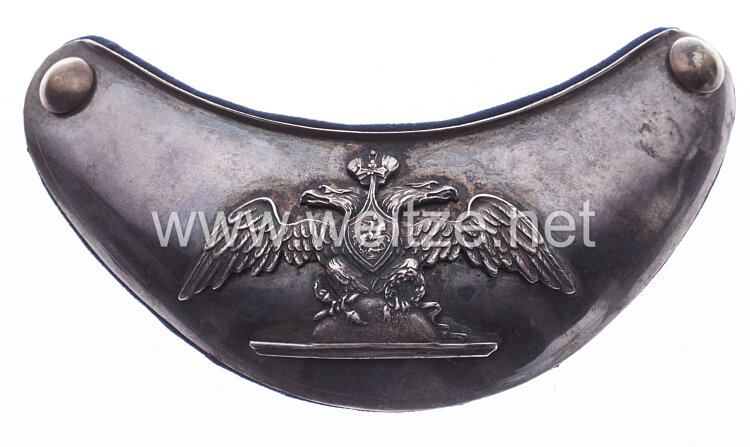
Imperial Russian Gorget for Officers of Line Regiments

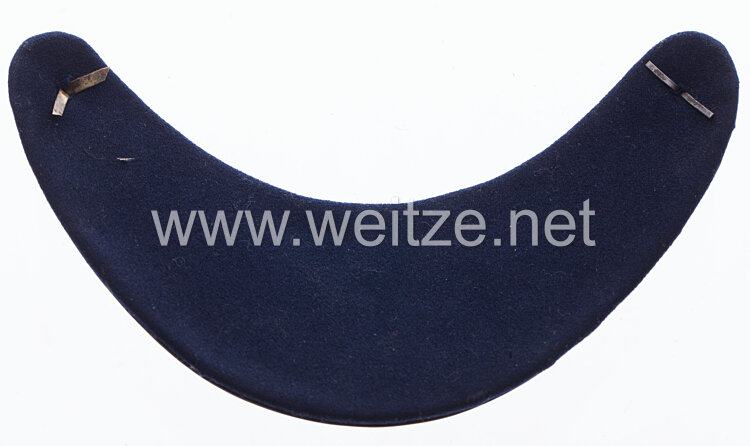
circa 1840. Gorget made of genuine silver, applied double-headed eagle, buttons on sides. Reverse with dark blue cloth backing. Lightly worn, condition 2.
248533
1.500,00

Imperial Russian Gorget for Officers of Line Regiments

The gorget collar for officers of the line regiments of Tsarist Russia from around 1840 represents a significant testament to the military uniform and rank insignia tradition of the Russian Empire. This distinction piece embodies the elegance and hierarchical character of Russian military affairs during the reign of Tsar Nicholas I (1825-1855), an era characterized by strict military discipline and uniform regulations.

The introduction of such gorget collars for officers of the line infantry occurred as part of comprehensive uniform reforms that the Russian military underwent in the first half of the 19th century. After the Napoleonic Wars (1812-1814), the Russian military leadership endeavored to establish a uniform and representative dress code that clearly indicated rank and affiliation with specific units.

The construction in genuine silver underscores the high status of the wearer within the military hierarchy. Silver was the prescribed metal for infantry officers, while cavalry frequently wore gold insignia. The applied double-headed eagle, the coat of arms of the Russian Empire, symbolized absolute loyalty to the Tsar and the Russian state. The double-headed eagle with its heads facing east and west represented the extension of the Russian Empire across two continents.

The technical execution of such gorget collars followed precise military regulations. The lateral fastening by means of buttons enabled the donning and removal of the collar, which was worn over the uniform coat. The dark blue cloth backing on the reverse side served not only for wearing comfort but also corresponded to the branch color of the line infantry. Dark blue was the traditional basic color of Russian infantry uniforms since the reforms of Peter the Great.

The line regiments formed the backbone of the Russian army. They differed from the Guards and Grenadier regiments through specific uniform details and insignia. While Guards officers wore more elaborate collars often decorated with precious stones, the gorget collars of line officers were designed more functionally, yet retained their representative significance.

In the era around 1840, the Russian military experienced a phase of consolidation. Uniform regulations were repeatedly refined, particularly through the Uniform Regulation of 1834, issued under the direction of War Minister Count Alexander Chernyshev. This ordinance standardized officer insignia and established precise specifications for materials, execution, and manner of wearing.

The artisanal manufacture of such gorget collars required specialized goldsmiths and military effects manufactories, located primarily in St. Petersburg and Moscow. Officers had to finance their uniform pieces themselves, which represented a considerable financial burden in the case of silver collars with elaborate double eagles. This contributed to the social exclusivity of the officer corps, which was recruited predominantly from the nobility.

The condition described as “lightly worn” indicates that this specimen was actually used in service. Many officers possessed multiple uniform sets for different occasions: parade uniforms, service uniforms, and field uniforms. Gorget collars of this type were worn primarily for representative occasions, parades, and official ceremonies.

The historical significance of such objects lies not only in their material nature but also in their symbolic value. They represent a military system based on strict hierarchy, loyalty to the crown, and traditional values. The Russian officer corps understood itself as the elite of the empire, and the uniform was the visible expression of this self-perception.

After the mid-19th century, especially after the Crimean War (1853-1856), uniform reforms occurred again. The elaborate gorget collars were increasingly replaced by more practical insignia, as the experiences of modern warfare necessitated a simplification of uniforms. Nevertheless, such ceremonial pieces remained in use for ceremonial occasions until the end of the Tsarist Empire in 1917.

Today, authentic gorget collars from the Nicholas era are sought-after collector's items that offer important insights into the military history, craftsmanship, and social structures of Tsarist Russia. They document an epoch in which military ranks and class distinctions were made visible through elaborate uniforming.