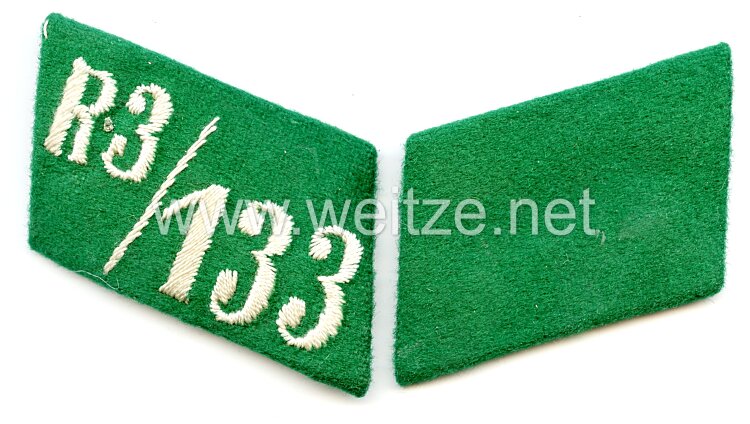
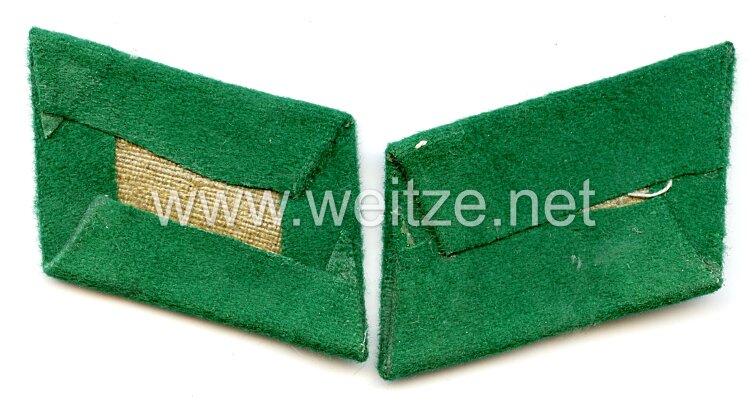
SA Pair of Collar Tabs SA-Gruppe Sachsen Reservesturm 3 of Standarte 133
These collar patches (Kragenspiegel) represent a significant artifact from the early organizational structure of the Sturmabteilung (SA) in the Saxony region. These rank insignia belonged to Reserve Storm 3 of Standard 133, which was based in Zwickau and was active around 1933 – a fateful year in German history that marked the Nazi seizure of power.
The SA, originally founded in 1920/21 as a paramilitary combat organization of the NSDAP, experienced explosive growth in the years leading up to 1933. While membership stood at approximately 60,000 in 1930, this number swelled to over 400,000 by early 1933. After the seizure of power, hundreds of thousands of opportunists streamed into the organization, quadrupling membership by 1934. This development necessitated a complex hierarchical structure.
The organizational structure of the SA followed a military model: the smallest unit was the Gruppe (group, 4-8 men), followed by Trupp (squad), Schar (platoon), Sturm (storm troop), Sturmbann (battalion), Standarte (standard/regiment), Brigade, Untergruppe (sub-group), and finally Gruppe as the highest territorial unit. The SA-Gruppe Sachsen (SA Group Saxony) was one of these supreme territorial units, encompassing all SA formations in the Saxon region.
A Standarte as a unit roughly corresponded to a regiment and consisted of several battalions with a total strength of 1,000 to 3,000 men. Standarte 133 was one of the numerous standards within SA-Gruppe Sachsen. Each standard was identified by a number, though the numbering did not indicate size or importance but merely served organizational registration purposes.
Particularly interesting is the designation “Reservesturm” (Reserve Storm Troop). These units were frequently formed for older members, men with limited physical capability, or members who could not attend all regular service evenings and exercises due to professional obligations. Nevertheless, reserve storm troops fulfilled important functions at propaganda events, marches, and securing party gatherings.
The collar patches served to identify membership in specific units and regions. The green cloth was characteristic of SA-Gruppe Sachsen, as each SA-Gruppe had its own group color: Berlin had crimson, Hochland white, Thuringia orange, and Saxony green. This color coding enabled quick visual identification of SA men to their home regions.
The white embroidery “R3/133” on the collar patches provides precise information about unit membership: the “R” stands for Reserve, the “3” for the third storm troop, and “133” for membership in Standarte 133. This type of marking followed the standardized uniform regulations of the SA leadership from 1932/33.
The location of Zwickau was a significant center of the National Socialist movement in Saxony during the 1920s and early 1930s. The industrial city with its working-class population offered contested terrain between Communists and National Socialists. The SA played a central role here in the violent assertion of National Socialist claims in public spaces.
The unworn condition of these collar patches raises interesting questions. They may have been produced shortly before or after the Röhm Affair in June 1934, when the importance of the SA rapidly diminished and many members left the organization. After the bloody elimination of the SA leadership around Ernst Röhm, the organization lost its paramilitary character and was degraded to a largely insignificant party organization.
Such uniform items were typically procured and attached by the SA men themselves or their families. The quality of the embroidery and preservation indicate solid craftsmanship typical of this period. The collar patches were worn in pairs on both sides of the brown SA shirt.
Today, such objects are important witnesses for researching the National Socialist organizational structure and serve as material evidence of the penetration of German society by paramilitary formations in the early 1930s.