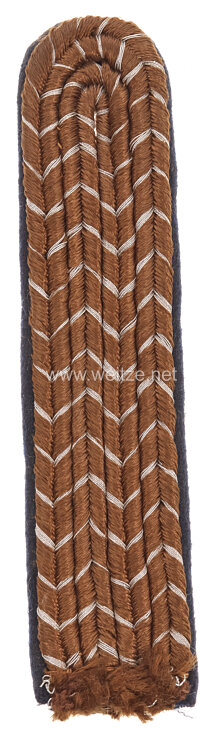
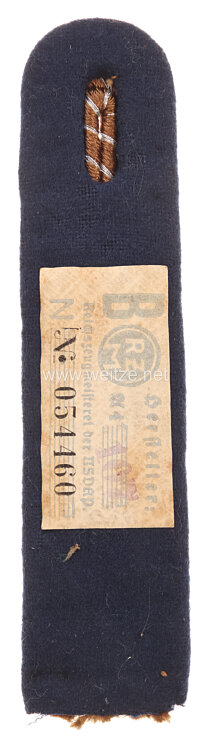
SA Single Shoulder Strap for SA Men of the Marine-SA and Medical Units
The SA shoulder strap for SA men of the Marine-SA and Medical Stürme represents a characteristic insignia of the paramilitary organization of the Sturmabteilung (SA) during the National Socialist period. The present example represents the second model, which was in use from 1939 to 1945 and identified specific affiliations within the SA organization through its cornflower blue backing.
The Sturmabteilung was founded in 1920/21 as the security detachment of the NSDAP and developed into one of the most significant paramilitary formations of the National Socialist movement. After the seizure of power in 1933, the SA grew to several million members. The uniform identification and standardization of this mass organization required a sophisticated system of rank insignia and affiliation markers.
The shoulder straps served as an essential element for identifying rank and affiliation within the SA hierarchy. The model described here dates from the later period of SA uniforming, after various changes in design and production were implemented in 1939. The transition to the second model occurred in the context of a general standardization of SA uniforms.
The cornflower blue color of the backing is of particular significance. Within the SA color system, this specific color designated affiliation with the Marine-SA, a special formation that represented maritime interests and was frequently active in coastal regions. The same coloring was also used for the Sanitätsstürme (Medical Stürme), those units responsible for medical care and sanitary services within the SA. This dual use of the same color for different functional areas was quite common in the SA uniform system.
The RZM paper label on the reverse is an authentic feature of official production. The Reichszeugmeisterei (RZM) was established in 1929 as the central procurement office of the NSDAP and from 1933 was responsible for quality control and certification of all uniform effects and insignia of party organizations. Each approved manufacturer received an RZM number that had to be affixed to the products. This served both quality assurance and economic control, preventing black market production.
The classification as a single shoulder strap indicates that this was a piece for simple SA men without special rank. Higher ranks wore more elaborate shoulder straps with additional markings such as stars, cords, or braids. The simple design for enlisted ranks corresponded to the hierarchical structure of the SA.
The stated unworn condition of the object is remarkable. Many uniform items from this period were used intensively, especially during the war years. Unworn pieces with preserved paper markings are therefore rarer. They may have remained unused for various reasons: as depot stocks, as spare parts that were never needed, or as late-phase productions that were never issued.
The Marine-SA held a special position within the SA organization. It was established in the early 1930s and was intended to integrate maritime tradition and the interests of the coastal population into the SA structure. After 1933, the Marine-SA assumed various representative and propaganda functions in port cities and coastal regions.
The Sanitätsstürme formed another important functional area within the SA. They were responsible for medical care at events, marches, and later also for air raid protection duties. The medical formations received basic training in first aid and emergency care.
After the so-called Röhm Putsch in June 1934, the SA lost considerable political significance. The SS increasingly assumed the role as the most important party militia. Nevertheless, the SA remained in existence until 1945 and fulfilled various tasks in the area of pre-military training, at propaganda events, and later also in air raid protection and cleanup operations after bombing raids.
Such uniform items are today significant contemporary historical documents that provide insight into the organization, hierarchy, and visual representation of National Socialist mass organizations. They document the sophisticated systems of identification and affiliation that were of considerable importance for the regime's self-presentation.