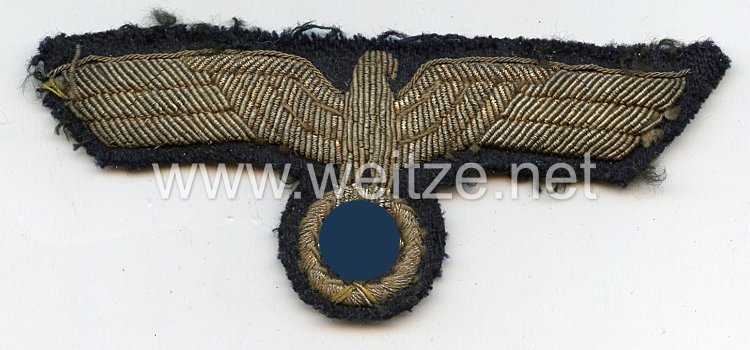
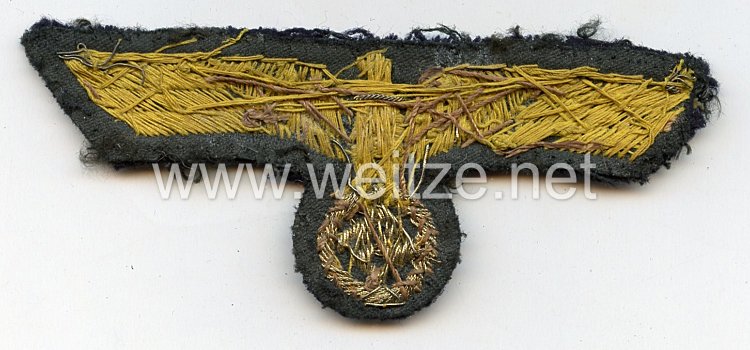
Kriegsmarine Breast Eagle for Naval Officers
The Kriegsmarine Breast Eagle for Naval Officers represents a significant rank insignia of the German naval warfare fleet during World War II. This hand-embroidered emblem made of metal thread on dark blue cloth backing embodies the maritime traditions and hierarchical structure of the Kriegsmarine between 1935 and 1945.
The Kriegsmarine was officially founded on June 1, 1935, when Nazi Germany broke the provisions of the Treaty of Versailles and renamed and significantly expanded the Reichsmarine of the Weimar Republic. This reorganization was accompanied by a comprehensive reform of uniform regulations, which included precise specifications for rank insignia and uniform emblems.
The breast eagle for naval officers differed significantly from those of other Wehrmacht branches. While Army and Luftwaffe versions existed in various designs, the naval eagle was distinguished by its specific stylization and method of attachment. The emblem was traditionally worn on the right breast of the uniform, above the breast pocket, clearly identifying the wearer as a member of the naval warfare fleet.
The manufacturing technique of these breast eagles varied considerably. Officer versions, such as the present example, were typically executed in hand embroidery on cloth backing. The metal thread used typically consisted of aluminum or silver-plated wire, embroidered onto the characteristic dark blue woolen fabric. This elaborate handwork distinguished officer insignia from machine-made or woven versions for enlisted ranks.
The design of the eagle itself followed clear regulations: a stylized eagle with outstretched wings, holding a swastika in an oak leaf wreath in its talons. The artistic execution could vary slightly depending on the manufacturer, as various workshops and suppliers produced for the navy. Well-known manufacturers included companies such as BEVO (Bandfabrik Ewald Vorsteher), although hand embroideries were often made by specialized military tailors.
The wearing method and position of the breast eagle were precisely regulated by the Dress Regulations for the Kriegsmarine. It was worn on various types of uniforms, including the dark blue service dress, the white summer uniform, and the dress uniform. Attachment was done by sewing, with professional military tailors typically performing this task.
Naval officers underwent intensive training, often beginning at the Naval Academy Mürwik in Flensburg-Mürwik, the main training facility for naval officers. Wearing the breast eagle symbolized not only military rank but also membership in an elite force with long maritime traditions dating back to the Imperial Navy.
At its peak, the Kriegsmarine comprised approximately 810,000 personnel and operated worldwide with surface vessels, submarines, and coastal defense units. Officers bore considerable responsibility in this complex organization, from commanding U-boats to leading capital ships such as the Bismarck or Tirpitz.
The present specimen, removed from the uniform and in used condition (grade 2-3), testifies to its actual use. Such removals were common after the war's end, when uniforms were reused for practical reasons while identifying emblems were removed. The state of preservation indicates normal wear, possibly slight oxidation of the metal thread or wear of the cloth backing.
From a historical perspective, such objects are important testimonies to military history. They document manufacturing techniques, material usage, and organizational structures. For collectors and historians, they provide insights into the everyday reality of military hierarchies and the material culture of the Kriegsmarine. Today, they are preserved in military historical collections and scientifically documented, with their historical context always requiring critical reflection.