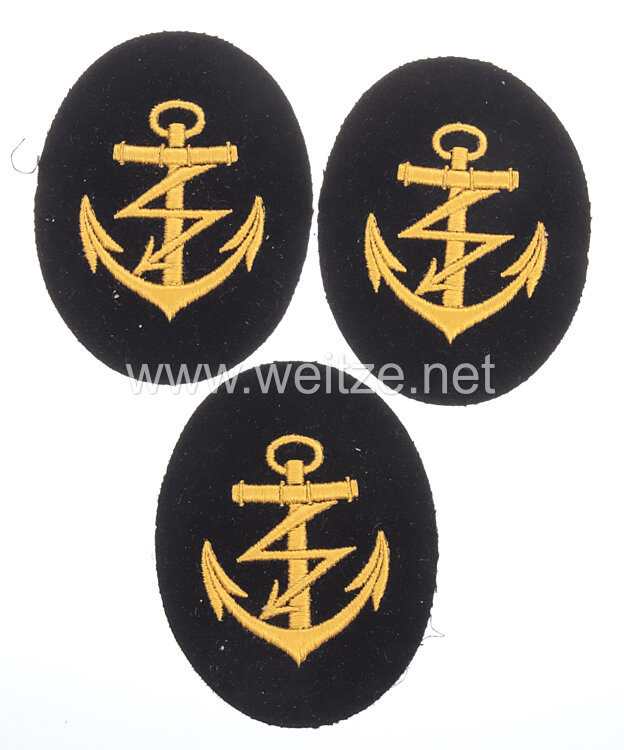
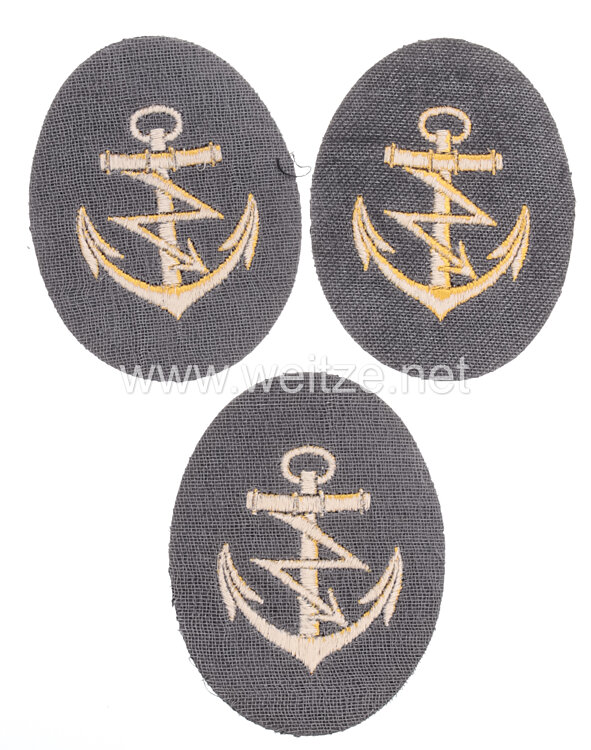
Kriegsmarine Sleeve Insignia Career Path Radio Petty Officer
The Kriegsmarine sleeve insignia for Funkmaat (Radio Petty Officer) represents a significant element of German naval uniform regulations during World War II. These career insignia served to immediately identify the specialization and rank of naval personnel within the complex hierarchy of the Kriegsmarine.
The Kriegsmarine, as the official designation of the German Navy from 1935 to 1945, developed a sophisticated system of uniform badges and markings. Following the reintroduction of general conscription in March 1935 and the associated buildup of the Wehrmacht, naval uniforms were newly regulated. The Kriegsmarine dress regulations precisely specified which insignia were to be worn by which ranks and career paths.
The term Funkmaat designated a non-commissioned officer in the signals branch, specialized in radio technology and maritime communications. Radio reconnaissance and communication played a decisive role in naval warfare. Funkmaate were responsible for operating and maintaining radio equipment aboard ship, receiving and transmitting encrypted messages, and were integral members of the ship's crew. Their training was technically demanding and included not only operation of radio equipment, but also knowledge of Morse code, encryption procedures, and technical maintenance.
The sleeve insignia was worn on the blue jumper, the everyday service uniform of the Kriegsmarine. This jumper, also called Deckbluse, was dyed dark blue and, together with corresponding trousers, formed the standard working uniform for enlisted men and non-commissioned officers. Unlike the walking-out dress or parade uniform, the blue jumper was designed for daily service aboard ship.
The career insignia of the Kriegsmarine followed a color-coded system that identified the various technical specializations. Signals personnel, to which the Funkmaate belonged, were identified by specific colors and symbols. The insignia was typically worn on the right upper arm and consisted of embroidered or woven elements on a fabric backing in the corresponding career color.
The technical importance of radio reconnaissance cannot be overstated. The B-Dienst organization of the Kriegsmarine, the radio reconnaissance service, played a central role in decrypting enemy messages, especially in the Atlantic during submarine warfare. Funkmaate were indispensable on both U-boats and surface vessels. They maintained communication with naval command and enabled coordination of fleet operations.
The manufacture of such sleeve insignia was carried out by various authorized manufacturers, both military depots and private firms that had contracts with the Wehrmacht. Quality could vary, with early war years often showing better materials and workmanship than later productions, as material shortages increased. Insignia were machine-embroidered or woven, sometimes also handcrafted.
The present example for the blue jumper is an authentic testament to the maritime uniforming of this era. The stated condition 2 suggests a well-preserved piece that may show moderate signs of use but still clearly displays its original form and details. Such insignia were either sewn on or ironed on, with the attachment method often providing clues about use and period.
For collectors and historians, these sleeve insignia are important objects of study. They provide insights into the organization, hierarchy, and technical specialization of the Kriegsmarine. The various career paths – from artillery through torpedo service to signals technology – reflected the increasing technical complexity of modern naval warfare. Correct identification of such insignia requires thorough knowledge of uniform regulations and their changes during the course of the war.
Today, authentic Kriegsmarine insignia are sought-after collector's items, which must however be treated with appropriate historical sensitivity. They serve as material witnesses to a historical period and are of documentary value for military-historical research. The preservation and scientific cataloging of such objects contributes to understanding naval history and the technical development of military communications.
The specialization represented by the Funkmaat insignia reflects the critical importance of radio communications in World War II naval operations. From the Battle of the Atlantic to operations in the North Sea and beyond, radio operators were the lifeline connecting individual vessels to their command structure, making them essential personnel despite often serving in the shadows of more celebrated combat roles.