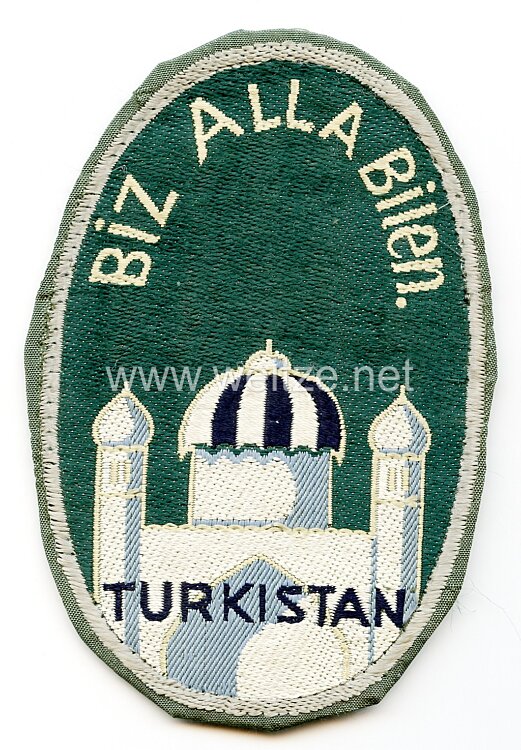
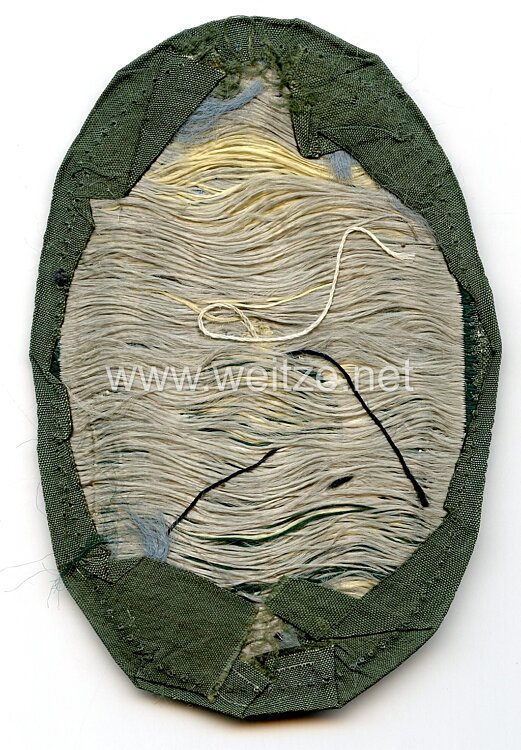
Wehrmacht Heer Sleeve Shield for Turkistan Volunteers
The Turkistan Sleeve Shield of the Wehrmacht represents one of the most historically significant badges of the volunteer formations established during World War II. This Bevo-woven example represents the complex history of the Eastern Legions and Nazi Germany's attempts to mobilize non-Russian peoples of the Soviet Union for the war against Stalin.
The Turkistan Legion was established from 1941/42 onwards from Soviet prisoners of war of Central Asian origin, primarily from the territories of present-day Uzbekistan, Kazakhstan, Kyrgyzstan, Turkmenistan, and Tajikistan. Following the German invasion of the Soviet Union in June 1941, hundreds of thousands of Red Army soldiers fell into captivity. Under the catastrophic conditions of German POW camps and facing the Stalinist oppression of their home regions, many Turkic soldiers agreed to fight on the German side.
The sleeve shield displays in a high-oval form a stylized mosque and bears the inscription “Biz Alla Bilen. Turkistan” (We with God. Turkistan). This design was intended to symbolize the Islamic and cultural identity of the Central Asian volunteers and emphasize their motivation to fight against the atheistic Soviet regime. The use of religious symbolism was remarkable, as it contradicted National Socialist ideology but was pragmatically employed to motivate the volunteers.
The Bevo weaving technique (Barmer Verschönerungsverfahren) was a high-quality manufacturing method for textile insignia, in which the design was directly woven into the fabric. This technique enabled fine details and durable badges that were distinctly superior to simpler embroidered or printed variants. The firm Johann Poell in Wuppertal was among the main manufacturers of such Bevo insignia.
The Turkistan units were initially employed as Hilfswillige (volunteer auxiliaries or Hiwis), later reorganized into regular combat units. The Turkistan Legion No. 450 was the main formation, with several battalions deployed in various theaters of war, mainly in France, Italy, and the Balkans. German leadership largely avoided their deployment on the Eastern Front to prevent defection.
The wearing of the sleeve shield on the right upper arm was regulated by Army ordinances. It was intended to honor the national identity of the volunteers and demonstrate their status as allies (not mere auxiliary troops). Similar sleeve shields existed for other Eastern Legions such as the Caucasian, Armenian, Georgian, and North Caucasian units.
Leadership of the Turkistan units was partly held by Veli Kajum Khan, an Uzbek nationalist, and Baymirza Hayit, both of whom aspired to an independent Central Asian republic. These leaders saw collaboration with Germany as an opportunity to liberate their homeland from Soviet rule – a hope that would prove to be a tragic illusion.
The historical assessment of these units remains complex and controversial. While some volunteers acted from genuine anti-communist conviction, others were forced into collaboration by the desperate situation in the POW camps. After the war's end, many of these soldiers were forcibly repatriated to the Soviet Union through Operation Keelhaul, where they were executed as traitors or deported to Gulags.
Unworn sleeve shields such as the described example are very rare today. Most were issued and worn during the war, or destroyed after the war's end. Surviving pieces are mainly found in military-historical collections and museums. They serve as material witnesses to a tragic episode of history in which national aspirations, ideological conflicts, and human suffering were interwoven in complex ways.
The study of such objects is of considerable importance for understanding the Eastern Legions, Nazi occupation policy, and intra-Soviet conflicts. They remind us of the thousands of Central Asian men who fought in a foreign war and were often crushed between the fronts.