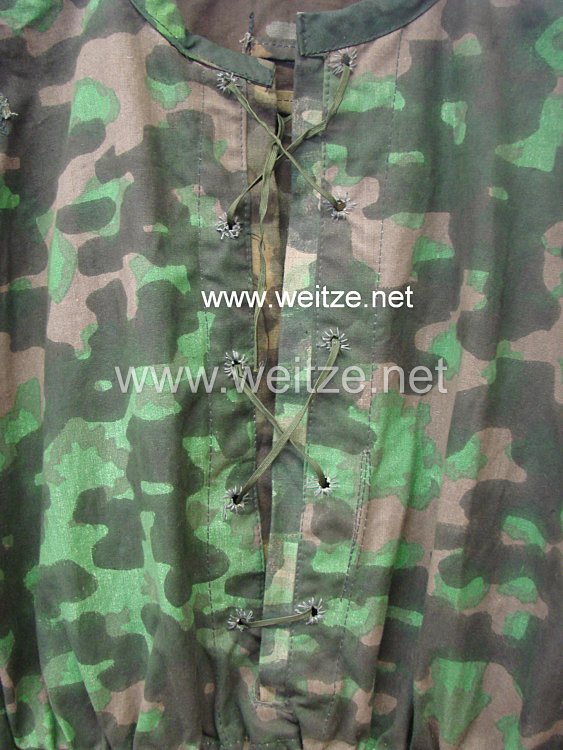
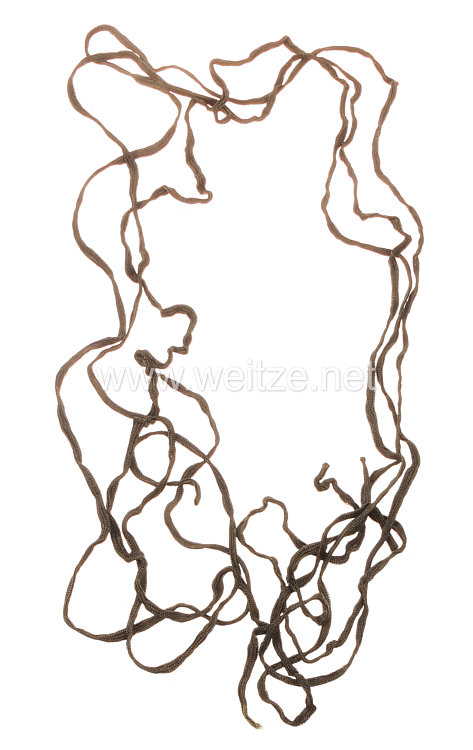
Waffen-SS Drawstring for the Reversible Camouflage Smock

Manufactured circa 1942/43, dark green woven cord for the camouflage smock. Length 120 cm. Unissued condition, condition 2+.
We were able to acquire a small remaining stock. Very rare, as most camouflage smocks are missing the drawstring!
446332
380,00

Waffen-SS Drawstring for the Reversible Camouflage Smock

The tie cord for the reversible camouflage smock of the Waffen-SS represents an important, though often overlooked, equipment detail in German military history of World War II. This dark green woven cord, measuring 120 cm in length, served as a functional closure element for the revolutionary camouflage smocks that were produced in series between 1942 and 1943.

The development of camouflage occupied a significant position in German military doctrine during the 1930s and early 1940s. While the Wehrmacht initially relied on traditional uniform colors, the Waffen-SS began developing camouflage patterns as early as 1937. The famous SS-Flecktarnmuster (SS splinter pattern) was developed under the direction of Johann Georg Otto Schick and represented one of the world's first military camouflage patterns based on scientific principles.

The reversible camouflage smock (Wendetarnhemd or Tarnbluse) was a technical innovation of its time. It could be reversed, offering two different camouflage patterns: one side for spring and summer with lighter green tones, the other side for autumn and winter with darker brown tones. This reversibility necessitated a special closure system, as conventional buttons or metal fasteners would have been impractical for a reversible garment.

The tie cord fulfilled several practical functions: it enabled a flexible closure of the smock that could be easily opened and closed, it caused no disturbing reflections as metal buttons would have done, and it was cost-effective to manufacture. The dark green coloring was chosen to harmonize with both sides of the camouflage smock and not compromise the camouflage itself.

The production of these cords took place in various textile factories throughout the German Reich. Manufacturing was subject to military administration regulations and had to meet certain quality standards. The cord needed to be tear-resistant, weather-resistant, and colorfast. The weaving followed a special process that gave the cord both strength and flexibility.

In military practice, the system proved to be ambivalent. While the theoretical advantages were obvious, front-line soldiers often reported practical difficulties: in wet conditions the cords would warp, in cold weather they could become stiff, and in the hectic pace of combat, lacing was more time-consuming than simple buttoning. This also explains why many surviving camouflage smocks today are found without their original tie cords – they were lost in field use or replaced with improvised solutions.

Production of the camouflage smocks and their tie cords reached its peak during the years 1942 to 1944. With the deteriorating war situation and increasing material and production bottlenecks from 1944 onwards, quality standards were partially lowered, and the availability of these equipment items became irregular.

From a collector-historical perspective, it is noteworthy that the tie cord today belongs to the rarer components of historical militaria. While camouflage smocks themselves, though rare, can still be found, the vast majority lack the original tie cord. This is due to their perishability as textile objects, their frequent loss in field use, and the fact that they were often deemed unimportant and discarded after the war.

The historical evaluation of these equipment items must always occur within the context of military historical research. They document the state of military-technical development of their time and provide insight into the everyday reality of soldiers. At the same time, critical historical classification of the organizations that wore this equipment is indispensable for a complete understanding of history.

The existence of unissued examples like the one described, manufactured around 1942/43, provides valuable documentation of original production standards and specifications. Such pieces serve as important reference material for historians and researchers studying the material culture and equipment development of the period.