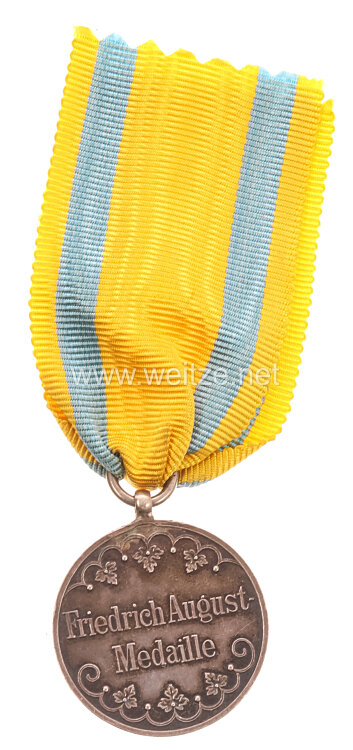
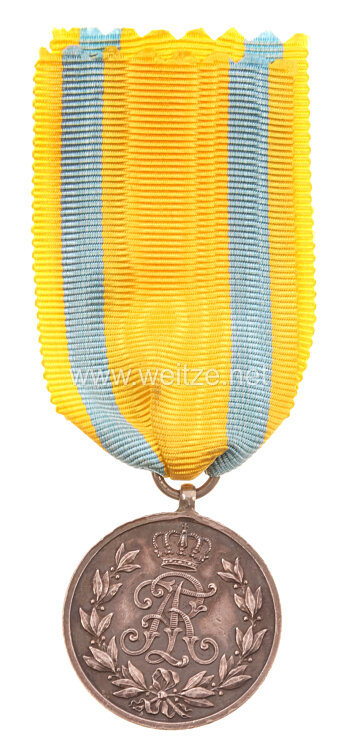
Kingdom of Saxony Friedrich August Medal in Silver
The Friedrich August Medal in Silver of the Kingdom of Saxony represents a significant decoration within the Saxon honors system of the 19th and early 20th centuries. This medal was instituted and awarded in honor of various Saxon monarchs named Friedrich August, with the precise attribution depending on the historical period.
The Kingdom of Saxony established itself after the Congress of Vienna in 1815 as a constitutional monarchy within the German Confederation. The Saxon rulers maintained a long tradition of instituting orders and medals to recognize both military merit and civilian achievements. The Friedrich August Medals were part of this comprehensive awards system.
King Friedrich August I (1750-1827, reigned 1806-1827) was the first Saxon king and ruled during the turbulent Napoleonic era. His successor Friedrich August II (1797-1854, reigned 1836-1854) implemented significant reforms. The last monarch of this name, King Friedrich August III (1865-1932, reigned 1904-1918), ruled during World War I until his abdication in November 1918.
The silver medal represented a middle rank in the hierarchical order of Saxon decorations. Typically, medals were awarded in gold for higher merit, in silver for significant achievements, and in bronze for more general recognition. The execution in silver indicates substantial appreciation that could be awarded to both military personnel and civilians.
The criteria for award varied depending on the specific occasion of institution. Such medals were frequently awarded for long and faithful service, special merit in war, or on special dynastic occasions such as reign jubilees. During the Napoleonic Wars, the Wars of Liberation 1813-1815, and later during the German Wars of Unification 1864-1871, numerous decorations were awarded to Saxon soldiers.
The ribbon on which the medal was worn held great significance in Saxon orders tradition. The colors of the ribbon – typically green and white for Saxony – not only identified the origin of the decoration but could also convey specific information about the occasion or nature of the award. Proper wearing on the ribbon followed strict protocol regulations.
The design of such medals followed the artistic conventions of their respective epoch. Typically, the medals displayed on the obverse the portrait of the eponymous monarch with an inscription of his title. The reverse frequently bore the Saxon coat of arms, inscriptions about the occasion of award, or symbolic representations such as laurel wreaths, oak leaves, or military emblems.
Striking took place in the Royal Saxon Mints, primarily in Dresden. The craftsmanship quality of these medals was consistently high and reflected the long tradition of Saxon metalworking and numismatic art. The silver medals were manufactured from high-quality silver and displayed detailed relief work.
After the end of the monarchy in 1918 and the founding of the Free State of Saxony, the royal decorations lost their official status but remained significant as historical memorabilia. Recipients of previously awarded decorations were permitted to continue wearing them, but no new awards were made.
Today these medals are important military-historical collector's items that provide insight into the awards system of the German Empire and specifically the Kingdom of Saxony. They document the military and social history of a significant German region during a transformative period of European history. Collectors and historians particularly value examples with verifiable provenance or documented award history.
The Friedrich August Medal in Silver thus represents more than merely a piece of metal on a ribbon – it embodies the honor culture of a bygone era, the relationship between monarch and subject, and the values that Saxon society deemed worthy of public recognition. Each medal tells a story of individual achievement within the broader context of Saxon and German history.