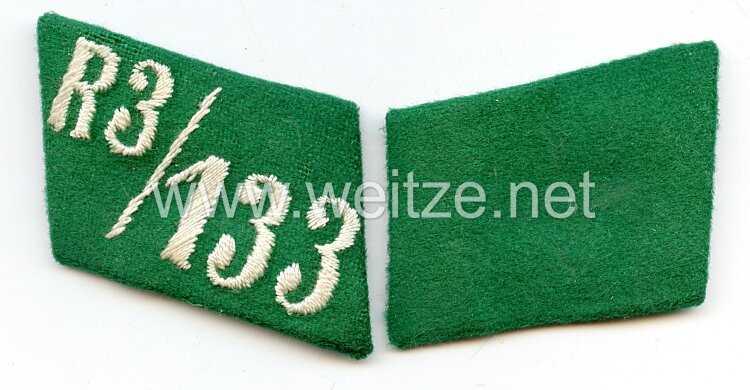
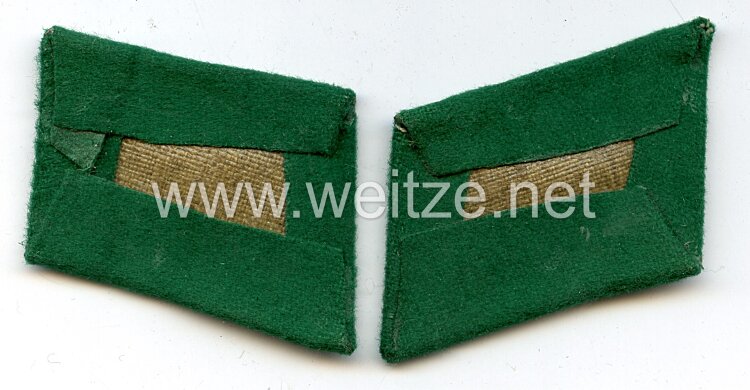
SA Pair of Collar Tabs SA-Gruppe Sachsen Reservesturm 3 of Standarte 133
These SA collar tabs represent a significant artifact from the early organizational structure of the Sturmabteilung (SA) during the formative years of the Nazi regime. These specific insignia belonged to Reservesturm 3 of Standarte 133 within the SA-Gruppe Sachsen (Saxony Group), stationed in Zwickau, and date to approximately 1933.
The SA was originally founded in 1920 as a paramilitary combat organization of the NSDAP and evolved by 1933 into a massive movement with several million members. The SA-Gruppe Sachsen formed one of the regional superior units organized according to Prussian military districts. After the seizure of power in January 1933, the SA experienced enormous membership growth due to many opportunistic joinings.
The uniforming and insignia regulations of the SA were subject to strict provisions laid down in various service regulations and uniform ordinances. Collar tabs belonged to the standard uniform and served to identify unit affiliation. The present pair shows green cloth with white embroidery of the designation “R3/133”, where the “R” stands for Reservesturm (reserve storm unit).
The designation Reservesturm is of particular historical significance. Following the massive membership increase in 1933, reserve units were formed alongside active storms, which partially accommodated older members, not fully deployable persons, or surplus new entries. The numbering “3/133” refers to the third reserve storm of Standarte 133.
A Standarte corresponded in the SA hierarchy to approximately a regiment and typically comprised several Sturmbanne, which were in turn divided into Stürme. The Standarten were generally organized by regions or larger cities. Standarte 133 was stationed in the Zwickau area, a significant industrial city in Saxony.
The coloring of the collar tabs followed the SA uniform system: Green cloth was characteristic of Saxon SA units. The SA groups used different collar tab colors for regional distinction. Saxony was traditionally associated with green color, while other groups wore different colors - for example, SA-Gruppe Ostland used black, SA-Gruppe Schlesien yellow collar tabs.
The white embroidery of the unit designation was standardized and had to be executed according to uniform regulations. The quality and execution of the embroidery varied depending on manufacturer and time of production. The “unworn” condition of these collar tabs is remarkable, as many SA uniform items from this period were intensively used.
The year 1933 marks a turning point in SA history. After the seizure of power, the organization expanded exponentially and temporarily assumed police functions as auxiliary police. The SA saw itself as the core of a future people's army and increasingly competed with the Reichswehr. These tensions ultimately led to the so-called “Röhm Purge” in June 1934, when the SA leadership was eliminated and the organization was disempowered.
The SA locations in industrial cities like Zwickau were strategically important. Zwickau had a significant workforce and was a center of the automobile industry. The SA attempted here to gain influence among the working class and combat communist structures.
From a uniform and insignia studies perspective, such collar tabs document the complex organizational structure of the SA. The precise designation allows attribution to a specific unit in a particular region and time. For historical research, such objects are valuable as they make traceable the regional organization and growth of the organization in the early phase of the NS regime.
The existence of reserve storms demonstrates the organizational challenges the SA faced after 1933. The integration of hundreds of thousands of new members - often disparagingly called “March casualties” - required new structures. Reserve units served as catchment basins for members who could not be integrated into regular combat units.