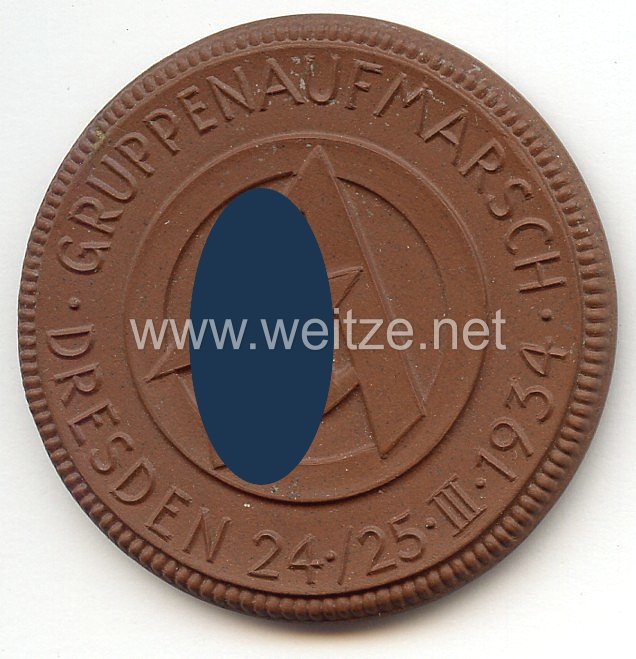
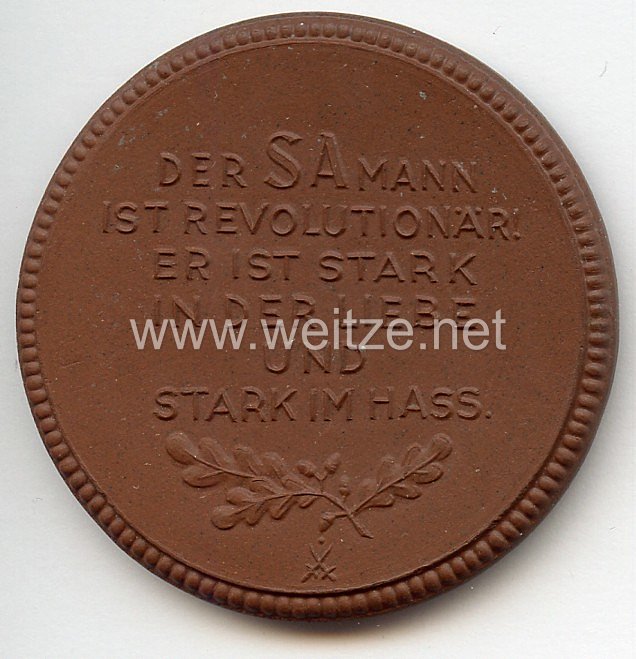
SA - Commemorative Medal - “Group Rally Dresden March 24-25, 1934 - The SA Man is Revolutionary! He is Strong in Love and Strong in Hate.”

Meissen Böttger medal, 51 mm, condition 2.
340232
180,00

SA - Commemorative Medal - “Group Rally Dresden March 24-25, 1934 - The SA Man is Revolutionary! He is Strong in Love and Strong in Hate.”

The SA Commemorative Medal for the Group Rally Dresden, March 24-25, 1934 represents a significant artifact of National Socialist propaganda culture and the self-presentation of the Sturmabteilung (SA) during the early phase of the NS regime. This medal, manufactured from Meissen Böttger stoneware with a diameter of 51 mm, documents one of the numerous mass rallies through which the SA demonstrated its power and unity.

The Sturmabteilung, founded in 1921 as the paramilitary combat organization of the NSDAP, had played a central role in the rise of the National Socialists by 1934. Under the leadership of Ernst Röhm, the SA had grown into a mass organization with several million members. The organization saw itself as a revolutionary force, which is reflected in the inscription engraved on the medal: “The SA man is revolutionary! He is strong in love and strong in hate.” These words embody the aggressive ideology and absolute claim of the SA.

The Group Rally in Dresden on March 24-25, 1934 took place during a politically volatile phase. At this time, conflict was already simmering between the SA leadership and the political leadership of the German Reich under Adolf Hitler. Röhm and his followers aspired to a “second revolution” and demanded a stronger social-revolutionary orientation of the regime, as well as the integration of the Reichswehr into the SA. These efforts met with massive resistance from the Reichswehr leadership, conservative circles, and ultimately Hitler himself, who wanted to consolidate his power.

The choice of Meissen Böttger stoneware for this medal is remarkable and speaks to the representative character of the award. The State Porcelain Manufactory Meissen had maintained an outstanding reputation for artistic craftsmanship since its founding in 1710. The Böttger stoneware, named after the alchemist Johann Friedrich Böttger, who is credited as the inventor of European porcelain, was used for particularly high-quality medals and plaques. The use of this material underscores the importance attached to such events and their commemoration.

Such commemorative medals fulfilled multiple functions within the National Socialist system. They served as honors for participants, strengthened the sense of belonging within the organization, and functioned as propaganda instruments. Participation in rallies and possession of corresponding badges were meant to intensify loyalty to the movement and deepen ideological indoctrination.

Only a few months after the Dresden rally, during the night of June 30 to July 1, 1934, the so-called “Röhm Purge” or “Night of the Long Knives” took place. In a coordinated action, Hitler had the SA leadership around Ernst Röhm arrested and murdered. This act of violence ended the political significance of the SA as an independent power factor. The organization was subsequently severely curtailed, while the Schutzstaffel (SS) under Heinrich Himmler rose to become the dominant instrument of power in the regime.

In this historical context, this medal gains particular significance: it documents the final phase of SA predominance and represents an organization shortly before its political decline. Objects like this medal are today important sources for researching National Socialist organizational culture, propaganda methods, and the self-staging of paramilitary associations.

From a museological and collection-historical perspective, such pieces belong to the documentary evidence of a criminal dictatorship. Their preservation and scholarly examination serve historical education and engagement with the National Socialist past. The condition grade 2 indicates a well-preserved medal, which underscores its significance as an authentic historical object.

r