Prussia/Württemberg Pair of Shoulder Boards for an Oberleutnant in Telegraphen-Bataillon Nr. 4

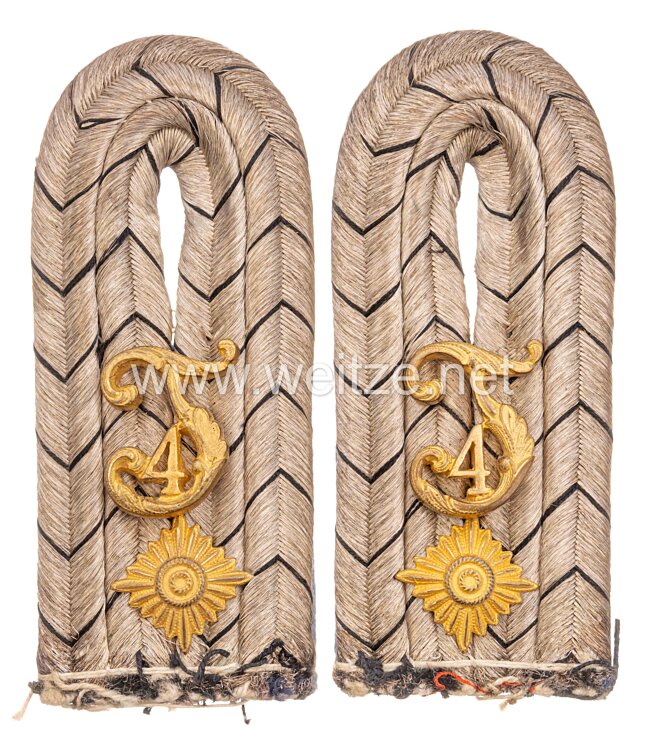
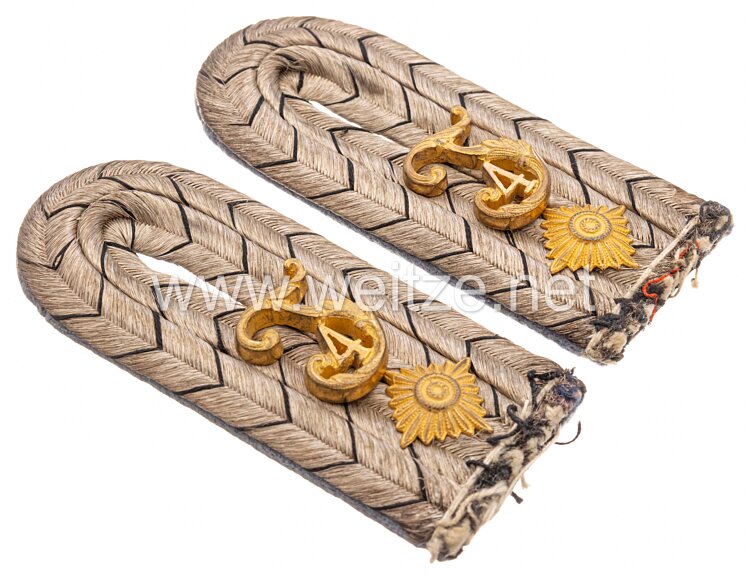
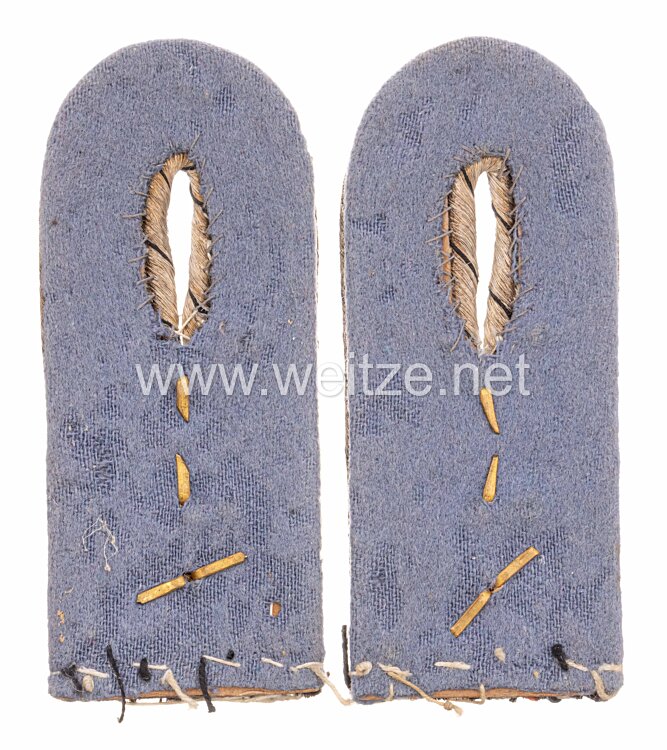
Garrison Karlsruhe/Freiburg. Circa 1914. Silver braid with black interwoven strands, gray cloth base, tall gilt metal ciphers “T4”, for sewing in. 9 cm long. Condition 2.
467232
350,00

Prussia/Württemberg Pair of Shoulder Boards for an Oberleutnant in Telegraphen-Bataillon Nr. 4

These shoulder boards for a First Lieutenant (Oberleutnant) of Telegraph Battalion No. 4 represent a fascinating testimony to the military organizational structure of the German Empire on the eve of World War I. These rank insignia combine the military traditions of Prussia and Württemberg and reflect the progressive technologization of warfare at the beginning of the 20th century.

Telegraph Battalion No. 4 was part of the German signal troops (Verkehrstruppen), a specialized branch responsible for military communications. The garrisons at Karlsruhe and Freiburg in the Grand Duchy of Baden and Kingdom of Württemberg underscore the federal structure of the Empire, in which various contingents from the federal states cooperated under Prussian leadership. The telegraph troops emerged in the second half of the 19th century in response to the increasing importance of electrical communication in military affairs.

The technical execution of these shoulder boards conforms to the uniform regulations of the Imperial Army. The silver braid with black interwoven threads identifies the officer's rank, with the color combination referencing Württemberg tradition. The gray cloth base corresponds to the field-gray uniform introduced from 1907/1910, which replaced the traditional colorful uniforms for practical field service. The gilded metal ciphers “T4” clearly identify the specific unit: “T” for Telegraph Battalion and “4” for the battalion number.

The rank of Oberleutnant (First Lieutenant) represented the second officer rank in the Imperial Army, between Lieutenant and Captain. First Lieutenants typically served as deputy company commanders or platoon leaders and bore considerable responsibility for training and leading their subordinates. In technical specialist units like the telegraph battalions, these officers were not only militarily but also technically highly qualified.

The telegraph troops played a crucial role in modern warfare. Since the experiences of the wars of 1866 and 1870/71, the Prussian and later German Army had recognized the importance of rapid and reliable communication. The telegraph battalions were responsible for laying and operating field cables, establishing telephone exchanges, and maintaining communication between staffs and troop units. By 1914, the German Army possessed several telegraph battalions organized by army corps.

The dating “around 1914” is particularly significant. This year marked the beginning of World War I, which confronted the telegraph troops with unprecedented challenges. Modern warfare, with its massive troop concentrations, complex operations, and extended front lines, was inconceivable without functional communications. Officers of the telegraph battalions had to be familiar not only with traditional field telegraphy but increasingly also with radio technology, optical signaling methods, and other innovations.

The craftsmanship quality of these shoulder boards is remarkable. They were designed as sewn-in pieces, permanently attached to the uniform, unlike the removable rank insignia of later periods. The length of 9 centimeters corresponds to the standardized dimensions of the Imperial era. The silver braid used was a mark of officer rank, while non-commissioned officers and enlisted men wore shoulder boards made of simpler materials.

The specialized nature of telegraph battalions reflected the German military's recognition that modern warfare required not just traditional combat arms but sophisticated technical support services. These units were staffed by personnel with specialized training in electrical engineering, telecommunications, and signal operations. Officers were expected to understand both military tactics and the technical aspects of communications equipment, making positions in telegraph battalions among the most technically demanding in the Imperial Army.

The preserved pair represents not only a military-historical artifact but also an example of the specialized military craftsmanship of the era. Numerous military effects manufacturers in the German Empire, especially in cities like Berlin, Leipzig, and the Rhineland, specialized in producing such rank insignia and uniform parts. The quality of execution reflects the high standards applied to officer corps equipment.

The combination of Prussian and Württemberg elements in these shoulder boards illustrates the complex federal military structure of Imperial Germany. While Prussia dominated the unified military command, the southern German kingdoms maintained certain distinctive traditions in their contingents. These regional variations added complexity to the uniform regulations but also preserved local military heritage within the unified Imperial Army.

Today, such shoulder boards are important study objects for military historians and collectors. They enable conclusions about organizational structures, technical developments, and the visual representation of military hierarchies in the Empire. Pieces from specialized technical troops like the telegraph battalions are rarer than those from infantry or cavalry and therefore possess special documentary value for researching military-technical development in the early 20th century.

r