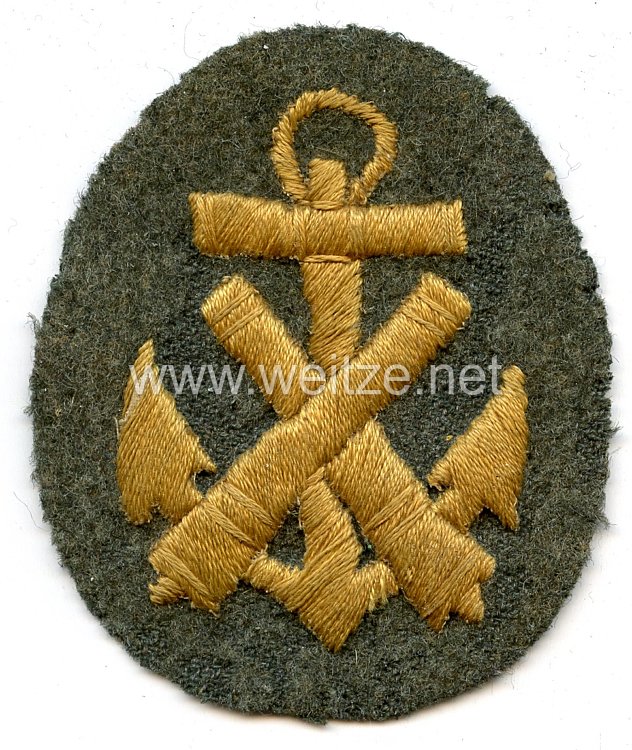
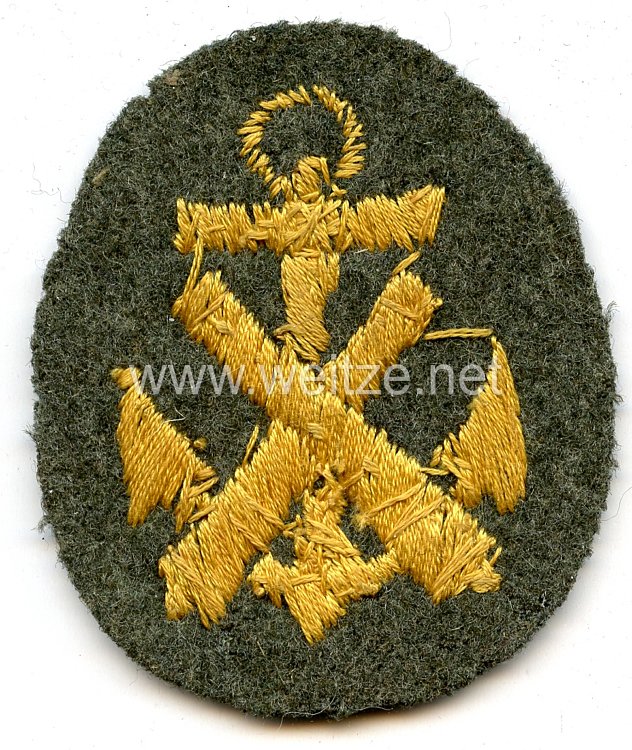
Kriegsmarine Sleeve Insignia Petty Officer Ordnance Mate
The sleeve insignia for Feuerwerksmaat (Ordnance Petty Officer) of the Kriegsmarine represents a fascinating example of the complex rank insignia systems used during World War II in the German armed forces. This hand-embroidered version for the field-grey uniform documents the maritime tradition of identifying specialized technical ratings within the German Navy.
The rank of Feuerwerksmaat belonged to the technical petty officer grades of the Kriegsmarine and was responsible for the administration, maintenance, and deployment of ammunition and explosives. The designation “Feuerwerksmaat” has its historical roots in the early modern period, when fireworkers in armies and navies were responsible for explosive materials. In the Imperial Navy and later in the Reichsmarine, this tradition was continued and adopted into the Kriegsmarine.
The uniform regulations of the Kriegsmarine provided for various versions of sleeve insignia worn on different types of uniforms. The field-grey uniform was primarily worn for shore duty, certain shipboard commands, and in coastal formations. This differed from the more familiar dark blue service uniform prescribed for regular sea duty.
The hand-embroidered execution of the sleeve insignia indicates a higher-quality production. During the war years, there were both machine-made and hand-embroidered versions of sleeve insignia. Hand-embroidered examples were often preferred by officers and petty officers who valued higher quality workmanship. These were frequently privately purchased rather than standard issue.
The sleeve insignia for technical petty officer career paths typically consisted of specific symbols identifying the respective specialization. For Feuerwerksmaate, these usually included crossed grenades or torpedoes combined with an anchor symbolizing maritime affiliation. The embroidery was typically done in silver or grey thread on the field-grey background.
The organization of the Kriegsmarine after 1935 followed strict hierarchies and specializations. After the Treaty of Versailles, Germany was initially permitted only a severely limited navy, but following the seizure of power in 1933 and the successive violation of treaty provisions, the Kriegsmarine was massively expanded. Technical ratings such as the Feuerwerksmaat gained increasing importance as modern warships required highly specialized personnel to handle complex weapons systems.
The training to become a Feuerwerksmaat included extensive theoretical and practical knowledge of explosives, ammunition, torpedoes, and other explosive ordnance. These specialists were indispensable on every warship and bore great responsibility for the safety of the crew as well as the operational readiness of the armament.
The wearing of field-grey uniforms by naval units was particularly common in coastal defense units, naval artillery detachments, and landing troops. These units often operated in cooperation with army formations and therefore wore field-grey clothing modeled on the army uniform instead of the navy blue service uniform.
The historical significance of such sleeve insignia lies not only in their functional use for identifying ranks and specializations, but also in their testimonial value for the social history of the military. They document the complex organization of the Wehrmacht, the importance of technical specialization in modern warfare, and the traditions of maritime ratings.
After the war ended in 1945, the Kriegsmarine was dissolved, and with it the traditional rank insignia disappeared. Many of these badges were kept by former soldiers or found their way into collections as historical artifacts. Today they are important study objects for military historians and uniform specialists dealing with the organizational history of the German armed forces.
The preserved condition of this example as a worn piece gives it special historical value, as it bears authentic traces of use from an insignia actually worn in service, thus providing direct testimony to the military reality of that era.