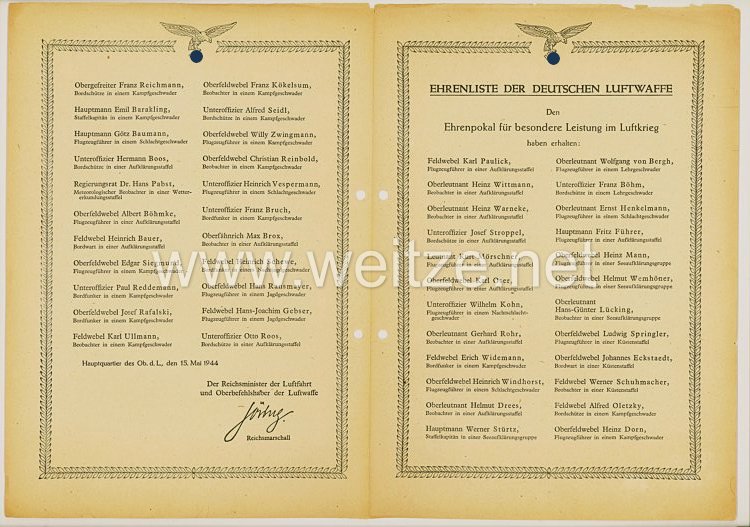
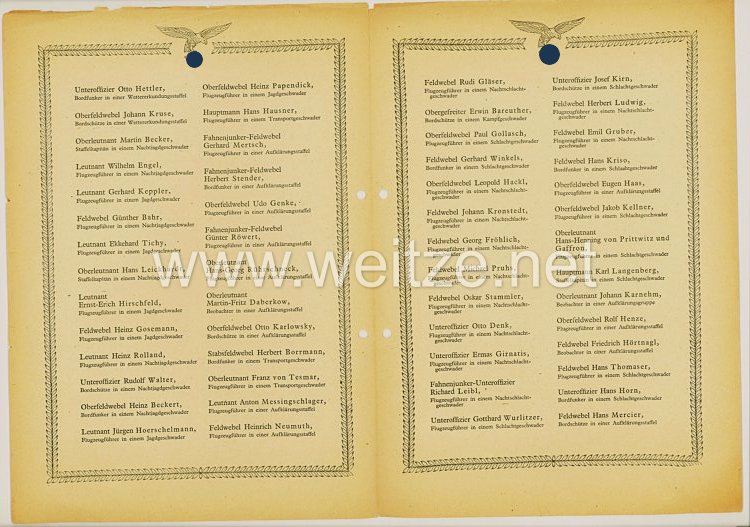
Honor Roll of the German Luftwaffe - Issue of May 15, 1944 Award of the Ehrenpokal
The Ehrenliste der Deutschen Luftwaffe (Honor Roll of the German Air Force) represented a significant propaganda instrument and official announcement organ during World War II, regularly publishing the names of Luftwaffe members who had been awarded military decorations. This edition from May 15, 1944 documents the awarding of the Ehrenpokal der Luftwaffe (Honor Goblet of the Luftwaffe), an important decoration for valor.
The Ehrenpokal der Luftwaffe was instituted on February 27, 1940, by Reichsmarschall Hermann Göring as Commander-in-Chief of the Luftwaffe. This decoration was intended for special achievements in aerial warfare and could be awarded to both flying and ground personnel. The goblet itself was made of silver-plated metal and bore an eagle emblem on its front along with a dedication inscription. It was presented in a special case and carried considerable symbolic value.
The Honor Roll was published by order of the Oberkommando der Luftwaffe (OKL - High Command of the Air Force) and served as official notification of medal awards. It appeared at irregular intervals as a DinA4 double sheet, frequently hole-punched for filing in binders, which underscores its function as an administrative document. The publication of names in the Honor Roll served multiple purposes: public recognition of military achievements, motivation of the troops, and simultaneously propaganda.
By May 1944, the date of this edition, the German Luftwaffe was already in an increasingly difficult situation. Allied air forces had largely achieved air superiority, and the strategic bomber offensive against the German Reich was reaching its peak. Nevertheless, decorations continued to be awarded to maintain combat morale and recognize outstanding achievements. During this phase of the war, requirements for valor decorations were particularly high, as intense aerial combat occurred daily over Germany, France, and other theaters of war.
The award criteria for the Honor Goblet were strictly regulated. Fighter pilots typically required at least three enemy aircraft shot down, while bomber pilots were evaluated based on special mission achievements. Ground personnel, particularly anti-aircraft crews, could also be decorated for exceptional performance. The award was made by the Commander-in-Chief of the Luftwaffe personally or by commanders authorized by him.
The format of the Honor Roll as a used, hole-punched double sheet indicates that these documents were used for internal administration and documentation in Luftwaffe offices. Such lists were filed in personnel records and served as official proof of the award. The hole-punching enabled insertion into file binders according to the administrative system then in use.
The historical significance of such documents today lies primarily in their source value for military-historical research. They enable the reconstruction of award dates, identification of units, and tracing of military careers. At the same time, they are testimonies to National Socialist honor culture and the propaganda apparatus that was maintained even in the final phase of the war.
In 1944, the production and distribution of such official documents was already hampered by material shortages and the general war situation. However, the continued publication of the Honor Roll into the late war period demonstrates the importance the Nazi regime placed on symbolic recognition of military achievements. The Honor Roll of May 15, 1944, dates from a time when the invasion of Normandy was imminent and the Wehrmacht was under increasing pressure on all fronts.
Such documents are today sought-after military-historical collectibles that provide important insights into the administrative practices and decoration system of the German Luftwaffe. They must always be viewed in the context of their time and serve the historical documentation and examination of this era.