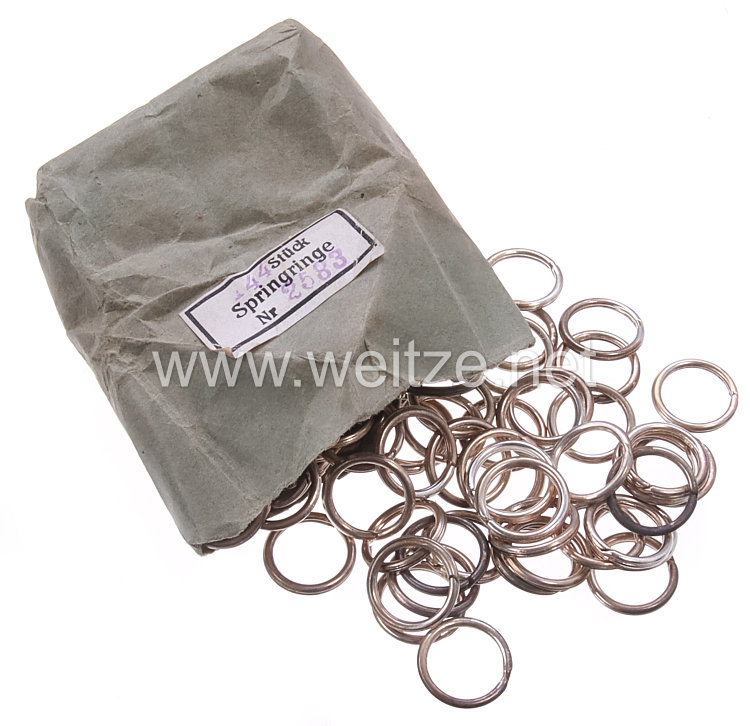
Kriegsmarine/ Luftwaffe / Heer: Jump Rings for Uniform Buttons

, for the tropical uniform or for the summer service tunic of all branches of service, diameter approx. 16 mm, unused, condition 2

Price per piece: 
403131
5,00

Kriegsmarine/ Luftwaffe / Heer: Jump Rings for Uniform Buttons

Jump Rings for Wehrmacht Uniform Buttons: A Detail of German Military Clothing 1933-1945

Jump rings or split rings for uniform buttons represent a small but essential detail of German military uniforms during the period of the Third Reich. These inconspicuous metal rings, approximately 16 mm in diameter, fulfilled an important practical function in attaching uniform buttons to the service uniforms of the Wehrmacht, including the Kriegsmarine, Luftwaffe, and Heer (Army).

Following its establishment in 1935, the Wehrmacht introduced a comprehensive system of uniform regulations that governed not only the visible aspects of clothing but also the technical details of manufacture and attachment. The Heeresdienstvorschrift (HDv) and corresponding regulations of the other service branches precisely specified how uniforms were to be manufactured. Jump rings belonged to the standardized equipment that enabled quick and secure attachment of buttons, particularly for the lighter fabrics of summer and tropical service uniforms.

The Wehrmacht's tropical uniform was increasingly developed from 1940 onward, when German troops were deployed in North Africa under the Deutsches Afrikakorps. These special uniforms made from lighter, olive-green or sand-colored fabric required adapted fastening systems. The jump rings allowed flexible attachment of buttons without damaging the thin tropical fabric. The summer service tunic, worn during warmer months in Europe, also utilized this practical fastening method.

Technically speaking, jump rings were simple but robust spring rings made of steel or brass that featured an opening and were under tension. This construction allowed buttons with eyelets to be quickly attached or removed, which was of great advantage during repairs or replacement of damaged buttons. Manufacturing took place in numerous German supplier companies that belonged to the war-essential textile industry.

The uniforming of the Wehrmacht was not merely a matter of aesthetics or tradition, but also of practicality and economy. The war economy had to produce millions of uniforms and countless small parts. Jump rings were inexpensive to manufacture and could be produced in large quantities in standardized form. This was particularly important as the Wehrmacht grew to over 18 million men between 1935 and 1945.

For all three service branches – Army, Navy, and Air Force – similar standards applied to fastening elements, even though the uniforms themselves differed in color, cut, and details. The Luftwaffe, founded in 1935 under Hermann Göring, introduced its characteristic blue-gray uniform, while the Kriegsmarine continued traditional maritime uniform traditions. Despite these differences, technical fastening elements such as jump rings were largely standardized.

Unused jump rings like the described specimens are today rare remnants of German military production. They testify to the enormous logistical achievement required to equip an army of millions. Many such small parts were stored in depots and, after the war's end in 1945, were distributed as surplus stock or destroyed.

For collectors and historians, even such inconspicuous objects offer important insights into the material culture of the Wehrmacht. They complement the understanding of military everyday reality beyond weapons and decorations. The preservation of such objects in unused condition is remarkable and indicates careful storage over nearly eight decades.

r