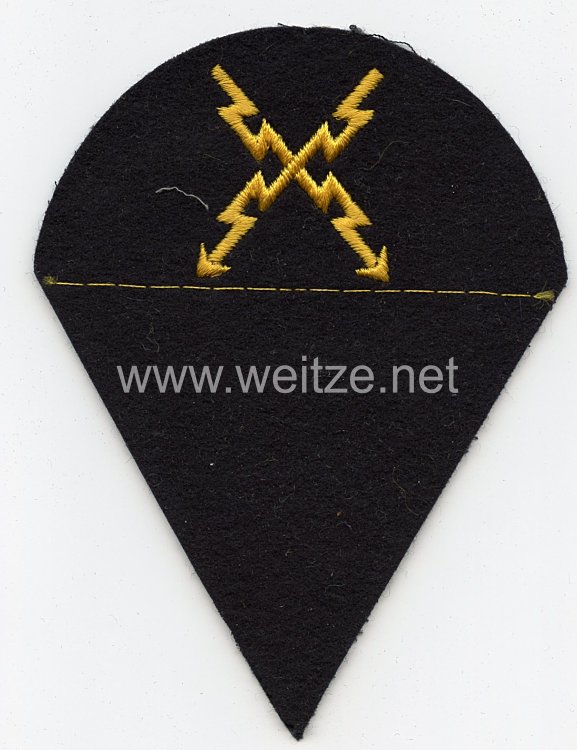
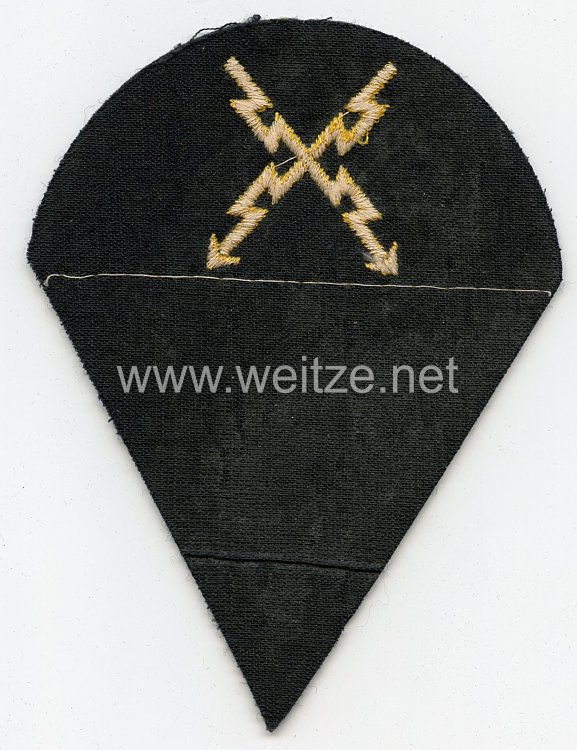
Kriegsmarine Career Insignia Enlisted Ranks Teleprinter Operator
The Kriegsmarine Career Badge for Enlisted Personnel in the Teleprinter Specialty represents a significant example of the specialized qualification badges introduced in the German Navy during World War II. These badges served as visual identifiers for naval personnel with specific technical skills and training.
Career badges (Laufbahnabzeichen) were systematically introduced in the Kriegsmarine from 1938 onwards to reflect the increasing specialization and technical complexity of modern naval warfare. With the rapid development of communications technology in the 1930s, telecommunications, including teleprinter operations, became an indispensable component of military infrastructure. Teleprinter operators (Fernschreiber) were responsible for the rapid and reliable transmission of encrypted messages between ships, submarines, and shore stations.
The design of these badges followed strict Kriegsmarine regulations. They were typically manufactured on dark blue cloth backing and worn on the left upper arm of the uniform. The version for the Colani (a colloquial term for the dark blue working suit of the Kriegsmarine) differed from versions for other uniform types. This working uniform was worn during daily service aboard ship and during practical duties.
The badge itself displayed symbolic representations of the respective specialty area. For signals personnel, these often included stylized lightning bolts or other symbols of electrical communication. Production occurred in various quality levels: from machine-embroidered variants for general use to hand-embroidered examples of higher quality.
The enlisted ranks of the Kriegsmarine formed the backbone of the naval forces. The hierarchy began with the Matrose (seaman) and extended through Matrosenobergefreiter, Matrosenhauptgefreiter to Obermaat. Each of these ranks could be worn in combination with a career badge indicating special training. Training as a teleprinter operator required several months of intensive schooling at specialized naval schools, where operation of complex teleprinter machines, encryption procedures, and message protocols were taught.
During the war, teleprinter operators played a critical role in communications between the Commander of U-boats (Befehlshaber der U-Boote - BdU) and submarine forces at sea. The famous Enigma machines were often used in conjunction with teleprinter systems to ensure communication security. Teleprinter operators were also stationed ashore at numerous naval bases from Norway to France.
This particular example shows the typical signs of wear from a badge worn during the war. The mention of foxing (Stockflecken) on the reverse indicates prolonged storage under humid conditions, which is not uncommon for textiles from this period. The condition rating of 2 corresponds in collector evaluation to a well-preserved piece with minor signs of use.
After the war's end, these badges became important military-historical collectibles. They document not only the organizational structure of the Kriegsmarine but also the high importance placed on technical specialization in modern warfare. The collection and preservation of such insignia contributes to understanding the everyday reality of naval personnel and supplements naval historiography, which often focuses on major sea battles, with the perspective of technical specialists.
Today, such badges are found in military history museums, private collections, and are studied by militaria researchers to better understand the complex organization and structure of the Kriegsmarine. They serve as material witnesses to an era in which technological innovation and military necessity drove the development of specialized professional roles within the armed forces.
The study of these badges also provides insights into the material culture of the Third Reich's navy, revealing details about manufacturing techniques, quality standards, and the daily life of sailors who wore them. Each badge tells a story not just of individual service, but of the broader technological and organizational evolution of naval warfare in the mid-twentieth century.