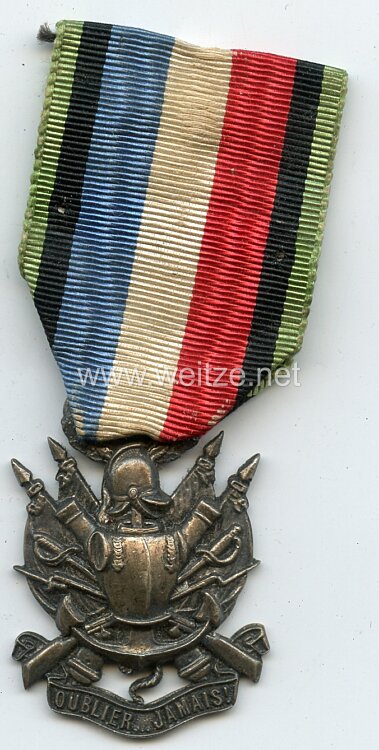
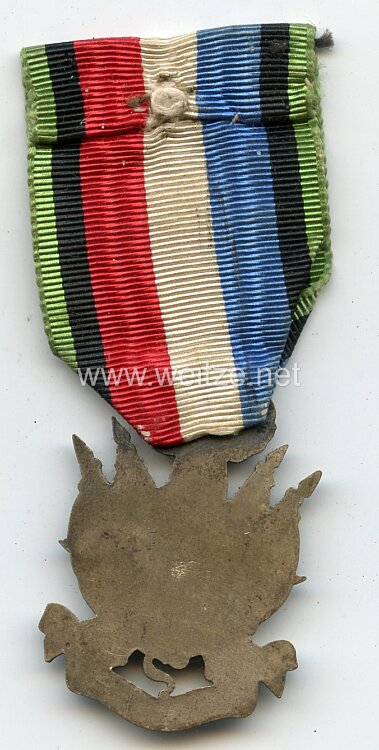
France Commemorative Medal “Oublier Jamais”

on ribbon, condition 2
270331
65,00

France Commemorative Medal “Oublier Jamais”

French Commemorative Medal “Oublier Jamais” (Never Forget)

The commemorative medal bearing the inscription “Oublier Jamais” (Never Forget) represents a significant artifact of French memorial culture, closely associated with the traumatic events of the Franco-Prussian War of 1870-1871 and the loss of Alsace-Lorraine.

Following France's devastating defeat in the war of 1870-1871 and the subsequent annexation of the provinces of Alsace and Lorraine by the newly founded German Empire, an intense culture of remembrance developed in France. The slogan “Oublier Jamais” or the longer version “N'oublions jamais” became a central motto of the French revanchist movement and national commemoration. These words expressed the collective refusal to forget the territorial humiliation and the determination to one day reclaim the lost provinces.

The medal itself was produced in various versions, often by private medallists and patriotic associations. It did not serve as an official state decoration but rather as a memorial and reminder, symbolizing national mourning and the desire for revenge. Typically, such medals featured depictions of the lost provinces, sometimes personified as mourning women, or symbols such as broken chains expressing hope for liberation.

The iconography of these medals was diverse. Common motifs included the Strasbourg Cathedral, maps of the annexed territories, the French tricolor, and patriotic allegories. The reverse sides often bore inscriptions with dates such as 1870-1871 or motivational slogans. The attached ribbon was usually in French national colors of blue-white-red or in black as a sign of mourning.

These medals were worn at patriotic events, commemorative ceremonies, and by veterans' associations. They played an important role in maintaining the “Esprit de Revanche” (Spirit of Revenge) that shaped French politics and society until World War I. Schoolchildren learned about the lost provinces, and in many French classrooms, maps hung showing Alsace-Lorraine in a different color to illustrate the annexation.

The medal symbolizes the complex Franco-German relationship in the late 19th and early 20th centuries. Revanchism was a significant factor in European diplomacy and contributed to the formation of alliance systems that eventually led to World War I. The French defeat of 1870-1871 and the persistent resentment over the loss of Alsace-Lorraine fundamentally influenced French foreign policy.

When France regained Alsace-Lorraine in November 1918 after World War I, the message of “Oublier Jamais” seemed fulfilled. The medals and symbols of this memorial culture became historical artifacts of a past era of national longing and mourning. Today they are important collectibles and museum objects providing insight into the French mentality of that time.

For collectors of military historical items, these medals represent fascinating objects of study. They document not only military events but also the psychological and cultural impacts of war and territorial loss on a nation. The preservation of such medals in good condition (such as the condition 2 of the described medal) is significant for historical collections.

The “Oublier Jamais” medal reminds us how memorial culture and national identity are intertwined and how material objects can serve as carriers of collective memory. It stands as testimony to an era of European history characterized by nationalism, revanchism, and ultimately devastating conflicts.