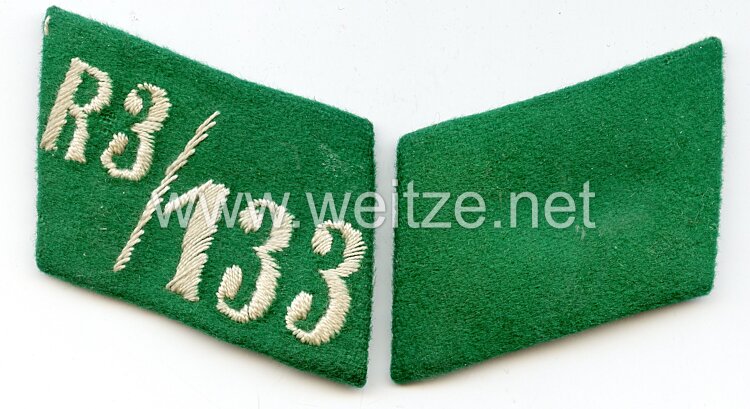
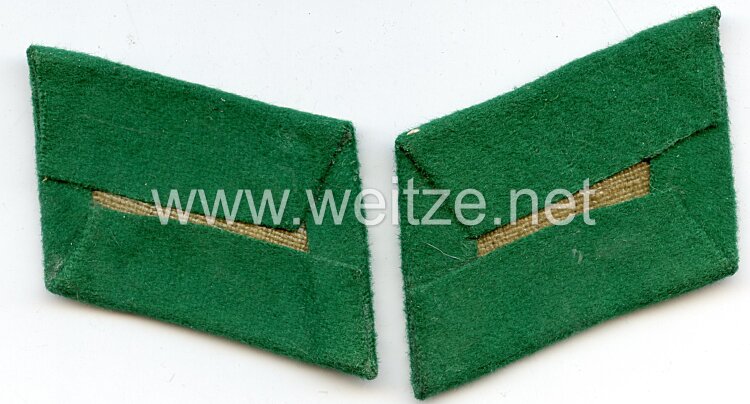
SA Pair of Collar Tabs SA-Gruppe Sachsen Reserve Storm 3 of Standarte 133
These SA collar patches represent significant evidence of the organizational structure of the Sturmabteilung (SA) during the early years of Nazi rule. These specific insignia belonged to Reserve Storm 3 of Standard 133 within the SA-Gruppe Sachsen (SA Group Saxony) and date from around 1933, the year of the Nazi seizure of power.
The Sturmabteilung was originally founded in 1920/21 as a paramilitary combat organization of the NSDAP. Under the leadership of Ernst Röhm, the SA developed into a mass organization that grew to several million members by 1934. The territorial organization of the SA followed a hierarchical system: the highest regional organizational level consisted of the SA Groups, which generally encompassed one or more Prussian provinces or German states.
The SA-Gruppe Sachsen was one of these regional units and had its area of command in the Free State of Saxony. Within this group, several Standards were organized - large-format units that typically comprised several thousand men. Standard 133 was one such unit, headquartered in Zwickau, a significant industrial city in western Saxony.
The collar patches display the embroidery “R3/133”, where the “R” stands for Reservesturm (Reserve Storm). The SA organization distinguished between active storms and reserve storms. While the active storms formed the core troops, reserve storms served various purposes: they could include older members, candidates, or men who could not participate in all activities of the active storms for professional or other reasons. The number “3” designates the third reserve storm, while “133” indicates the associated standard.
The execution of the collar patches corresponds to the SA clothing regulations. The green cloth as the base color was characteristic of SA-Gruppe Sachsen. Each SA group had its own group color, which was applied to collar patches, cap piping, and other uniform parts. This color coding enabled quick identification of an SA man's regional affiliation. The white embroidery of the unit designation formed a clear contrast to the green background and corresponded to standardized regulations.
The year 1933 marks a decisive turning point in the history of the SA. After Hitler's appointment as Reich Chancellor on January 30, 1933, the SA played a central role in enforcing Nazi rule. SA men were significantly involved in intimidating political opponents, guarding concentration camps, and terrorist actions. The SA's membership exploded during this period, as many opportunists and unemployed people joined the organization.
The unworn condition of these collar patches is remarkable. This could have various reasons: possibly they were made for a member who never entered active service, or they remained as spare pieces in storage. It is also conceivable that they were no longer used after the Röhm Purge in June 1934. During this event, also called the “Night of the Long Knives,” Hitler had the SA leadership around Ernst Röhm murdered and broke the power of the organization. Afterward, the SA lost considerable importance, and the SS took over its most important functions.
From a collection history perspective, such uniform parts are important documents of the Nazi era. They illustrate the detailed organization and hierarchy of the Nazi formations and show the importance of symbols and uniforms for identity formation within these organizations. The precise identification down to the individual storm level demonstrates the SA's military organizational aspirations.
For historical research, such objects offer insights into the local and regional structure of the SA. Standard 133 in Zwickau was part of a dense network of SA units that covered all of Germany. Zwickau itself had been an important center of the workers' movement, which the National Socialists sought to conquer. The presence of several storms, including reserve storms, shows the penetration of society by the SA organization.
These collar patches thus serve as material witnesses to a dark chapter of German history, documenting the organizational structure and territorial reach of one of the most important instruments of Nazi terror and control.