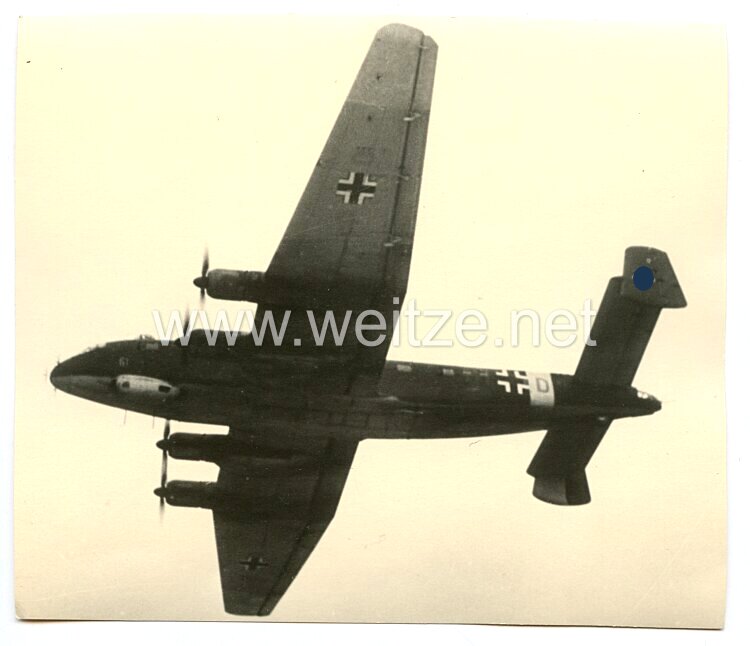
Luftwaffe Photograph, Junkers Ju 290 of Fernaufklärungsgruppe 5
This photograph documents a remarkable chapter of German air warfare during World War II, showing a Junkers Ju 290 of Fernaufklärungsgruppe 5 (FAGr 5 - Long-Range Reconnaissance Group 5). This photographic record, measuring approximately 18 x 15.5 cm, represents an authentic historical testimony from the late phase of the war and provides insight into the strategic reconnaissance operations of the Luftwaffe.
The Junkers Ju 290 evolved from the civilian Ju 90 and was produced from 1942 onwards as a four-engine long-range aircraft for the Luftwaffe. With a wingspan of 42.00 meters and a length of 28.64 meters, it was among the largest operational aircraft of the German air force. Powered by four BMW 801 D radial engines of 1,700 hp each, the Ju 290 reached a maximum speed of approximately 440 km/h and possessed an impressive range of up to 6,000 kilometers, which made it ideally suited for long-range reconnaissance missions.
Fernaufklärungsgruppe 5 was established in March 1943 and was primarily responsible for maritime long-range reconnaissance operations over the Atlantic and northern seas. The unit initially operated from French bases, particularly from Mont-de-Marsan, and later also from Norwegian bases. Its main task consisted of reconnaissance of Allied convoys, weather observation over the Atlantic, and monitoring enemy naval movements. This information was of decisive importance for German naval warfare, particularly for coordinating U-boat operations.
From autumn 1943 onwards, FAGr 5 received its first Ju 290 aircraft, which had previously been employed mainly with Kampfgeschwader 200 (KG 200) and in transport units. The Ju 290 proved ideal for long-range reconnaissance missions: its large interior offered space for extensive navigation and radio equipment as well as for the multi-person crew required during missions lasting many hours over the Atlantic. The armament typically consisted of several MG 131 and MG 151/20 machine guns in various gun positions to defend against Allied fighters.
The photographic documentation of aircraft and military operations was systematically organized in the Luftwaffe. Official photographs were often taken by specially trained Luftwaffe war correspondents who served either with propaganda companies or directly with operational units. Such photos served multiple purposes: they were used for documentation, propaganda, technical evaluation, and often also as personal mementos for the soldiers involved.
The operational reality of FAGr 5 was characterized by extremely demanding and dangerous missions. Flights over the Atlantic often lasted ten to twelve hours, during which crews were exposed to extreme weather conditions, enemy air defenses, and the constant danger from Allied long-range fighter aircraft. With increasing Allied air superiority from 1944 onwards, these missions became increasingly costly. Allied forces developed effective tactics to counter German reconnaissance aircraft, particularly through the deployment of carrier-based fighters and long-range patrol aircraft.
Production of the Ju 290 remained relatively limited with approximately 65 examples built, mainly due to resource shortages, production priorities for fighter aircraft, and increasing Allied bombing of the German aircraft industry. Despite its technical qualities, the Ju 290 could no longer influence the course of the war. The last missions of FAGr 5 took place in April 1945, before the surviving aircraft were destroyed or captured by the Allies.
This photograph, although trimmed, represents an important document of air war history. Such contemporary photographs are today valuable historical sources that provide insight into technical details, operational conditions, and the daily life of Luftwaffe units. The indicated condition 2 suggests a well-preserved photograph that, despite its age and wartime circumstances, has survived transmission. For historians and collectors of military aviation history, authentic photographs like this represent important primary sources that complement and illustrate written records.