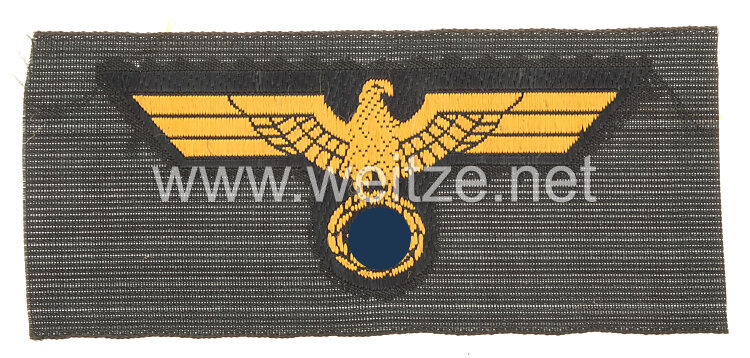
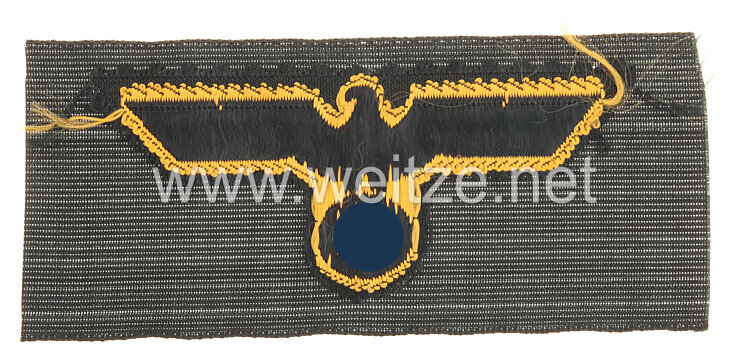
Kriegsmarine Coastal Artillery Enlisted Men's Side Cap Eagle

Bevo-woven construction, yellow on dark green, Condition 2.
452030
65,00

Kriegsmarine Coastal Artillery Enlisted Men's Side Cap Eagle

The Kriegsmarine Ship Cap Eagle for Enlisted Men of the Coastal Artillery represents an important example of Third Reich military insignia that reflects the complex organizational structure of German naval forces during World War II.

The Coastal Artillery (Küstenartillerie) formed a significant component of the Kriegsmarine and was responsible for defending German coasts, harbors, and naval bases. These units operated along the North Sea and Baltic Sea coasts, and later along occupied coastal areas from Norway to the French Atlantic coast. Coastal artillery units were established in 1935 following Germany's official rearmament and played a crucial role in the Atlantic Wall defense system.

This badge is manufactured in the typical Bevo weaving technique, named after the company Bevo (Bandfabrik Ewald Vorsteher) from Wuppertal. This innovative weaving technique enabled machine production of insignia with fine details and was increasingly used for military effects from the mid-1930s onward. The Bevo technique offered advantages over embroidered badges through more cost-effective mass production while maintaining high quality and durability.

The color combination of yellow on dark green was characteristic of the Kriegsmarine's coastal artillery. While the Kriegsmarine generally wore dark blue uniforms, the branch colors of various specialist services differed. The yellow branch color identified the wearer as a member of the coastal artillery, in contrast to other branch colors such as white for infantry or red for artillery in the Army.

The eagle itself follows the standardized design prescribed for enlisted ranks of the Kriegsmarine. The national emblem shows the stylized eagle with outstretched wings, holding a swastika in its talons. This symbol was worn on the Schiffchen (ship cap or side cap), the characteristic boat-shaped headgear of enlisted men and non-commissioned officers without sword knot.

The introduction of uniform national emblems followed detailed regulations of the Dress Regulations for the Kriegsmarine. These regulations precisely specified which insignia were to be worn on which uniform parts and by which ranks. For enlisted men, the ship cap eagle was the most visible national emblem on their uniform.

The wearing method was clearly defined: the eagle was attached to the left side of the ship cap, approximately at temple height. Correct positioning and attachment were part of military discipline and were checked during inspections. The badge was typically sewn on, with the woven version being particularly practical for this purpose due to its flat construction.

Production quantities of such badges were considerable, as the Kriegsmarine expanded significantly during World War II. From approximately 50,000 men in 1935, the Kriegsmarine grew to over 700,000 members by 1944. The coastal artillery formed a substantial portion, especially after the expansion of coastal fortifications from 1940 onward.

After the war ended in 1945, all insignia bearing National Socialist symbols were banned by Allied Control regulations. Many were destroyed, making surviving examples historical documents today. The condition grade 2 indicated for this specimen corresponds to a well-preserved piece with minor signs of wear according to common collector nomenclature, which is remarkable for a textile badge over 75 years old.

From a historical perspective, such badges document the sophisticated hierarchy and organizational structure of the German Wehrmacht. They allow conclusions about production techniques, material availability, and the importance of military symbolism in Nazi Germany. For military history research, they provide important insights into the daily life and equipment of ordinary soldiers, while historical research often focuses on strategy and leadership levels.

Today, these objects serve exclusively as historical artifacts that help us understand the material culture and organizational structure of World War II military forces. They are studied by historians, museums, and researchers as primary sources that complement written documentation and oral histories.

r