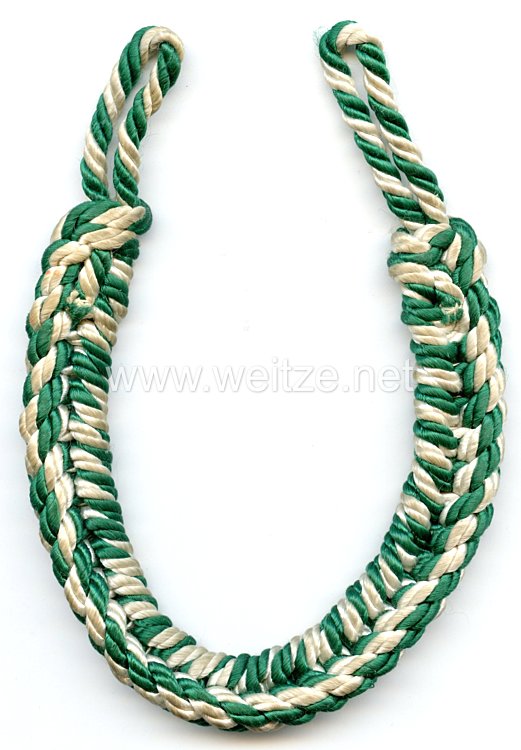
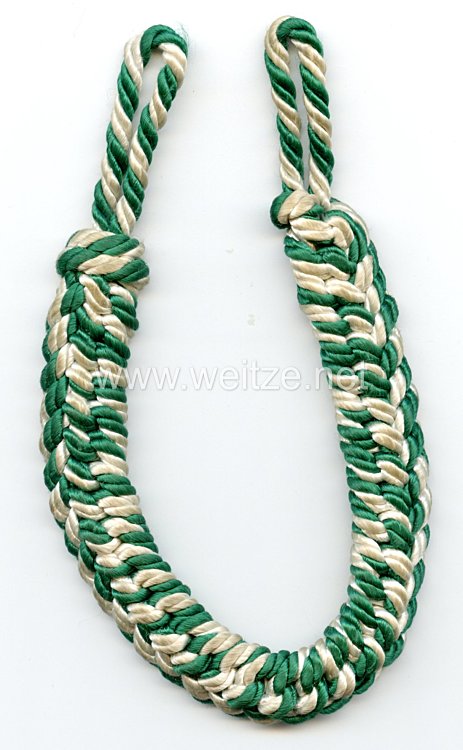
Hitler Youth (HJ) Leader's Cord for Gefolgschaftsführer

Green/white braided. Condition 2.
441330
70,00

Hitler Youth (HJ) Leader's Cord for Gefolgschaftsführer

The Hitler Youth (HJ) Leader's Cord for Gefolgschaftsführer represents a characteristic insignia of the hierarchical structure within the National Socialist youth organization. This green-and-white braided cord embodies the complex system of ranks and authority that the Third Reich established even among its youngest members.

The Hitler Youth (Hitlerjugend) was founded in 1926 and developed into the state youth organization of National Socialist Germany after the seizure of power in 1933. With the Law concerning the Hitler Youth of December 1, 1936, membership became effectively mandatory. The organization was divided into various units: the smallest unit was the Kameradschaft (comradeship) with about 15 boys, several Kameradschaften formed a Schar (squad), several Scharen formed a Gefolgschaft (following), and above these were Stamm, Bann, and Gebiet (region).

The Gefolgschaftsführer commanded a Gefolgschaft of approximately 120 to 160 boys aged 14 to 18 years. This rank corresponded roughly to a captain in military structures and represented a middle leadership level. The Gefolgschaft was the central organizational unit for practical activities such as field exercises, marches, and ideological training sessions.

The Führerschnur (leader's cord) served as an external symbol of rank and authority. It was attached at the right shoulder and passed under the arm, where it was fixed to the uniform with a button. The green-and-white color combination was specifically designated for the rank of Gefolgschaftsführer. The HJ uniform regulations precisely specified which colors corresponded to which ranks: Unterscharführer wore a single-color cord, while higher ranks received various color combinations.

The manufacture of these leader's cords followed standardized specifications by authorized manufacturers. The cords were braided from artificial silk or cotton and had to meet certain quality standards. Procurement was partly regulated through the HJ organization itself, though sometimes the wearers or their families had to purchase the equipment pieces themselves, which led to shortages particularly during the war years.

The introduction of leader's cords and other rank insignia served several purposes: they visualized the hierarchy, encouraged ambition for advancement within the organization, and imitated military structures. The HJ explicitly understood itself as a pre-military training organization that prepared boys for their later service in the Wehrmacht. The military-like structure with clear chains of command was an integral component of National Socialist educational ideology.

A Gefolgschaftsführer was typically between 16 and 18 years old, sometimes younger. He bore considerable responsibility for conducting services, maintaining discipline among his subordinates, and ensuring the ideological alignment of his unit. The position required not only organizational skill but also ideological reliability in the regime's terms.

After the end of World War II, the Hitler Youth was banned and dissolved in 1945 by Control Council Law No. 2. Its symbols and insignia, including the leader's cords, became relics of a dark era in German history. Today, such objects are of historical interest to museums, educational institutions, and collectors engaged with the history of National Socialism.

Scientific engagement with such objects serves historical processing and documentation. It enables understanding of the mechanisms of totalitarian rule, particularly the systematic indoctrination and militarization of youth. The leader's cords are material witnesses to a system that incorporated children and adolescents into its ideological and military structures.

The condition of such historical textiles varies considerably. Factors such as storage, light exposure, and humidity influence their condition over the decades. Well-preserved examples enable detailed studies of manufacturing techniques, materials, and the practical implementation of uniform regulations.

These artifacts remind us of the importance of critical historical examination and serve as tangible evidence of how totalitarian regimes systematically organized and manipulated young people for their purposes.

r