Hesse Infantry Officer's Saber

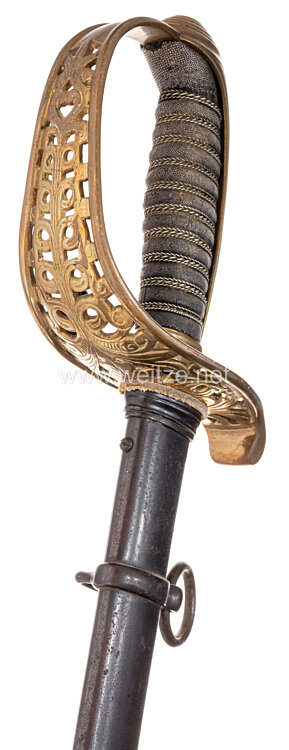
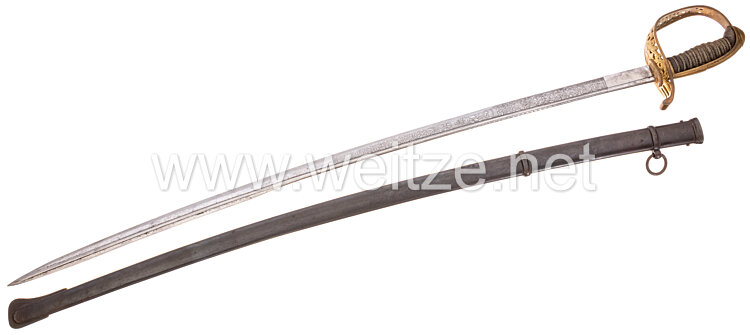
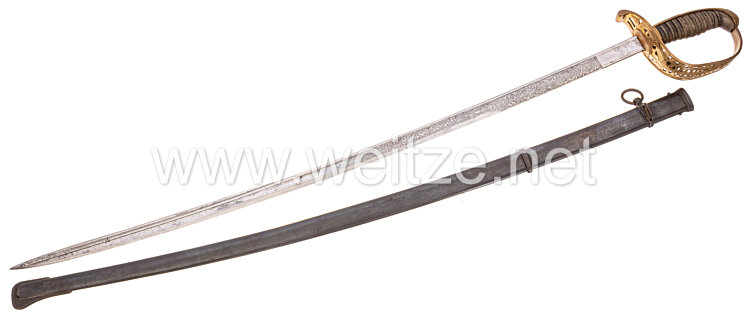
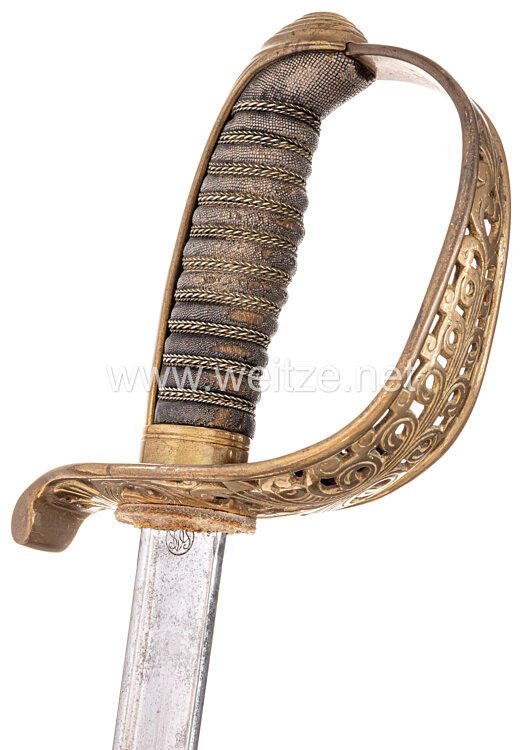
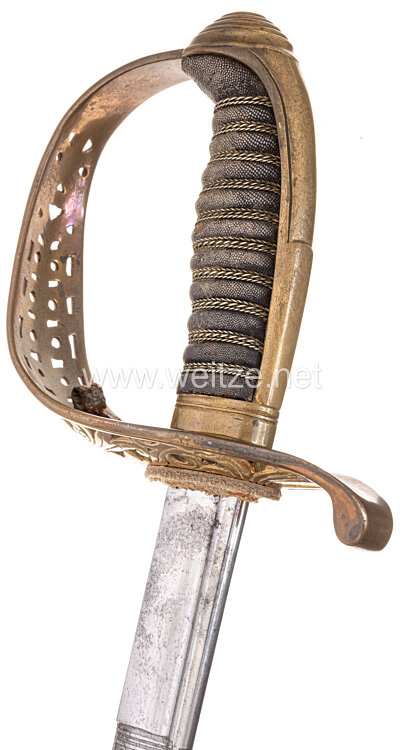
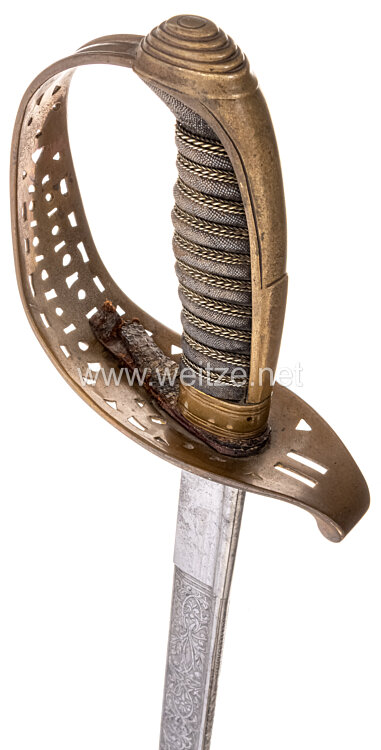
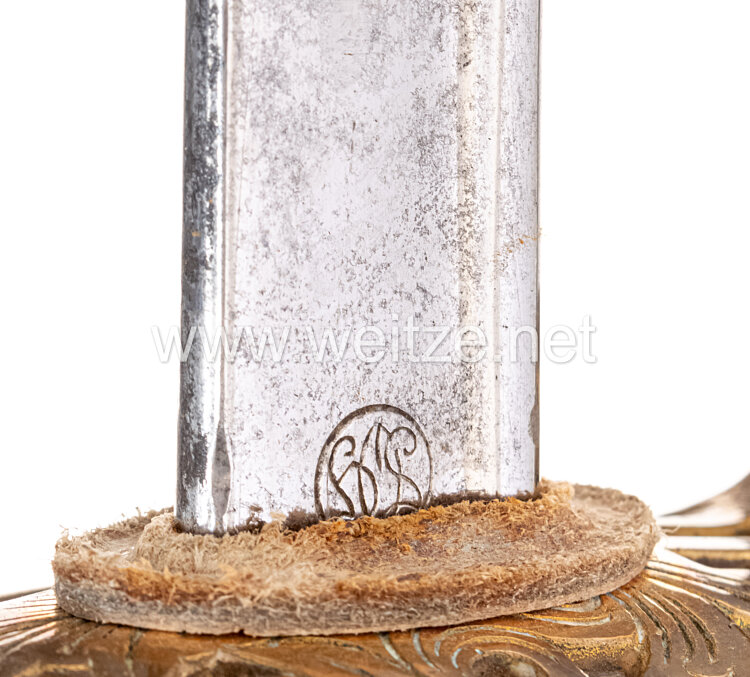
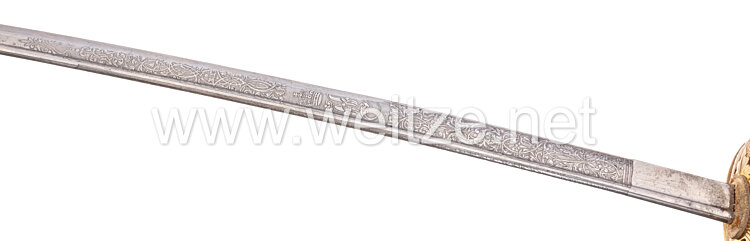
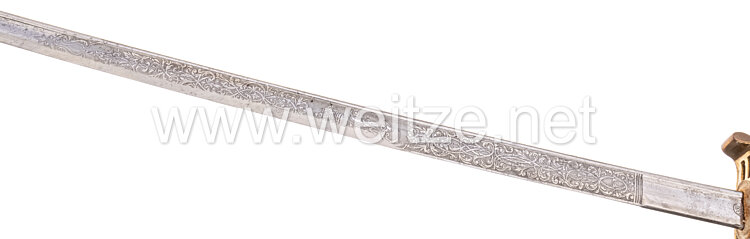
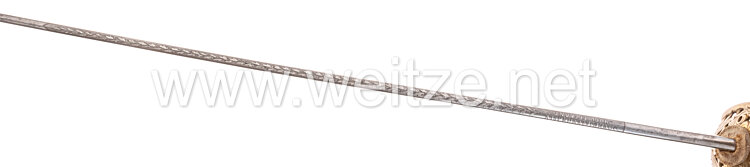
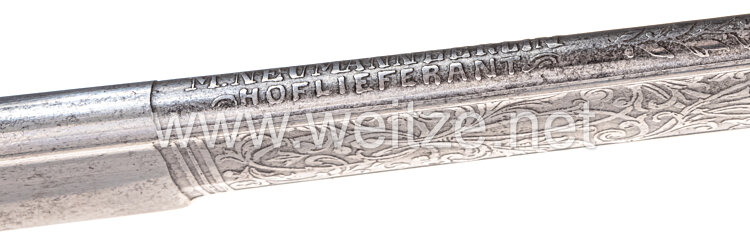
Circa 1910. Slightly curved fullered blade with ricasso, etched on both sides, blade width approximately 2.3 cm, length approximately 80 cm, centered on both sides of the blade the royal cipher “L”, edge combat-sharpened, portions of the etching near the edge ground away as a result, on the quarte side toward the spine of the blade with maker's mark. Pierced and florally decorated brass hilt, shagreen grip with intact wire wrapping, finger loop torn. Blued steel scabbard with two suspension rings and one movable suspension ring, the lower one removed per regulation. Condition 2.

Overall length 96 cm.
464530
1.200,00

Hesse Infantry Officer's Saber

The Hessian Infantry Officer's Saber from around 1910 represents a significant phase in the military equipment of the Grand Duchy of Hesse during the late Imperial era. This weapon embodies both military tradition and the social standing of the officer corps in the German Empire before World War I.

The Grand Duchy of Hesse-Darmstadt, as one of the member states of the German Reich after 1871, maintained its own armed forces, though these were assigned to the Prussian army corps. Hessian troops, together with other southern German units, formed the XVIII Army Corps with headquarters in Frankfurt am Main. The ruler's cipher “L” engraved on the saber refers to Grand Duke Ernst Ludwig of Hesse and by Rhine (1868-1937), who reigned from 1892 to 1918. This period was characterized by cultural flourishing and military modernization.

The infantry officer's saber had been standardized since the Army Regulations of 1889, though individual federal states retained certain freedoms in decorative design. The slightly curved fullered blade with a length of approximately 80 cm corresponded to regulations for infantry officers and differed from the straight blades of cavalry sabers. The double-sided etching on the blade was characteristic of high-quality officer weapons and served both decorative and identificatory purposes.

The ray skin (galuchat) on the grip was a traditional material for military edged weapons, as it was non-slip and durable. The wire wrapping, usually made of brass wire, additionally reinforced the grip and provided secure hold. The pierced brass hilt with floral patterns reflected contemporary taste and demonstrated craftsmanship. These decorations were often particularly artfully executed on Hessian sabers and differed in details from Prussian models.

Noteworthy is the “combat sharpening” of the edge, indicating that this saber was actually prepared for combat use. While officer sabers were increasingly becoming ceremonial weapons around 1910, the looming threat of war made practical usability relevant again. The grinding away of parts of the etching through sharpening is an authentic sign of this adaptation. This likely occurred in the pre-war period or at the beginning of World War I in 1914, when many officers had their sabers resharpened.

The blued steel scabbard with two ring bands corresponded to wearing methods on shoulder straps (bandolier) or on the belt. The removal of the lower ring band was a regulation modification for certain carrying styles or ranks. The movable carrying ring allowed natural movement of the weapon while walking and riding.

The manufacturer's mark on the blade points to one of the numerous Solingen or southern German bladesmiths who produced for the German armies. Well-known manufacturers included Eickhorn, WKC (Waffenfabrik Clauberg), or Carl Eyckell, all known for their quality work.

By 1910, the officer's saber already had a long tradition in the German armies. It was not only a weapon but also a badge of rank and part of the uniform. Wearing the saber was mandatory for officers in dress uniform and at official occasions. The weapon symbolized honor, duty, and the special position of the officer as leader and role model.

With the outbreak of World War I in 1914, it quickly became apparent that the saber as a weapon had become largely obsolete in modern trench warfare. Nevertheless, it retained its symbolic significance and continued to be worn in rear areas and at ceremonial occasions. After the November Revolution of 1918 and the abdication of Grand Duke Ernst Ludwig, the era of the Hessian monarchy ended, along with the tradition of this specific weapon type.

Today, Hessian infantry officer sabers from the period before World War I are sought-after collector's items that offer insight into the military culture of the German Empire. They document craft traditions, military hierarchies, and the connection between regional identity and Reich-wide military organization.