Prussia Deluxe Presentation Saber for the Commander of the Thuringian Hussar Regiment No. 12, Wilhelm August von Wulffen († 1841)

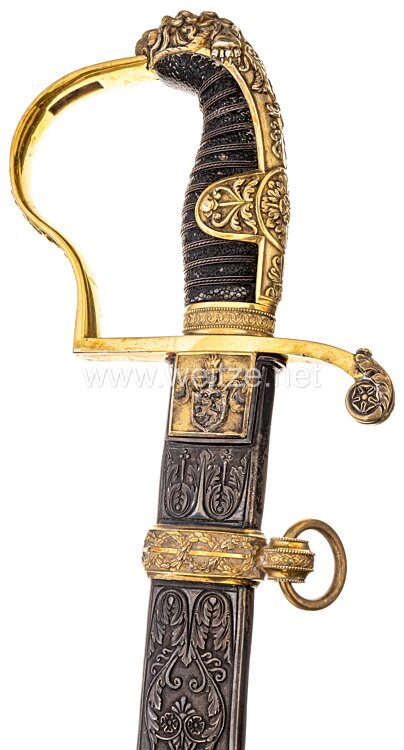
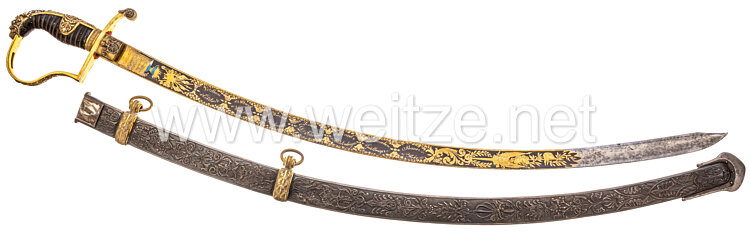
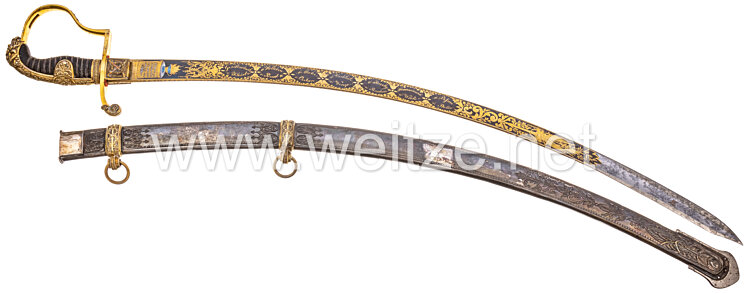
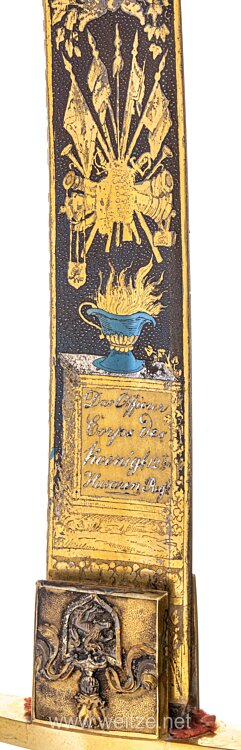
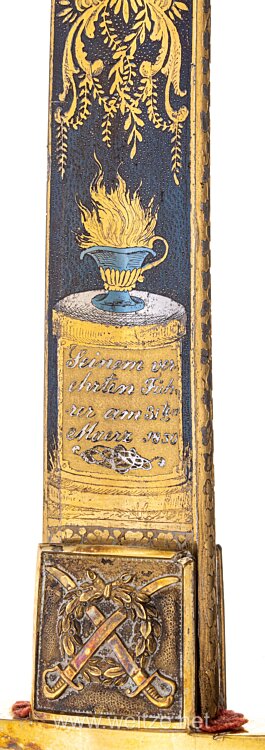
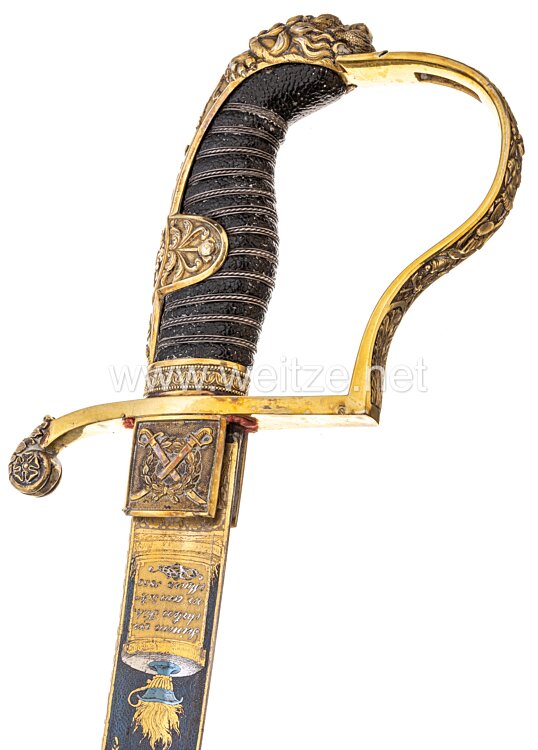
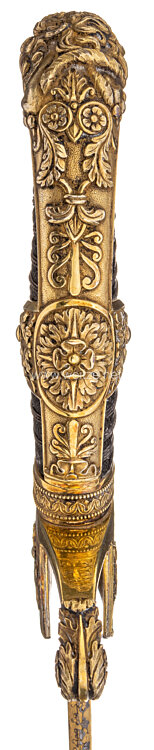
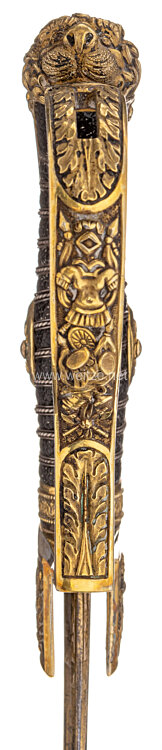
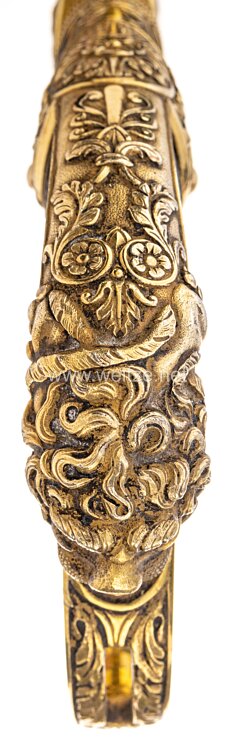
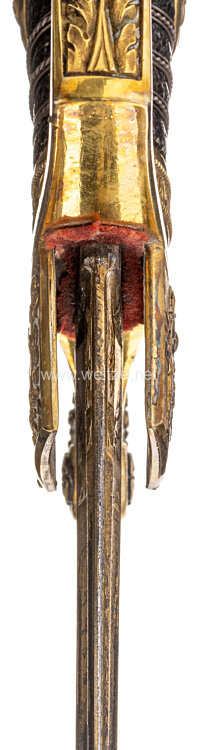
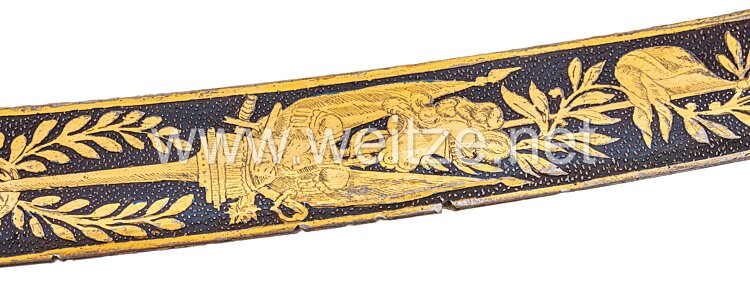
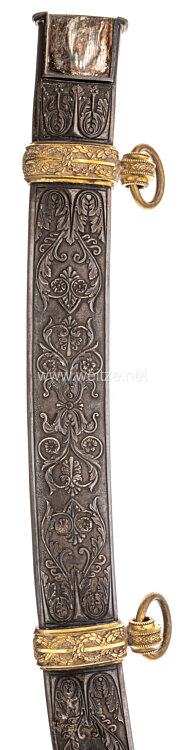
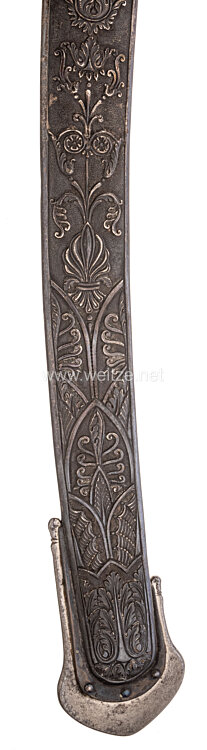
Circa 1830. Elegantly curved back-edged blade, approximately 3.3 cm wide and 84.6 cm long, with wide fullers on both sides and double-edged pandur point, both sides almost completely decorated with very well-preserved gilded etchings on blued, grained ground, at the ricasso an encircling dedication “Das Officier Corps des Koenigl. 12ten Husaren Regts.” - “Seinem verehrten Führer am 31ten Maerz 1830”, on both sides of the blade in oval, foliate-framed cartouches the names of the officers such as "Vitzthum v. Eckstaedt", "von Kleist", "von Strachwitz", "von Holleben", "von Plotho" etc. Richly relief-decorated stirrup guard hilt of gilded silver with sword knot slot, lion's head pommel with paws crossed behind the head, blackened sharkskin grip with triple silver wire binding, on the false edge side of the knuckle guard the coat of arms of Colonel Wilhelm August von Wulffen, the commander honored upon his departure. Solid silver scabbard, richly relief-decorated in neoclassical style (palmette, tendril and foliate motifs), two gilded ring mounts decorated with laurel wreaths, with two movable suspension rings. Overall length 101 cm, weight of scabbard approximately 0.8 kg. Lightly worn, with beautiful patina, condition 2.

Wilhelm August von Wulffen (1782 - 1841) entered the Dragoon Regiment "von Prittwitz" as a Junker on December 1, 1796. On April 13, 1799, he was transferred as a cornet to the Gardes du Corps Regiment. He fought as an officer in the battles of Auerstedt, on the Katzbach, and at Waterloo, among others. On February 11, 1814, he was assigned to the headquarters of Field Marshal Blücher. He commanded the 12th Hussar Regiment from May 11, 1816 to March 29, 1830. From April 1817, the regiment was garrisoned in Eisleben, Artern, Sangerhausen, and Cölleda. Von Wulffen was later promoted to Major General and commanded the 7th Landwehr Brigade. He retired from service on March 20, 1834 and received the Order of the Red Eagle, 2nd Class with Oak Leaves.

A unique, magnificent saber with fascinating history!

458729

Prussia Deluxe Presentation Saber for the Commander of the Thuringian Hussar Regiment No. 12, Wilhelm August von Wulffen († 1841)

This magnificent saber embodies one of the noblest traditions of the Prussian officer corps: the presentation of a precious gift to an esteemed commander upon his departure. On March 31, 1830, the officers of the Royal Thuringian Hussar Regiment Nr. 12 presented this extraordinary saber to their Colonel Wilhelm August von Wulffen, who had commanded the regiment since May 11, 1816. The dedication inscribed around the blade root expresses their esteem clearly: “Das Officier Corps des Koenigl. 12ten Husaren Regts. Seinem verehrten Führer am 31ten Maerz 1830” (The Officer Corps of the Royal 12th Hussar Regiment. To their esteemed commander on March 31, 1830).

The regiment itself emerged from the aftermath of the Napoleonic Wars and the reorganization of Germany. When Prussia received parts of Saxony, King Friedrich Wilhelm III ordered the establishment of the 12th Hussar Regiment from the allocated territories on March 25, 1815. The former Saxon hussars, who had now become Prussian, formed the core of the new regiment from May 8, 1815. Initially stationed in Silesia, the regiment was transferred in early April 1817 to Eisleben, Artern, Sangerhausen, and Cölleda in the former Thuringian district.

Wilhelm August von Wulffen was born on November 29, 1782 in Büssow, Kreis Friedeberg in der Neumark. His military career began on December 1, 1796 when he entered the dragoon regiment “von Prittwitz” as a junker. On April 13, 1799, he was transferred as a cornet to the Gardes du Corps regiment. During the Wars of Liberation, he fought at Auerstedt, on the Katzbach, and at Waterloo. He was wounded in the engagement at Goldberg and decorated with the Iron Cross Second Class. He further fought at Issy, on the Katzbach, at Ligny and Belle Alliance, as well as at the sieges of Glogau, Laon, and La Ferte. On February 11, 1814, he was transferred to the headquarters of Field Marshal Blücher.

Von Wulffen was transferred as commander to the 12th Hussar Regiment on May 11, 1816. There, on March 30, 1819, with patent dated April 17, 1819, he was promoted to colonel. On March 30, 1830, he was transferred as commander to the 7th Landwehr Brigade and in this position was promoted to major general on March 30, 1831. The presentation date of March 31, 1830, marked his final day with the regiment before this transfer. On August 18, 1825, he received the Service Cross, and on September 4, 1825, he became a Knight of the Order of St. John. When he retired from service on March 20, 1834, the king conferred upon him the Red Eagle Order Second Class with Oak Leaves, writing: “I hereby confer upon you as proof of my satisfaction with the zeal you have shown in all circumstances the Red Eagle Order Second Class with Oak Leaves”. Von Wulffen died on November 22, 1841 in Steele, now part of Essen.

The saber itself is a masterpiece of goldsmith's art from around 1830. The elegantly curved blade measures approximately 3.3 cm in width and 84.6 cm in length, with a total length of 101 cm. The blade features nearly completely preserved gilded etching on both sides against a blued, granulated ground. On both sides of the blade, in oval, leaf-framed cartouches, appear the names of the officers who gave the gift, including “Vitzthum v. Eckstaedt”, “von Kleist”, “von Strachwitz”, “von Holleben”, and “von Plotho”. The richly relief-decorated guard is made of gilded silver featuring a lion's head pommel with crossed paws behind the head. The blackened sharkskin grip bears triple silver wire wrapping. On the terz-side guard appears the coat of arms of the honored commander. The massive silver scabbard, which alone weighs approximately 0.8 kg, is richly relief-decorated in the neoclassical style with palmettes, scrollwork, and leaf motifs, and features two gilded ring bands decorated with laurel wreaths with movable suspension rings attached.

Such presentation sabers were common in the Prussian military tradition when officers departed command or marked significant service milestones. They served ceremonial and representational purposes rather than combat use, though they followed the general form of period hussar sabers, distinguished by exceptional materials and personalized decoration. The presentation date coincided with a period of heightened military alert: from 1830, the regiment was briefly transferred to the Rhineland, as the July Revolution of 1830 in France had created new tensions along the French border. Subsequently, it returned to its stations.

r