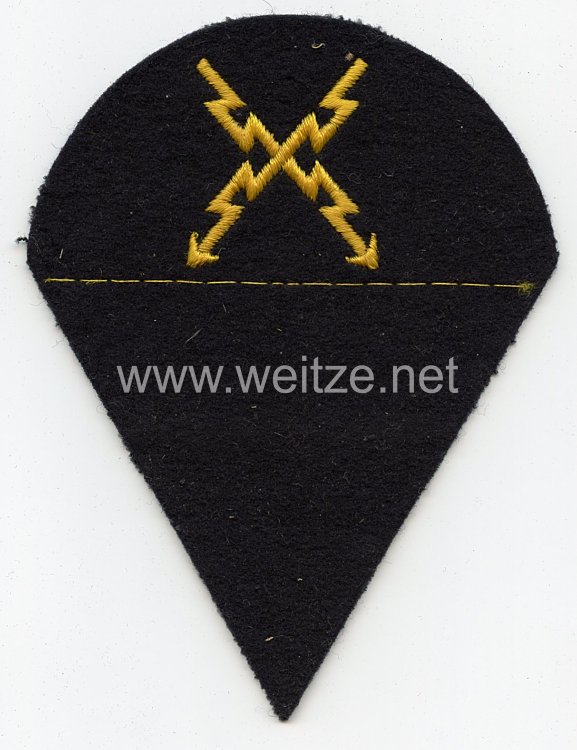
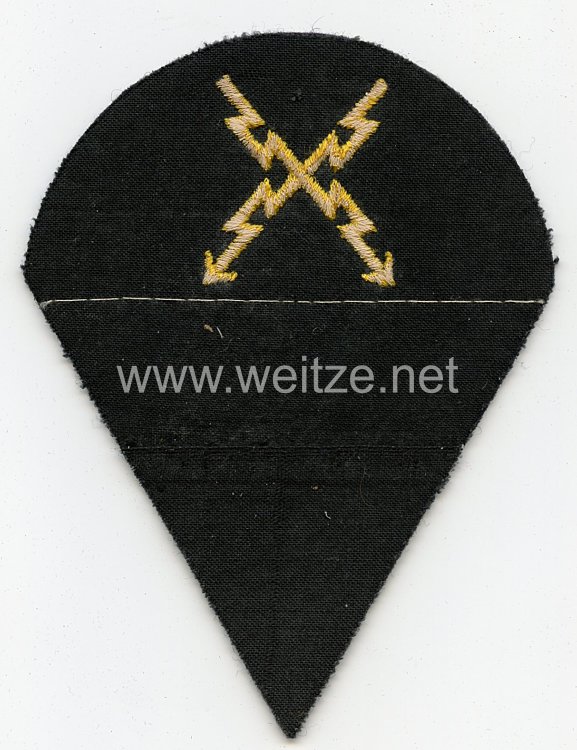
Kriegsmarine Career Insignia Enlisted Men Teleprinter Operator

Version for collar tabs, reverse with foxing, condition 2.
376629
25,00

Kriegsmarine Career Insignia Enlisted Men Teleprinter Operator

The Kriegsmarine Career Badge for Enlisted Personnel in Teleprinter Service represents a fascinating testament to the technical specialization within the German Navy during World War II. These badges belonged to a comprehensive system of career and proficiency insignia that the Kriegsmarine introduced to identify special qualifications and specialties of its crew members.

The career badges (Laufbahnabzeichen) were regulated by various orders and regulations issued between 1936 and 1945. They served not only as external identification of special qualifications but also expressed pride in acquired expertise. The system of career badges differed fundamentally from rank insignia and rather marked professional specialization within the Navy.

The teleprinter service represented an indispensable component of military communication during World War II. Teleprinters enabled rapid and largely secure transmission of messages between ships, submarines, coastal stations, and naval bases. Operating these complex technical devices required thorough training and special knowledge in telegraphy, cryptography, and radio technology.

The execution for the Colani refers to a special wearing method for these badges. Career badges were worn on the blue naval drill uniform used in daily service aboard ship. The term “Colani” was the colloquial designation for this practical working uniform, named after the Italian cotton fabric “Colanetto.”

The badges for enlisted personnel differed in design from those of non-commissioned officers and officers. They were typically worn on the left upper arm and showed through their specific symbolism the respective specialty. For teleprinter operators, symbols were usually used that referred to the technical nature of their work, often in the form of stylized lightning bolts or technical equipment.

The production of these badges was carried out by various suppliers to the Wehrmacht and Kriegsmarine. They were generally manufactured on dark blue cloth and decorated with embroidery or sewn-on metal elements. Quality could vary depending on the time of manufacture and producer, with earlier war years often showing better workmanship than later productions under the difficult conditions from 1943 onwards.

The awarding of such career badges was subject to certain prerequisites. The wearer had to complete appropriate training and pass an examination. For teleprinter operators, this included mastery of the equipment, knowledge of encryption techniques, and the ability to work reliably under often difficult conditions aboard ship. Training took place in special naval schools and lasted several months.

The signals service of the Kriegsmarine was hierarchically organized. Communications officers supervised all communication aboard ship, while specialized enlisted personnel such as teleprinter operators, radio operators, and cipher clerks performed the practical work. These men played a crucial role in the Navy's operational capability, as coordinated fleet operations were impossible without functioning communications.

The technical equipment included various models of teleprinter machines, some derived from civilian devices. Known systems included the Siemens Hellschreiber and various teleprinter machines that could also transmit encrypted messages. The combination with the famous Enigma machine and other cipher devices made the teleprinter service a highly sensitive area.

The present specimen shows foxing on the reverse, indicating storage under less than optimal conditions. Such discoloration is common in textiles from this period and results from moisture and organic deposits. The stated condition 2 corresponds to a good to very good state of preservation with slight signs of use according to common collector categories.

After 1945, these badges became increasingly valued by collectors of military historical objects. They document not only military organization but also the technological state and importance of specialized communications in modern naval warfare. Today they are important sources for researching naval history and the development of military communications technology.

The specialization represented by such badges reflects the increasing complexity of naval operations during the Second World War. The Kriegsmarine recognized that modern warfare required highly trained specialists in numerous technical fields, and the badge system both acknowledged and incentivized such expertise among the ranks.

r