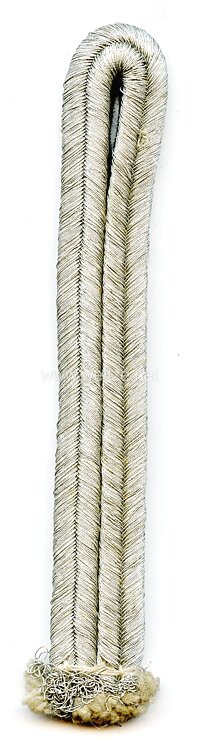
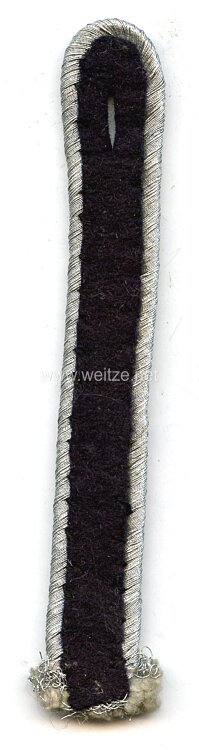
Kriegsmarine Single Shoulder Board for a Fähnrich (Officer Candidate)
This single shoulder board for a Kriegsmarine Fähnrich (naval cadet officer) represents an important component of the rank insignia system of the German Navy during World War II. This sewn-in version with backing displays the characteristic features of service rank insignia for aspiring officers in the German Navy between 1935 and 1945.
The Kriegsmarine was officially established on June 1, 1935, after Nazi Germany rejected the military restrictions of the Treaty of Versailles. The new navy required a comprehensive system of rank insignia and uniform regulations that partly drew upon the traditions of the Imperial Navy while also introducing its own elements.
The rank of Fähnrich (ensign) represented a crucial stage in the officer career path. Fähnriche were officer candidates who had already completed their basic training and were now gaining practical experience before being promoted to Leutnant zur See (junior lieutenant). The position was comparable to the rank of cadet or midshipman in other navies and marked the transition from enlisted ranks to the officer corps.
The shoulder boards (also called Schulterklappen) of the Kriegsmarine followed precise regulations laid down in the Uniform Regulations for the Kriegsmarine (M.Dv. Nr. 54). These regulations specified exactly the material, color, dimensions, and manner of wearing rank insignia. For Fähnriche, the shoulder board typically consisted of golden-yellow braid on a dark blue background, corresponding to the navy’s branch color.
The single piece described here was intended for attachment to the right or left shoulder of the service jacket or service tunic. The “sewn-in” version means that this shoulder board was permanently stitched to the uniform piece, as opposed to removable variants that were fastened with buttons. The mentioned backing served to provide stability to the shoulder board and maintain its shape.
During the war, a prospective naval officer went through several training stages. After basic training as a sailor, suitable candidates were appointed as Seekadetten (naval cadets). After successfully completing further courses, including practical sea service, they were promoted to Fähnrich zur See. In this position, they typically served on warships and gained practical experience before being appointed Leutnant zur See after about a year and passing examinations.
The rank insignia of the Kriegsmarine differed significantly from those of the Wehrmacht (Army) and Luftwaffe (Air Force). While the Army primarily used silver-colored braiding, the Kriegsmarine traditionally used golden-yellow tones that harked back to long maritime tradition. This coloring was also common in other European navies and symbolized the special status of naval forces.
The manufacture of such shoulder boards was carried out by specialized manufacturers and tailors who often had many years of experience in producing military equipment. Companies such as ASSMANN, Friedrich Linden, and others were well-known producers of uniform effects. Quality could vary depending on whether these were official depot items or privately procured pieces.
During the course of the war, especially after 1943, material shortages and the increasingly difficult economic situation led to simplifications in uniform production. Nevertheless, the rank insignia system remained largely intact, as it was indispensable for military hierarchy and discipline.
The shoulder boards of naval officer candidates were not merely decorative elements but served important practical functions. They allowed immediate recognition of rank and status, which was crucial for maintaining military order and command structure aboard ships and in naval installations. The distinction between different officer grades had to be clearly visible even at a distance or in poor lighting conditions typical of naval service.
The Fähnrich occupied a unique position in the naval hierarchy. While technically not yet full officers, they were accorded certain privileges and responsibilities that set them apart from enlisted personnel. They messed with officers, wore officer-style uniforms, and were expected to demonstrate leadership capabilities. However, they were still under instruction and subject to evaluation by their superiors.
Today, such shoulder boards are important objects of study for military historians and collectors. They document not only the rank system of the Kriegsmarine but also the craftsmanship and materials of that era. The indicated condition 2 suggests a well-preserved specimen that still clearly shows its characteristic features despite its age.
The study of such uniform items contributes to a better understanding of the everyday reality of soldiers and supplements the grand strategic and political narratives of military history with important details of material culture and the organizational structure of the Kriegsmarine.