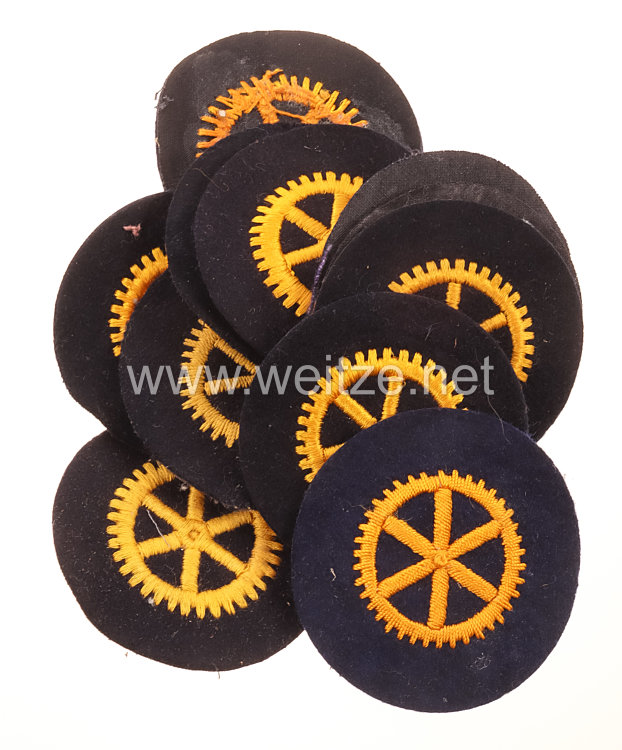
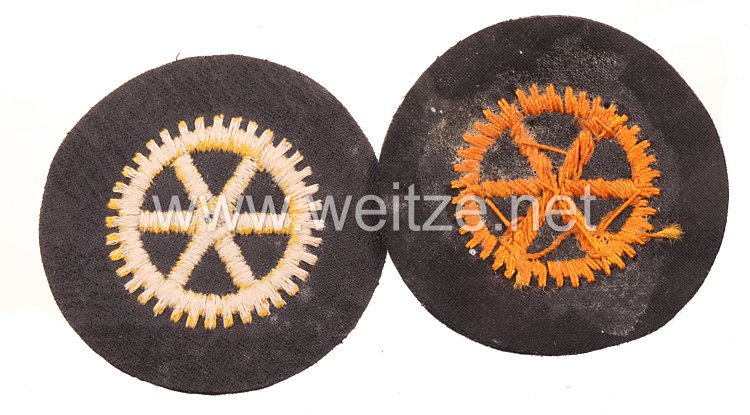
Kriegsmarine Sleeve Insignia Machine Personnel Career Track

for the blue blouse. Condition 2.

Price per piece: 6 Euro.

Condition may vary.
440829
6,00

Kriegsmarine Sleeve Insignia Machine Personnel Career Track

Kriegsmarine Sleeve Badge for Engineering Career Path: Rank Insignia of the German Navy 1935-1945

The sleeve badge of the Engineering Career Path (Maschinenlaufbahn) of the Kriegsmarine represents an important component of the uniform system of the German Navy during World War II. These special badges served to identify professional specializations within the complex hierarchy of the German naval forces.

Historical Background

With the official renaming of the Reichsmarine to Kriegsmarine on May 21, 1935, a comprehensive reorganization of the German naval forces took place under the National Socialist regime. The Kriegsmarine developed an elaborate system of rank insignia and career path identifications that made the various specializations and ranks within the navy clearly recognizable. The Maschinenlaufbahn (Engineering Career Path) encompassed all technical specialists responsible for the operation and maintenance of ship engines, steam boilers, diesel motors, and later also the complex submarine propulsion systems.

The Blue Blouse and Its Significance

The blue blouse (also called Blusenjacke) was part of the working and shipboard uniform of the enlisted men and petty officers of the Kriegsmarine. It was made from blue drill fabric and served as practical work clothing aboard warships and submarines. Unlike dress uniforms or walking-out dress, the blue blouse was designed for daily duty and had to withstand the harsh demands of naval service.

Structure and Design of Sleeve Badges

The sleeve badges of the Engineering Career Path were worn on the left upper arm and typically consisted of embroidered or woven symbols on a dark blue background. The characteristic feature of the Maschinenlaufbahn was usually a cogwheel or ship's propeller, combined with various stars or other symbols that indicated the respective rank within the career path. These badges made it possible to recognize at a glance the function and qualification of a crew member.

Career path badges differed fundamentally from rank insignia worn on shoulder boards or sleeves. While rank insignia indicated the service grade, career path badges identified the professional specialization – a system that continues in modified forms in many navies worldwide to this day.

The Importance of the Engineering Career Path

Members of the Engineering Career Path played a critical role in the Kriegsmarine. Without their expertise, neither surface units nor submarines would have been operational. Particularly in the U-boat force, which was of central importance to German naval warfare, engineering personnel were indispensable. They had to keep the complex diesel and electric motors of the U-boats running under extreme conditions – confined spaces, high temperatures, noise, and constant danger.

Training for the Engineering Career Path took place in specialized naval schools and lasted several months to years, depending on the rank sought. The Naval Artillery School and various technical schools of the Kriegsmarine trained the personnel who later served on ships.

Production and Variants

Sleeve badges were produced both by official naval clothing offices and by private manufacturers. This led to certain variations in quality and execution, although the basic designs were standardized through uniform regulations. The Clothing Regulations of the Kriegsmarine (BVM) regulated in detail the appearance and wearing of all uniform parts and badges.

Quality differences resulted from various manufacturing methods: Early badges were often hand-embroidered and of higher quality, while later wartime productions were increasingly machine-made and of simpler execution. The backing material used also varied – from felt to cloth to simpler material in the later war years.

Collector Value and Preservation

Today, original Kriegsmarine sleeve badges are sought-after collectibles of military historical artifacts. The condition of such badges is usually assessed according to a scale, whereby Condition 2 typically designates a well-preserved piece with slight signs of use but without severe damage. Collectors and military historians value these badges as authentic witnesses to naval history.

Historical Context

The examination of such military historical objects always requires critical historical contextualization. The Kriegsmarine was an integral part of the Wehrmacht of National Socialist Germany and thus involved in the crimes of World War II. The scholarly engagement with such objects serves historical reappraisal and understanding of this era, not its glorification.

r