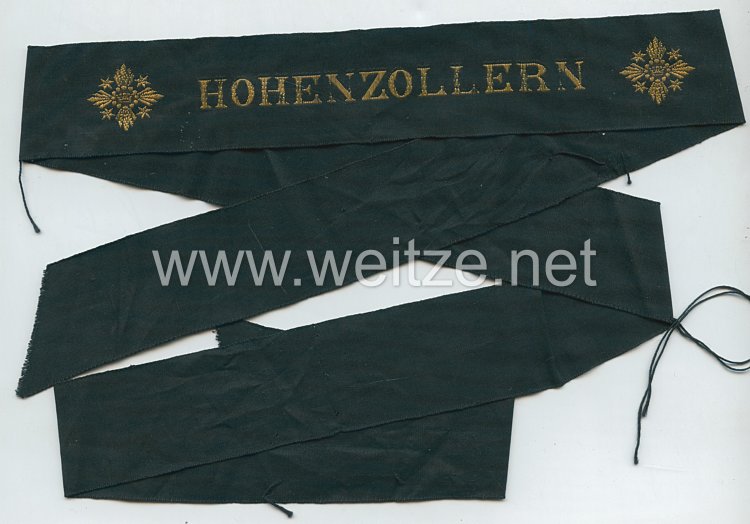
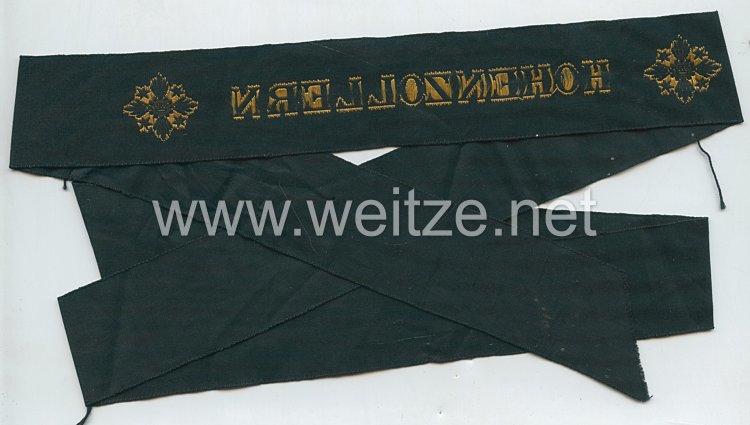
Imperial Cap Tally "Hohenzollern" for Child's Sailor Cap
The Imperial cap ribbon "Hohenzollern" for children's sailor caps represents a fascinating testament to German naval history and the social traditions of the Imperial era. These special cap ribbons were not manufactured for active naval personnel, but for children who wore the so-called sailor suit – a phenomenon that was widespread in Europe during the late 19th and early 20th centuries.
The Hohenzollern Dynasty ruled over the German Empire from 1871 to 1918. The name "Hohenzollern" on a cap ribbon held special significance as it referred to the reigning imperial family. Emperor Wilhelm I (1871-1888), Friedrich III (1888), and especially Wilhelm II (1888-1918) shaped this era. Wilhelm II was particularly known for his passion for military uniforms and naval affairs, which also influenced civilian society.
The tradition of children's sailor suits began in England as early as the 1840s when Queen Victoria dressed her son, the Prince of Wales, in a sailor suit. This fashion quickly spread throughout European nobility and the upper bourgeoisie. In Germany, this trend reached its peak during the Wilhelmine era (1888-1918), when the Imperial Navy became a symbol of national pride.
The described cap ribbon with a length of 90 cm corresponds to the typical measurements for children's cap ribbons of that time. Unlike the cap ribbons of active naval personnel, which bore ship names, these children's ribbons were often inscribed with dynastic names such as "Hohenzollern." The Imperial Navy actually had several ships bearing the name "Hohenzollern," including the famous imperial yacht SMY Hohenzollern, which served from 1893 to 1914.
These cap ribbons were typically manufactured from black or dark blue ribbon with gold or yellow lettering. The inscription was usually done in block letters and stylistically corresponded to original naval cap ribbons. Manufacturers of these children's cap ribbons were often the same companies that supplied the Navy with uniform parts, or specialized manufacturers of children's clothing.
The social significance of these garments was considerable. Wearing sailor suits with corresponding cap ribbons served several purposes: it demonstrated the family's patriotic sentiment, displayed social status (this clothing was not inexpensive), and reflected the militarization of Wilhelmine society. Photographs from this period frequently show children in sailor clothing, demonstrating the widespread nature of this fashion.
After the end of the Empire in 1918, this fashion gradually lost significance, although sailor suits for children were still worn until the 1950s. However, the imperial and dynastic references disappeared. Cap ribbons bearing the inscription "Hohenzollern" were no longer produced after 1918, making authentic examples rare collectibles.
For collectors of military historical objects, such children's cap ribbons are particularly interesting because they are rarer than military originals. They document not only naval history but also the social and cultural history of the Empire. The condition of preservation is of particular importance for textiles over 100 years old, as the material is susceptible to wear, light exposure, and moisture.
The authentication of such objects requires expertise regarding the materials used, manufacturing techniques, and stylistic characteristics of the era. Reproductions exist, which is why details such as thread thickness, weave, signs of aging, and manufacturing methods must be carefully examined.
In summary, an imperial cap ribbon "Hohenzollern" for children's sailor caps represents a significant cultural-historical artifact that provides insights into Wilhelmine society, the importance of the Navy in public consciousness, and child-rearing in the German Empire.