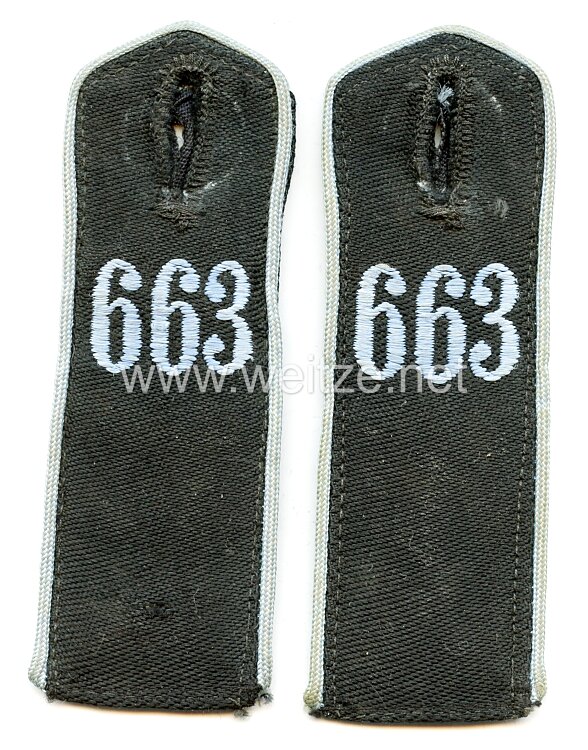
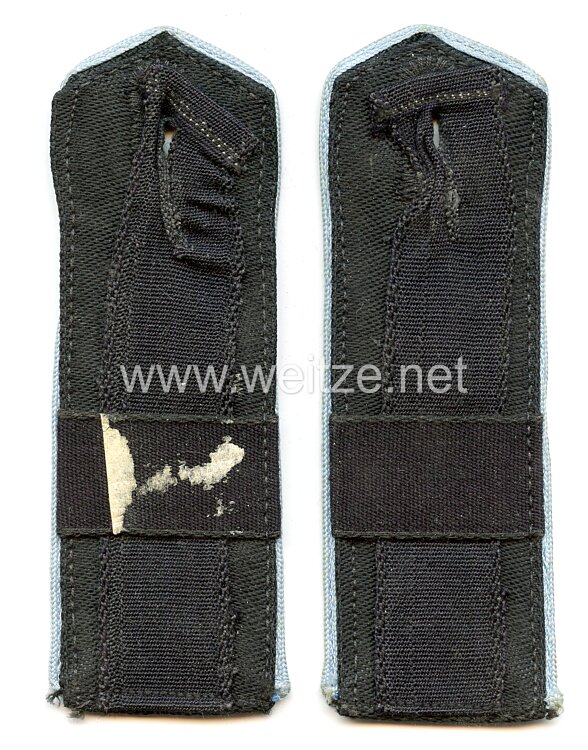
Flieger-HJ Pair of Shoulder Straps, Bann "663"
These Flieger-HJ shoulder straps bearing the Bann 663 designation represent a fascinating piece of textile history from the National Socialist era and belong to the uniform of the Flieger-Hitlerjugend (Hitler Youth Flying Corps), a specialized branch within the Hitler Youth organization.
The Hitler Youth (HJ) was founded in 1926 and evolved after 1933 into the state youth organization of the German Reich. Within this organization, various specialized divisions existed that were intended to prepare young people for specific military and paramilitary fields. The Flieger-HJ was officially established in 1937 as the successor to earlier aviation youth groups and was designed to inspire young people about aviation and provide preliminary training for the Luftwaffe.
The organizational structure of the HJ was hierarchically arranged. A Bann represented a middle administrative unit comprising approximately 3,000 to 5,000 members and uniting several Stämme (smaller units). Each Bann was identified by a number that was displayed on uniform items, particularly on shoulder straps. Bann 663 was stationed in Litzmannstadt, as the city of Łódź was called during the German occupation of Poland.
Litzmannstadt in the Wartheland territory was part of the areas annexed in 1939 following the invasion of Poland. The Wartheland was incorporated directly into the German Reich as a Reichsgau and was intended to be completely Germanized. The city of Łódź, renamed Litzmannstadt after German General Karl Litzmann, developed into an important industrial center under German administration. The establishment of HJ structures in these annexed territories was part of the National Socialist Germanization policy.
The shoulder straps of the Flieger-HJ differed from those of other HJ divisions through their specific coloring and markings. The Flieger-HJ generally used silver-gray or light blue base colors that symbolically referred to aviation. The shoulder straps were worn on both shoulders of the uniform jacket and served to identify the unit as well as rank within the organization.
The production of these uniform items followed strict guidelines laid down in various uniform regulations. The loops on the back of the shoulder straps served to attach them to the uniform via buttons. This practical construction allowed for easy attachment and removal, which was necessary, for example, when washing uniforms or during transfers.
Training in the Flieger-HJ included theoretical instruction in aviation science, meteorology, and navigation, as well as practical activities such as model aircraft construction and later also gliding. From the age of 14, members of the Flieger-HJ could participate in gliding courses. This preliminary training was intended to facilitate the transition to the Luftwaffe and create a pool of pre-trained recruits.
Uniforming played a central role in the HJ for creating a sense of community and militarily shaping young people. The shoulder straps as visible rank insignia contributed to the hierarchical structure and military character of the organization. For many young people, wearing the uniform was associated with pride, while simultaneously serving ideological indoctrination and military formation.
After 1945, all NSDAP organizations, including the Hitler Youth and its divisions, were banned and dissolved by the Allied Control Council. Uniforms and insignia were partially confiscated and destroyed. Surviving pieces such as these shoulder straps today possess exclusively historical documentary value and are important witnesses for researching National Socialist youth organizations and their uniform history.
From a scholarly perspective, such objects provide insights into the organizational structure, geographic distribution of HJ units, and the material culture of National Socialism. The Bann number 663 specifically documents the presence of the Flieger-HJ in the annexed eastern territories and thus also the expansion of the National Socialist youth organization beyond the pre-war borders of the German Reich.