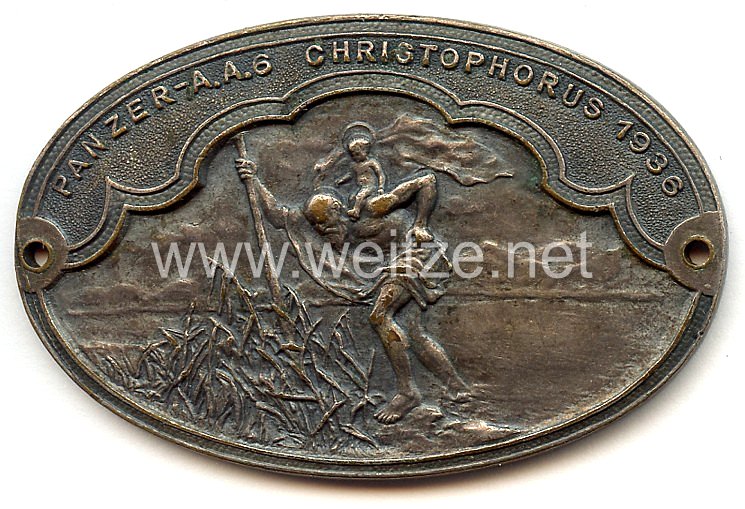
Commemorative Plaque of Panzer-Abwehr-Abteilung 6 - St. Christopherus 1936
Historical Context: Commemorative Plaque of Panzer-Abwehr-Abteilung 6 with St. Christopher Motif, 1936
This commemorative plaque from 1936 represents a fascinating testament to the build-up phase of the German Wehrmacht and documents the development of anti-tank units in the period before World War II. The Panzer-Abwehr-Abteilung 6 (Anti-Tank Battalion 6) was part of the systematic reorganization of German armed forces following the reintroduction of universal conscription in March 1935.
The anti-tank arm developed in the 1930s as a response to the increasing mechanization of European armies. After World War I, the deployment of tanks had revolutionized warfare, and military leadership recognized the necessity of specialized units to combat armored vehicles. The Panzer-Abwehr-Abteilungen were established as independent units and received special training and equipment.
The St. Christopher motif on this plaque holds particular symbolic significance. Saint Christopher has been venerated for centuries as the patron saint of travelers and was frequently honored in military contexts as protector of soldiers and vehicle crews. His depiction on military memorabilia was widespread in the Wehrmacht, especially among motorized and mechanized units. The choice of this religious symbol reflects the still-present Christian tradition in German military culture of the 1930s.
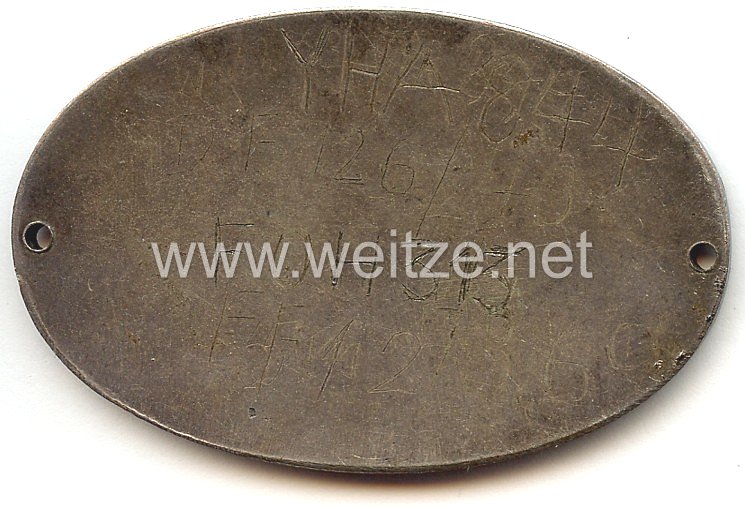
The technical features of the plaque – iron construction measuring 40 x 60 mm with holes on both sides – indicate it was intended for wearing or attachment to equipment items. Such commemorative plaques were often issued on special occasions: founding anniversaries, successful maneuvers, transfers, or as farewell gifts at the end of service. The numbers and letters scratched on the reverse could represent identification numbers, dates, or personal initials of the original owner.
In 1936, the Wehrmacht was in a phase of intensive expansion and modernization. The Panzer-Abwehr-Abteilungen were equipped with various weapons, including the 3.7 cm PaK 36, which served as the standard anti-tank gun. These units conducted extensive exercises and developed tactics for combating armored vehicles. Panzer-Abwehr-Abteilung 6 was likely assigned to an army corps or division and played an important role in the military structure.
Commemorative plaques like this were an integral part of military tradition and served multiple purposes. They strengthened esprit de corps and soldiers' connection to their unit, documented service time, and were often preserved as personal mementos. The production of such objects was frequently carried out by local craftsmen or specialized firms that produced military insignia and equipment.
The use of iron as material was typical for this period and reflects both economic and practical considerations. Iron was inexpensive and readily available, while more precious metals were reserved for more important military purposes. The patina and condition of such iron plaques often tell their own story of decades of preservation.
In the broader historical context, this plaque stands at the beginning of a development that led to World War II. The anti-tank troops, still under construction in 1936, would play a central role in warfare in the coming years. However, the initial equipment soon proved inadequate against the more heavily armored vehicles of the Allies, leading to the development of stronger anti-tank weapons.
For collectors and historians, such commemorative plaques offer valuable insights into the everyday culture and traditions of the Wehrmacht. They document not only military organizational structures but also the personal bonds and identity of soldiers. The religious symbolism of Saint Christopher also demonstrates the complex relationship between religious tradition and military culture in 1930s Germany.
This plaque is thus more than a simple metal object – it is a historical witness to a specific historical epoch and documents the development of the German anti-tank force in its early phase. Such artifacts serve as tangible connections to the past, reminding us of the human dimension behind military history and the traditions that shaped soldiers' lives during this pivotal period in European history.