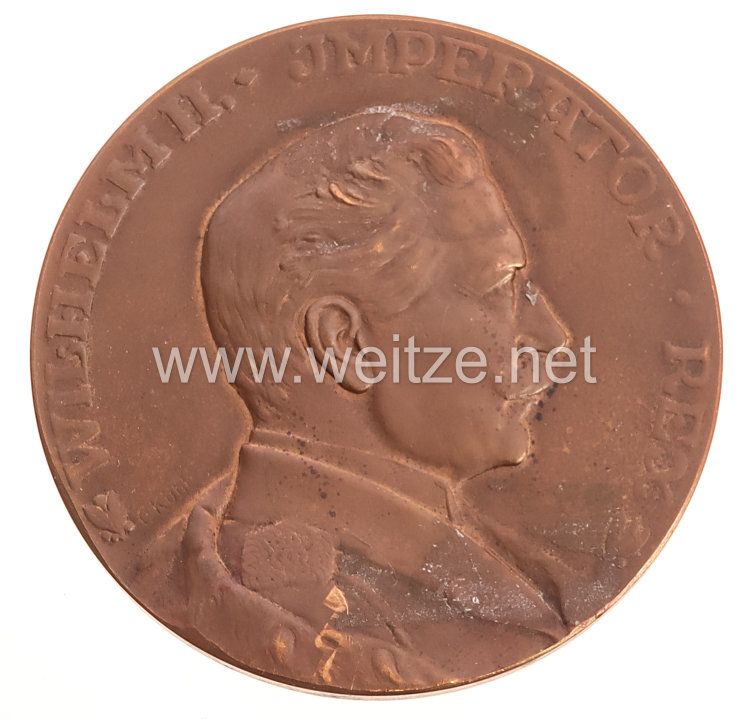
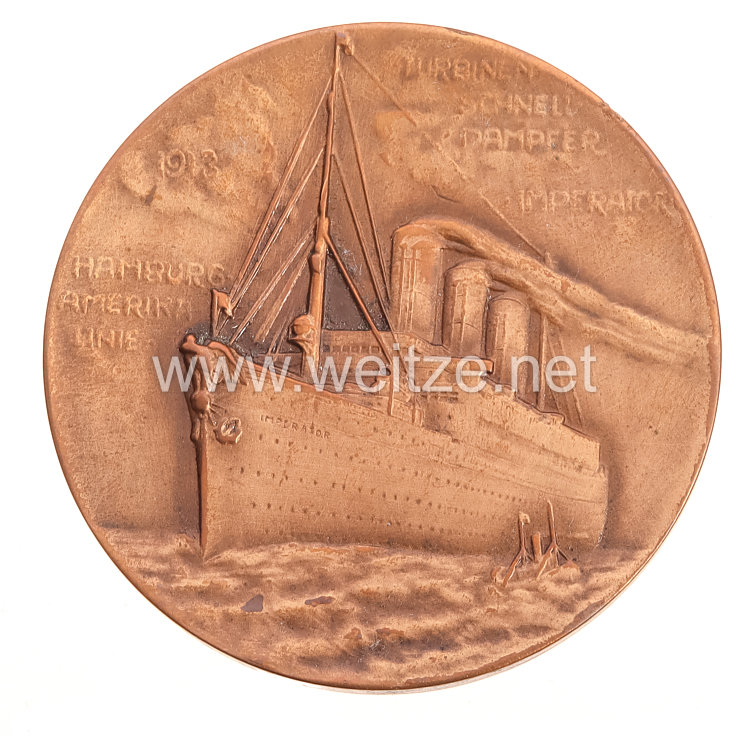
German Empire Non-Wearable Commemorative Medal of the Hamburg-Amerika Line, Issued on the Occasion of the Commissioning of the “Imperator” in May 1913

Large bronze medal, diameter 60 mm, obverse depicting Kaiser Wilhelm II with inscription “Wilhelm II. Imperator Rex”, reverse depicting the ship with text “1913 Hamburg-Amerika-Linie Turbinen-Schnell-Dampfer Imperator”. Condition 2-
444429
150,00

German Empire Non-Wearable Commemorative Medal of the Hamburg-Amerika Line, Issued on the Occasion of the Commissioning of the “Imperator” in May 1913

The commemorative medal of the Hamburg-Amerika Line marking the commissioning of the SS Imperator in May 1913 represents a pinnacle of German maritime ambitions in the late Imperial period. This large-format bronze medal, measuring 60 millimeters in diameter, was not intended to be worn but created as a prestigious memento of one of the most significant events in German merchant marine history.

The Hamburg-Amerika Line (HAPAG), founded in 1847, had developed by the turn of the century into the world's largest shipping company. Under the visionary leadership of Albert Ballin, who served as Director General from 1899 to 1918, the shipping line pursued an aggressive expansion strategy. Ballin, a close confidant of Kaiser Wilhelm II, recognized the importance of luxury liners not merely as means of transport but as floating ambassadors of German engineering excellence and culture.

The SS Imperator was the first of three planned giant ships of the so-called Imperator class, which also included the Vaterland and the Bismarck. At 276 meters in length and over 52,000 gross register tons, the Imperator was the largest passenger ship in the world at the time of her commissioning. Construction took place at the renowned Vulcan shipyard in Hamburg, and the vessel was intended to break British dominance on the North Atlantic, embodied by Cunard liners such as the Lusitania and Mauretania.

The obverse of the medal displays the portrait of Kaiser Wilhelm II with the Latin inscription “Wilhelm II. Imperator Rex”. This depiction skillfully links imperial authority with the maritime venture. The title “Imperator” (Latin for emperor or commander) was deliberately chosen to symbolize both the ship's greatness and the imperial power of the German Reich. Wilhelm II, himself an enthusiastic promoter of the German fleet, had a personal interest in developing the merchant marine, which he viewed as the commercial counterpart to the Imperial Navy.

The reverse presents a detailed representation of the ship with the text “1913 Hamburg-Amerika-Linie Turbinen-Schnell-Dampfer Imperator”. The designation as a turbine express steamer highlights the most modern propulsion technology of the time. The Imperator was equipped with four Parsons steam turbines that enabled speeds of up to 23 knots. This technological innovation marked a significant advance over older reciprocating steam engines.

Such commemorative medals were frequently struck during the Wilhelmine era for significant occasions. They served multiple purposes: as advertising tools for the shipping line, as prestigious gifts for important guests and investors, and as collectors' items for maritime enthusiasts. Production of these medals was typically undertaken by renowned medallists and minting establishments known for their precision craftsmanship.

The Imperator's maiden voyage took place on June 10, 1913, from Cuxhaven to New York. The ship attracted worldwide attention not only for its size but also for its luxurious appointments. The interiors, designed by leading artists and architects, included a magnificent dining hall in Louis XVI style, a Pompeian swimming pool, and a knights' hall. The ship could accommodate over 4,000 passengers in three classes.

The outbreak of World War I in August 1914 abruptly ended the golden age of German luxury liners. The Imperator lay idle in Hamburg harbor throughout the war. After Germany's defeat in 1918, the ship was ceded to Great Britain as reparations and sailed from 1920 under the name RMS Berengaria for the Cunard Line.

This medal thus documents a brief but significant moment of German maritime greatness. It stands symbolically for the Empire's ambitions to demonstrate its technological progress and position as a world power. Today, such medals are sought-after collectibles that possess not only economic-historical value but also art-historical and cultural significance. They commemorate an era when national identity and technological progress were inextricably linked with maritime achievements.