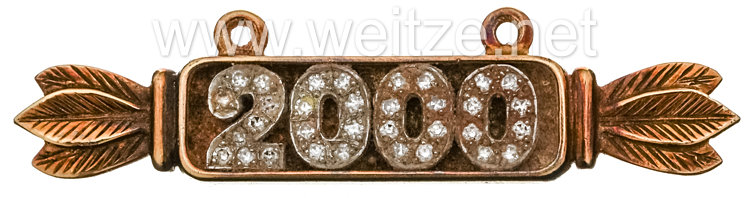
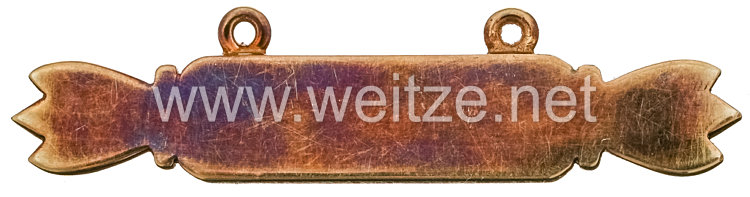
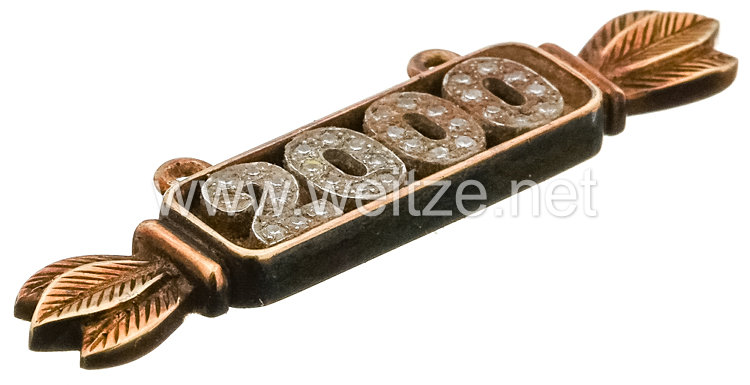
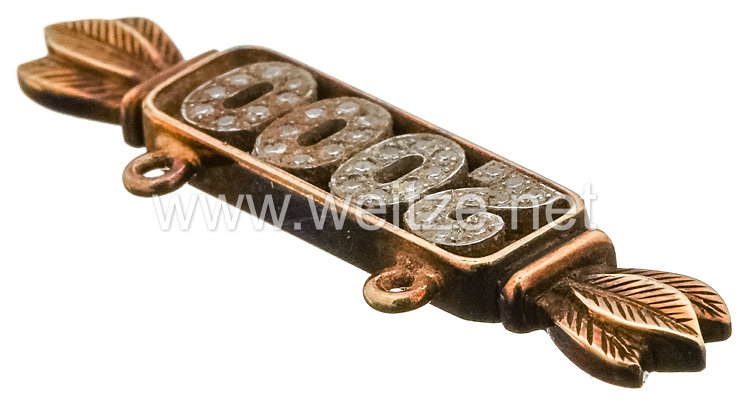
Luftwaffe Golden Front Flying Clasp Pendant with Diamonds for "2000" Enemy Sorties

This is certainly an excellent jeweler's custom piece made of genuine gold, with individually set numerals "2000" adorned with genuine diamonds, and hand-engraved laurel leaves on the sides. Only slight signs of age, condition 2.
The only known recipient of a "2000" pendant clasp in gold with diamonds was Oberst Rudel. His decorations remain in family possession to this day. 
We were able to acquire this piece from an old German collection, unfortunately without further documentation. Perhaps a presentation sample or a piece intended for another award?
388728

Luftwaffe Golden Front Flying Clasp Pendant with Diamonds for "2000" Enemy Sorties

The Front Flying Clasp for Bomber Pilots ranked among the most significant decorations of the German Luftwaffe during World War II. It was instituted on January 30, 1941, by Reichsmarschall Hermann Göring to recognize the exceptional achievements of aircrews who had completed a specific number of operational sorties against the enemy.

The award system was structured in graduated stages: the Bronze Clasp was awarded after 20 missions, the Silver Clasp after 60 missions, and the Gold Clasp after 110 missions. For each additional 110 missions, a pendant could be awarded to the Gold Clasp, indicating the total number of operational flights. These pendants were initially awarded in increments of 200, 300, 400, 500, 600, 700, 800, 900, and 1000.

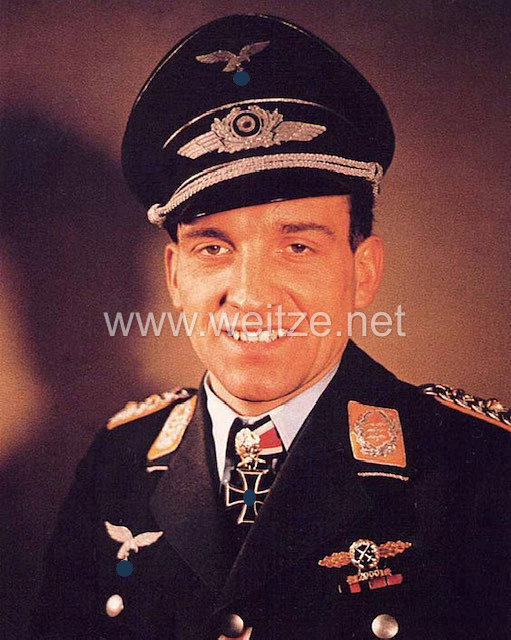
The present jeweler's creation featuring the number “2000” set with diamonds represents an absolute anomaly. In the entire history of the Luftwaffe, only one documented case exists of a pendant with this number being awarded: Oberst Hans-Ulrich Rudel, the most successful ground-attack pilot of World War II.

Hans-Ulrich Rudel flew exclusively the Junkers Ju 87 “Stuka” dive bomber and completed a total of 2,530 combat missions, a number that remains unmatched to this day. His extraordinary achievements included the destruction of numerous tanks, vehicles, and military targets on the Eastern Front. As the sole recipient of the highest grade of the Iron Cross with Golden Oak Leaves, Swords and Diamonds, he received this unique decoration on March 29, 1944, as the first and only soldier ever to be so honored.

The technical execution of such high-quality awards was carried out by specialized jewelers and goldsmiths. The Berlin manufacturer C.E. Juncker was one of the most renowned producers of Luftwaffe decorations, but other prestigious firms such as Gebrüder Godet or Klein & Quenzer also manufactured high-quality orders and badges. Custom pieces set with diamonds were always exclusive individual creations, handcrafted with meticulous attention to detail.

The pendants for the Front Flying Clasp typically consisted of gold-plated metal or genuine gold and displayed the achieved mission number between two stylized laurel branches. Attachment was accomplished through a movable loop on the main clasp. In particularly high-ranking executions, such as the present example, the numbers were set with diamonds, emphasizing the exceptional nature of the achievement.

After the war ended in 1945, many personal decorations remained in the possession of their recipients or their families. Rudel's awards are known to remain in family possession to this day. This raises intriguing questions regarding the present piece: Could it possibly be a presentation sample from the jeweler, a replacement piece, or a creation for an award that was never made?

The historical rarity of such an object cannot be overestimated. While regular Front Flying Clasps were manufactured in larger quantities, pendants for higher numbers were already rare. A pendant with the number 2000 and diamond setting belongs to the absolute rarities of military phalerics.

The hand-engraved execution of the laurel branches and the individually set diamonds testify to the highest craftsmanship quality. Such work required not only technical skill but also access to valuable materials, which became increasingly difficult during the war. This suggests that the piece was either made relatively early or under special circumstances.

For collectors and historians, such objects raise important questions about the manufacture, award, and transmission of decorations from the Third Reich. The documentation of such pieces contributes to understanding the military honors culture of that era, independent of the moral evaluation of the regime and its wars.

r