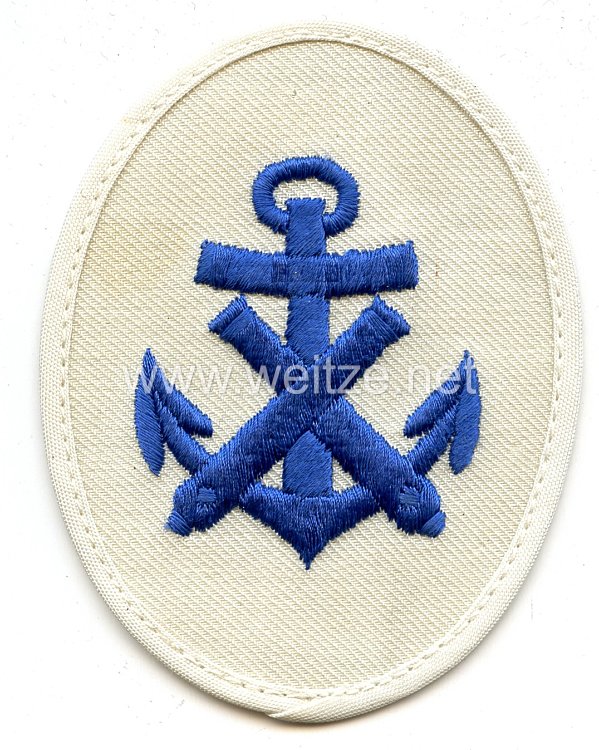
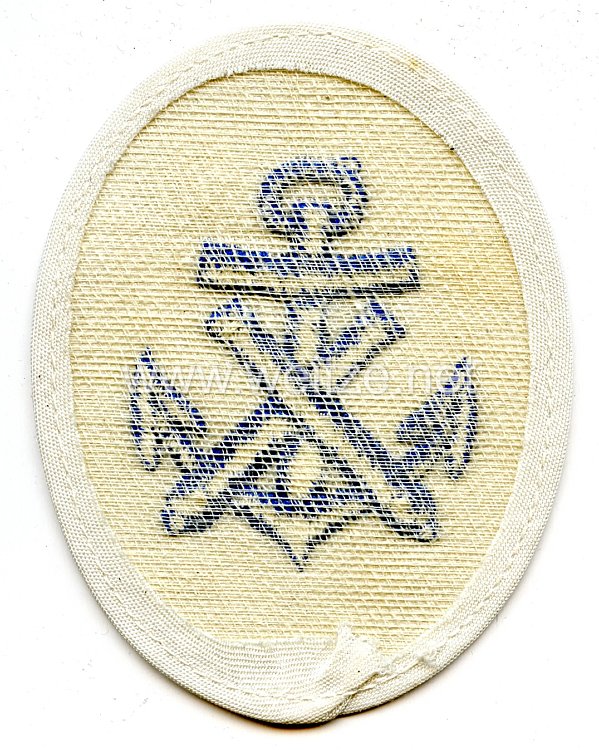
Kriegsmarine Sleeve Insignia Petty Officer Ordnance Artificer
Kriegsmarine Sleeve Badge Feuerwerksmaat - Historical Context
The sleeve badge of the Feuerwerksmaat of the Kriegsmarine represents an important component of the complex career and rank insignia system of the German Navy during World War II. This particular version for the white summer blouse documents the differentiated textile equipment of the Kriegsmarine, which provided various uniform variants for different seasons and occasions.
The Feuerwerksmaat belonged to the Feuerwerker (ordnance artificer) career track, a highly specialized technical role within the Kriegsmarine. The designation “Feuerwerker” has historical roots dating back to the 18th century, when these specialists were responsible for handling gunpowder, ammunition, and pyrotechnic materials. In the Kriegsmarine of the 1930s and 1940s, Feuerwerker assumed responsibility for ammunition management, torpedo technology, and mine equipment aboard warships.
The career group of Feuerwerker was strictly separated from general ship personnel and required specialized technical training. The rank of Maat (mate) roughly corresponded to a non-commissioned officer in the army and was the first NCO rank that could be achieved after promotion from sailor or able seaman. Feuerwerksmaate bore significant responsibility for the safe handling and storage of ammunition and explosives – a task requiring the highest precision and expertise.
The sleeve badge itself followed the uniform regulations of the Kriegsmarine, which were detailed in the “Dress Regulations for the Navy” (M.Dv. Nr. 53). These regulations were first systematically codified in 1936 following the reintroduction of general conscription and the rebuilding of the German Navy. The badges were to be worn on the right upper arm and indicated the wearer's career specialty through their specific design.
For Feuerwerker, the characteristic symbol was a crossed device symbolizing their technical specialization in ammunition and torpedo matters. The execution in dark blue embroidery on a white background was intended for the white summer uniform, which was worn during warmer months or in tropical deployment areas. The Kriegsmarine placed great emphasis on uniform appearance and precise execution of these badges, which were mostly machine-manufactured to ensure consistent quality.
The white blouse (officially: white blouse suit) belonged to the summer uniform and was typically worn from May to September, and beyond that in Mediterranean and overseas areas. It consisted of a white cotton blouse with an attached sailor collar, which was provided with the corresponding sleeve badges and rank insignia. This uniform variant was particularly common among crews of surface ships, less so among submarine crews who often wore simplified working clothes for practical reasons.
The production of uniform badges was strictly regulated during the war. Various manufacturers and suppliers were commissioned with production, with quality varying throughout the war due to material shortages. Badges for the white uniform were technically more demanding to produce than those for the standard dark blue uniform due to the lighter base color.
The military daily routine of a Feuerwerksmaat included supervising ammunition stocks, maintaining torpedoes and mines, and instructing subordinate enlisted ranks in the proper handling of these dangerous materials. On larger ships such as battleships, cruisers, or aircraft carriers, several Feuerwerker worked in hierarchically structured teams. The responsibility was immense, as errors could have catastrophic consequences – as numerous documented ammunition explosions on warships of various nations demonstrate.
The historical significance of such badges today lies in their function as material witnesses of a vanished military system. They document the social hierarchy, technical specialization, and organizational complexity of the Kriegsmarine. For military-historical research, they are important sources for understanding organizational structures, career paths, and the material culture of the military in the Third Reich.
Today, such sleeve badges are sought-after collector's items, whose value depends on condition, authenticity, and rarity. Preservation in good condition is often problematic due to the organic material (cotton, textile embroidery), making well-preserved examples particularly valuable.