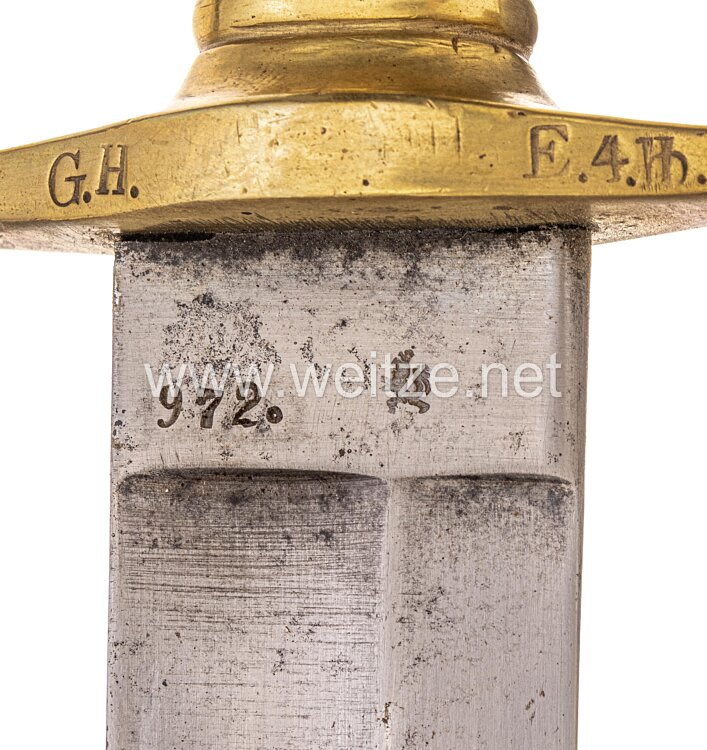
Grand Duchy of Hesse Artillery Fascine Knife circa 1855

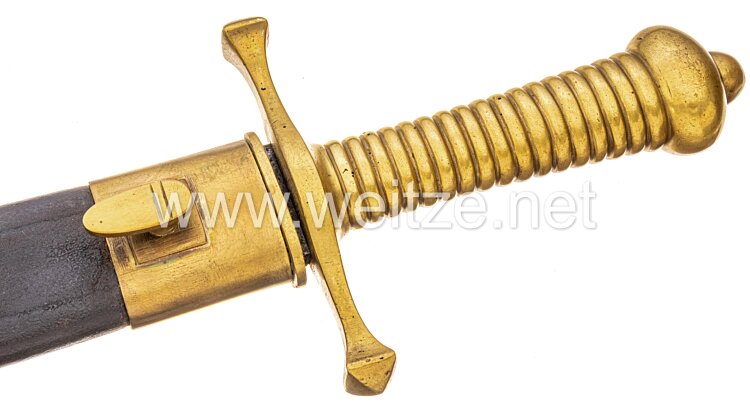
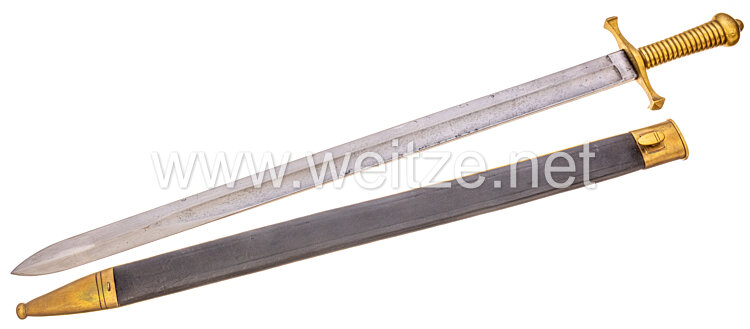
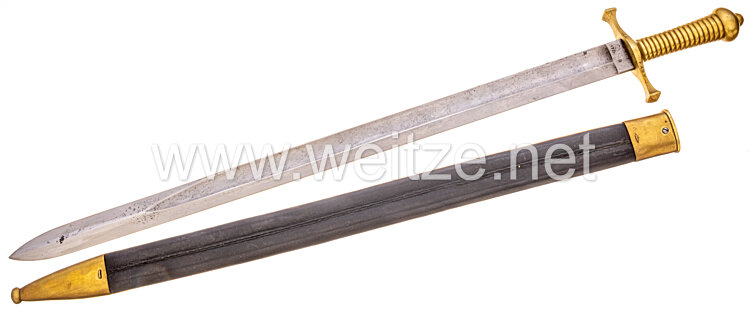
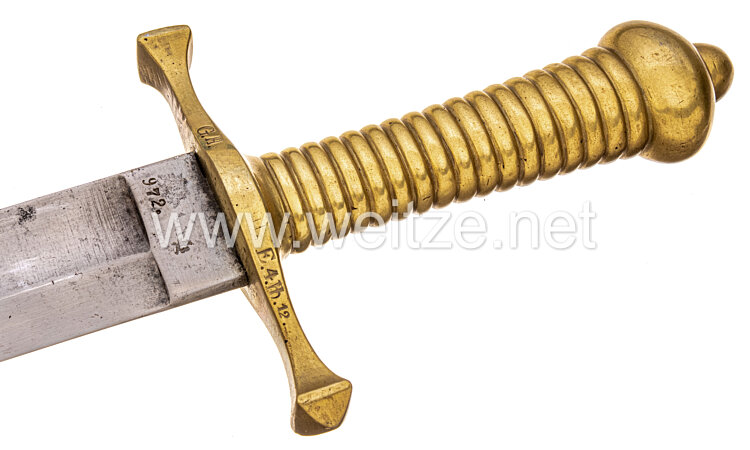
Clean and unshortened blade, with central point and wide fuller, stamped on the false edge with the Hessian lion and weapon number "972," one-piece brass hilt, the crossguard straight and ending in angular form, stamped "GH" and "E.4.II.12," with scabbard, the latter unmarked, somewhat shrunk, otherwise very well preserved. Condition 2
464928
1.600,00

Grand Duchy of Hesse Artillery Fascine Knife circa 1855

The Faschinenmesser (fascine knife) of the Grand Duchy of Hesse Artillery from the mid-19th century represents an important transitional type in the development of military edged weapons. These weapons, introduced around 1855, served the artillery not primarily as combat weapons but as versatile tools for technical and logistical tasks.

The Grand Duchy of Hesse, officially the Grand Duchy of Hesse and by Rhine, was a significant German middle state after the Congress of Vienna in 1815. The military organization of the Grand Duchy underwent several reforms in the 19th century, with artillery gaining particular importance as a technical branch. The Hessian army maintained several artillery regiments equipped according to the military standards of the time.

The term “Faschinenmesser” derives from fascines, bundles of brushwood or branches used in fortification construction and field work. These knives served for cutting branches, preparing wood for entrenchment work, manufacturing palisades, and other technical tasks. In the artillery, such tools were particularly important for preparing gun positions and road construction.

The marking on the false edge with the Hessian lion is characteristic of weapons from the Grand Duchy. The Hessian lion, a red-gold crowned lion with red claws on a silver field, was the heraldic animal of the Ludovingians and later of the Hessian princely houses. This marking served for clear identification as state property and military equipment.

The stamp “GH” stands for “Großherzogtum Hessen” (Grand Duchy of Hesse) and was a common marking for military property. The additional marking “E.4.II.12” indicates a specific military organizational structure, with such codes typically documenting assignment to companies, batteries, or equipment batches. The weapon number “972” enabled tracking of individual pieces in military registers.

The construction with a one-piece brass hilt was widespread during this era. Brass offered several advantages: it was more corrosion-resistant than iron, easier to work, and gave the weapon a representative appearance. The straight crossguard with angular ends corresponded to the functional design of the time, oriented toward practicality and robustness.

The wide fuller on the blade served to reduce weight without significant loss of stability. This constructive solution was standard for cutting weapons and large knives of the 19th century. The centered point enabled versatile applications, both for thrusting and cutting work.

The period around 1855 was a time of fundamental changes in European military affairs. The Crimean War (1853-1856) demonstrated the importance of modern artillery and technical equipment. The German states, including Hesse, modernized their armies and standardized equipment according to contemporary insights.

The artillery of the Grand Duchy of Hesse was later integrated into the structures of the North German Confederation (1866) and finally the German Empire (1871). After the foundation of the Reich, the Hessian units were incorporated into the Imperial Army as the XXV Army Corps, but initially retained their traditional uniforms and partly their equipment items.

Fascine knives of this type remained in use until the end of the 19th century but were increasingly replaced by specialized tools and pioneer equipment. They represent an era when the boundary between weapon and tool in military edged weapons was still fluid.

For collectors and military historians, Hessian militaria from this period are of particular interest as they document the military culture of a German middle state before the founding of the Reich. Preservation with the original scabbard, even showing signs of use, significantly increases historical value, as scabbards were frequently lost or replaced.

r