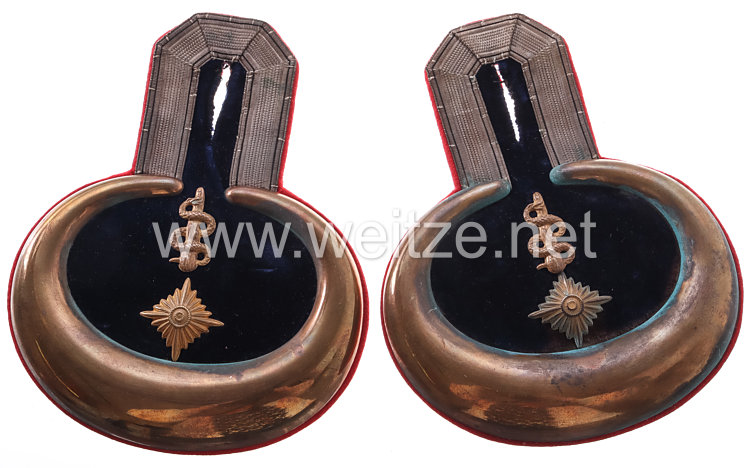
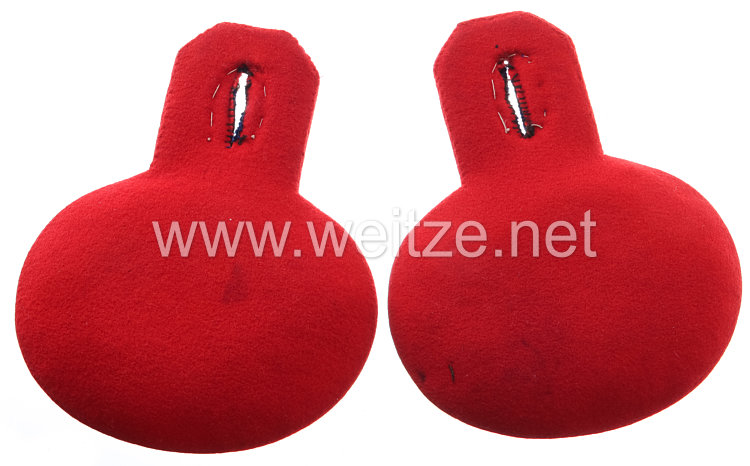
Prussia Pair of Epaulettes for a Senior Medical Officer

holding the rank of First Lieutenant. Large pattern circa 1890. Condition 2.


387527
350,00

Prussia Pair of Epaulettes for a Senior Medical Officer

This pair of Prussian epaulettes for a senior military physician (Oberarzt) holding the rank equivalent of a first lieutenant, dating from around 1890, represents a fascinating chapter in the military medical history of the German Empire. These rank insignia embody the complex hierarchy and organization of the Prussian medical service during an era of fundamental reforms in the military health system.

The Prussian military medical service underwent remarkable development during the 19th century. Following the experiences of the Wars of Liberation and particularly after the Franco-Prussian War of 1870-71, the central importance of professional medical care for troops was recognized. Medical officers received a special status that combined their academic training with military rank structures.

The rank designation Oberarzt (senior physician) in the Prussian army corresponded to the military grade of Oberleutnant (first lieutenant). This equivalence was clearly defined in Prussian rank lists and uniform regulations. An Oberarzt typically had completed medical studies and accumulated several years of service experience as an assistant physician or junior physician. The position carried considerable responsibility, as senior physicians were often independently responsible for the medical care of entire battalions or regimental units.

The epaulettes themselves were elaborately crafted rank insignia worn on both shoulders of the uniform. The large version from around 1890 was characterized by distinctive features: a curved, padded body covered with metallic bouillons (twisted metal threads), and fringes made of the same material. For medical officers, these were typically manufactured in silver-colored finish, distinguishing them from other branches of service. The base color of the backing was usually dark blue, corresponding to the service color of the medical corps.

The uniform regulations of this period were extremely precise. The Prussian Army ordinances specified exactly how epaulettes should be constructed: material, size, attachment method, and manner of wearing were regulated down to the smallest detail. The large version was worn with the full dress uniform, the society dress, and for special occasions, while simpler shoulder straps were provided for field service.

Around 1890, the German Empire under Kaiser Wilhelm II was in a phase of military expansion and modernization. The medical service benefited from the medical advances of the time, particularly through the discoveries of Robert Koch and other pioneers of bacteriology. Military physicians were not only troop doctors but also involved in the advancement of military medicine.

The social position of an Oberarzt was considerable. As both an academic and an officer, he belonged to the upper social class. The elaborate epaulettes underscored this status and were visible signs of membership in the officer corps. At social occasions, parades, and official receptions, medical officers wore their full dress uniforms with the magnificent epaulettes.

The manufacture of such epaulettes was carried out by specialized military equipment makers. Companies such as Gebrüder Wegerhoff in Berlin and other renowned manufacturers of military trimmings produced these rank insignia with precise handwork. The quality reflected the demands of the Prussian army for its representation.

Condition grade 2 indicates a well-preserved example that has survived the decades. This is remarkable, as these objects were made from delicate materials and were subject to both mechanical stress and deterioration through oxidation.

After the end of World War I in 1918 and the dissolution of the Imperial Army, these rank insignia lost their official function. The Weimar Republic introduced new, simpler uniforms. Nevertheless, these epaulettes remained significant as historical witnesses of a vanished era and are today preserved by collectors and museums as important military-historical documents.

These epaulettes provide insight into the professionalization of military medicine, the social structure of the Imperial officer corps, and the meticulous attention to detail that characterized Prussian military organization. They represent not merely decorative objects, but tangible evidence of a sophisticated system that sought to recognize and honor the medical profession within the military hierarchy.