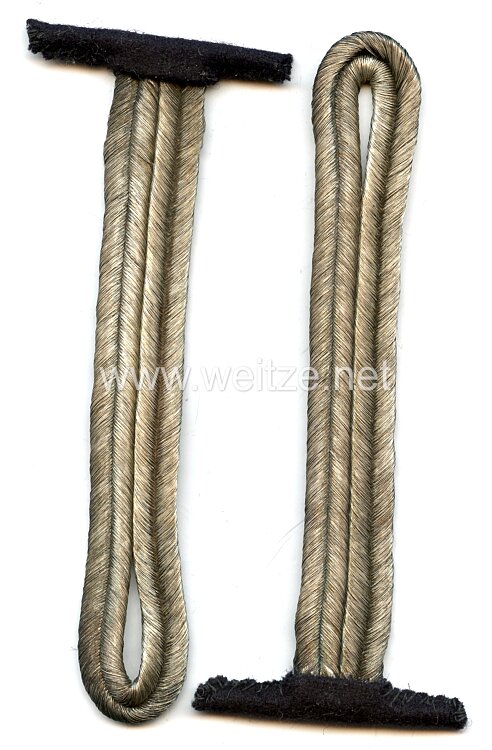
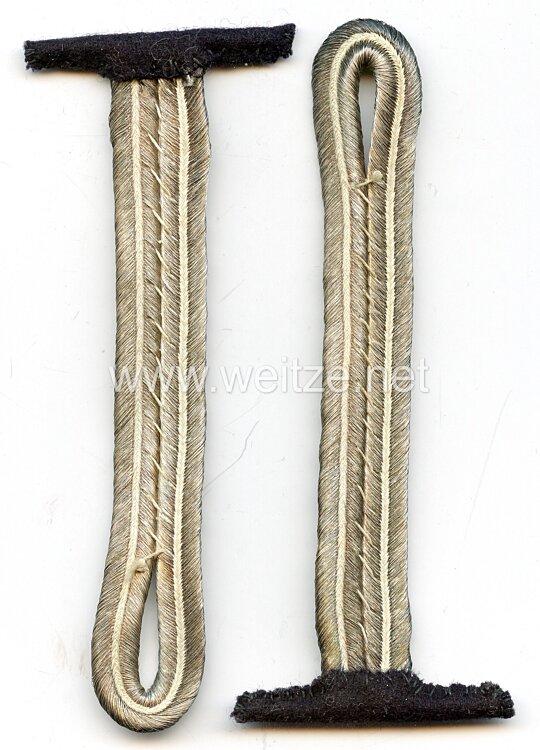
Kriegsmarine Pair of Shoulder Boards for an Ensign
These shoulder boards for a Fähnrich (Officer Cadet) of the Kriegsmarine represent a significant component of the rank insignia system of the German Navy during World War II. This pair of shoulder boards with fastening loops served to identify the rank of a Fähnrich, an officer candidate who was in the transitional phase between non-commissioned officer and lieutenant.
The Kriegsmarine, the official designation of the German Navy from 1935 to 1945, developed a complex system of rank insignia based on traditional maritime conventions but shaped by the specific requirements and ideology of National Socialist Germany. The establishment of the Kriegsmarine occurred on May 21, 1935, and marked the break with the restrictions of the Treaty of Versailles.
The rank of Fähnrich was introduced in the Kriegsmarine in 1936 and corresponded to the traditional officer candidate rank of the Imperial Navy. Fähnriche had completed their basic military training and were undergoing officer training. They already wore officer uniforms but were not yet fully part of the officer corps.
The shoulder boards with fastening loops were characteristic of the Kriegsmarine's rank insignia. The loop (Steg) referred to the fastening device that secured the shoulder board to the uniform jacket. The construction typically consisted of a padded base covered with dark blue or black cloth, corresponding to the navy's branch color.
For a Fähnrich, the shoulder boards displayed characteristic features: the base color was dark blue, with gold-colored edging and a gold button at the upper end. The specific design of the Fähnrich shoulder boards differed from those of higher and lower ranks through the combination of gold-colored elements and the still-absent rank stars of lieutenants.
The uniform regulations of the Kriegsmarine were detailed in various dress orders. The “Anzugsordnung für die Kriegsmarine” (M.Dv. Nr. 357) of 1938 and its later supplements precisely specified how shoulder boards were to be worn, in which uniform combinations they were used, and what specific features applied to each rank.
The manufacture of such shoulder boards was carried out by specialized military outfitters and tailors. High-quality examples were often privately procured, while standardized versions were issued through military channels. Quality could vary considerably depending on origin and time of manufacture. Toward the end of the war, material shortages and economic constraints led to simplified versions.
Condition 2 in militaria collecting terminology indicates a very well-preserved object with minimal signs of wear. This suggests that the shoulder boards were either lightly worn or carefully preserved.
Officer training in the Kriegsmarine was demanding and encompassed several years. After basic training as a recruit and time as a sailor, officer candidates attended the Naval Officer School. As Fähnrich, they completed practical training aboard ships and specialized in various areas such as navigation, weapons technology, or engineering.
The historical significance of such uniform items lies not only in their military function but also in their documentary value. They attest to the organizational structure, hierarchies, and material culture of the Kriegsmarine. For historians and collectors, they offer insights into the everyday reality of naval personnel and the importance of rank and status in the military society of the Third Reich.
Today, such objects are important study items for museums and military history research institutions. They help document and understand the history of the German Navy in World War II. At the same time, they require sensitive handling, as they are part of the history of a criminal dictatorship.