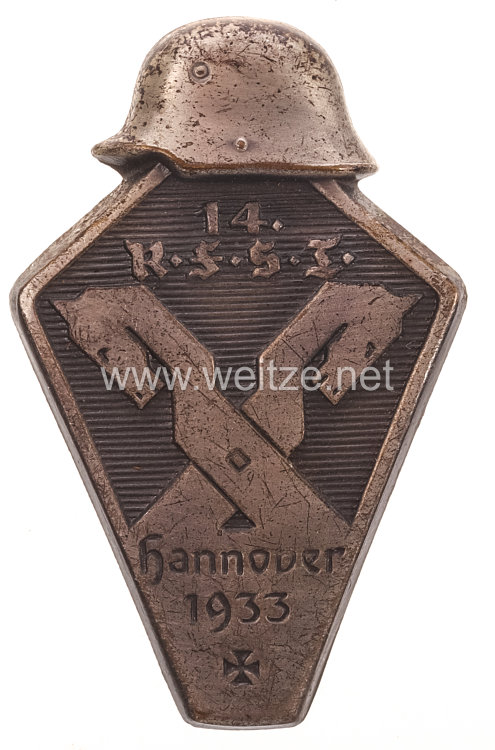
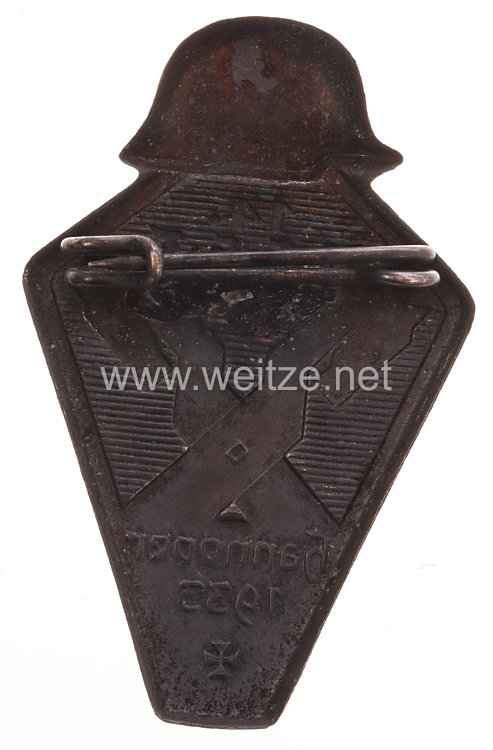
Stahlhelmbund - Meeting Badge - 14th R.F.S.T. Hannover 1933 (Reichsfrontsoldatentag)
Historical Context: Stahlhelmbund Rally Badge for the 14th Reichsfrontsoldatentag Hannover 1933
This tin badge documents a significant event in the history of German veteran organizations during the Weimar Republic: the 14th Reichsfrontsoldatentag (Reich Front Soldiers' Day) of the Stahlhelm - Bund der Frontsoldaten (Steel Helmet - League of Front Soldiers), which took place in Hannover in 1933. This year marked a decisive turning point both for the organization and for German history.
The Stahlhelmbund was founded on December 25, 1918, in Magdeburg by front officer Franz Seldte and developed into the largest veteran organization of the Weimar Republic. The name referred to the characteristic German steel helmet of World War I and was intended to symbolize the connection to front-line experience. The organization understood itself as a non-political soldiers' league but increasingly developed into a nationalist-conservative, anti-republican force.
The Reichsfrontsoldatentage were annual major events of the Stahlhelmbund, organized as mass rallies and demonstrations. These meetings served several purposes: fostering camaraderie among former front soldiers, political manifestation, and demonstration of military strength. These events often attracted tens of thousands of participants from across the Reich.
The year 1933 was of extraordinary historical significance. On January 30, 1933, Adolf Hitler was appointed Reich Chancellor, marking the end of the Weimar Republic and the beginning of the National Socialist dictatorship. The Stahlhelmbund, which had already previously represented nationalist and anti-democratic positions, now became caught up in the process of Gleichschaltung (forced coordination).
The 14th Reichsfrontsoldatentag in Hannover took place during this transitional phase. The event was characterized by political upheaval and the Stahlhelmbund's attempts to maintain its independence from the NSDAP. Franz Seldte himself had already entered Hitler's cabinet as Reich Minister of Labor in January 1933, illustrating the complex relationship between the Stahlhelmbund and the Nazi regime.
Rally badges like this one were characteristic commemorative and participation items for such events. They were typically made of tin, inexpensive to manufacture, and could be produced in large quantities. The badges were usually attached to clothing with a pin and worn during the event. They documented participation and later served as souvenirs.
The design of such badges typically followed a recognizable pattern: they contained information about the venue, year, and type of meeting. They were often adorned with symbolic elements referring to the front soldier tradition, such as stylized steel helmets, oak leaves, or military symbols.
After 1933, the gradual Gleichschaltung of the Stahlhelmbund took place. In April 1933, the organization was transformed into the “Nationalsozialistischer Deutscher Frontkämpferbund (Stahlhelm)” (National Socialist German Front Fighters' League). Younger members were transferred to the SA, while older members were absorbed into the so-called “Traditionsverband” (Traditional Association). In 1935, the independent organization was completely dissolved, and its members were integrated into various Nazi organizations.
For collectors and historians, such rally badges are important historical documents. They document not only the history of a specific organization but also the political and social transformation of Germany in the early 1930s. The year 1933 marked a particularly critical moment when traditional conservative and nationalist organizations were confronted with rising National Socialism.
The preservation of such objects in “condition 2” (which in collector terminology denotes good to very good condition) is remarkable, as these tin badges were susceptible to corrosion and damage due to their material and use. The pin attachment is also a characteristic feature of this time period.
Today, such objects serve historical research and education. They recall a time of profound political upheaval and the role that veteran organizations played in German history between the world wars. The badge for the 14th Reichsfrontsoldatentag 1933 in Hannover thus symbolically represents the end of an era and the beginning of one of the darkest periods in German history.