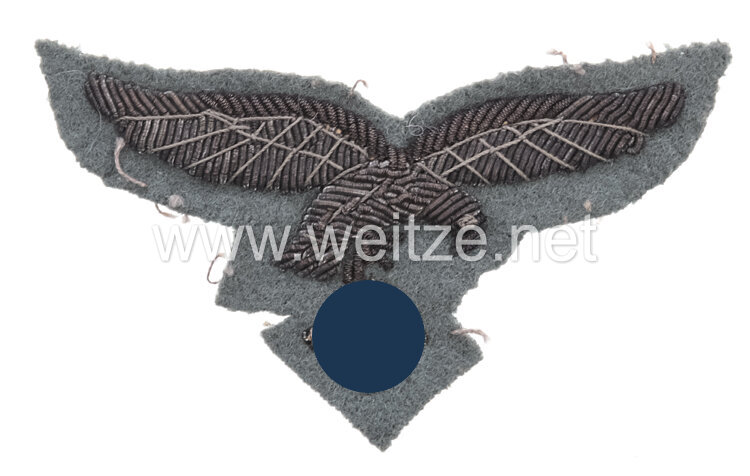
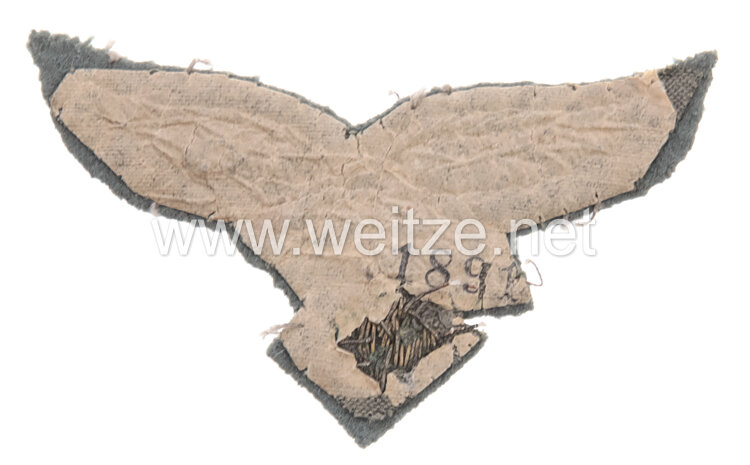
Prussian State Police "L. P.G. General Göring" Visor Cap Eagle for Officers

circa 1935. Early metal thread hand-embroidered version of the Luftwaffe eagle 1st model on field gray. Lightly worn, condition 2.
The Landespolizeigruppe General Göring existed from January 1934. In 1935, Göring was appointed Commander-in-Chief of the Luftwaffe. Since he wanted to retain control over his “favorite unit,” it was transferred to the Luftwaffe in September 1935 and renamed Regiment General Göring.
462426
850,00

Prussian State Police "L. P.G. General Göring" Visor Cap Eagle for Officers

This officer's visor cap eagle from the Prussian State Police, specifically the Landespolizeigruppe General Göring (State Police Group General Göring), represents a significant transitional piece in German military history of the 1930s. This early hand-embroidered metal thread version of the Luftwaffe eagle, 1st model on field-gray background documents the complex transformation of paramilitary police units into regular air force formations during the National Socialist rearmament phase.

The Landespolizeigruppe General Göring (L.P.G. General Göring) was formed in January 1934 from the consolidation of several Prussian police units. Hermann Göring, who had served since 1933 as Prussian Minister President and Reich Commissioner for the Prussian Ministry of the Interior, used his position to build a personal elite unit. This force was significantly better equipped and trained than normal police formations and carried a strongly military character from the beginning.

The uniforming of the Landespolizeigruppe reflected its special status. While formally belonging to the Prussian State Police, it already wore insignia that indicated its future destination. The eagle presented here already shows the typical design of the early Luftwaffe eagle, albeit still on the field-gray backing of the police uniform. These hand-embroidered metal thread versions were exclusively reserved for officers and differed significantly from the machine-made or woven variants worn by enlisted men and non-commissioned officers.

The artistic quality of these early officer embroideries was remarkable. Specialized workshops used fine aluminum or silver threads to depict the characteristic eagle with spread wings and the swastika in its talons. The embroidery was executed on a field-gray cloth backing, which was then sewn onto the visor cap. The effort involved in such handwork also explains the considerable price difference between officer and enlisted insignia.

In March 1935, Hitler publicly announced the reintroduction of universal conscription and the existence of the Luftwaffe, openly breaking the provisions of the Treaty of Versailles. Göring was appointed Commander-in-Chief of the Luftwaffe. However, as he did not want to relinquish control over his “favorite unit,” he ordered the transfer of the Landespolizeigruppe to the Luftwaffe in September 1935. It was renamed Regiment General Göring and formed the core of an elite unit that later expanded into the Division Hermann Göring and eventually the Fallschirm-Panzerkorps Hermann Göring (Parachute Panzer Corps Hermann Göring).

This organizational transformation explains the relative rarity of L.P.G. General Göring insignia. The unit existed under this name for only about eighteen months, from January 1934 to September 1935. Officers who wore such visor cap eagles had to adapt their uniforms and insignia accordingly after the transfer to the Luftwaffe. Many of the early police emblems were replaced with purely military Luftwaffe insignia, making original pieces from this transitional period sought-after collector's items today.

The visor cap itself was a central element of the German officer's uniform. It signaled rank and affiliation and was worn with great care. The eagle was prominently placed on the front of the cap, above the cap band and cockade. For the Landespolizeigruppe and later the Regiment General Göring, headgear held particular significance, as the unit placed great value on external appearance and discipline.

From today's historical perspective, such uniform items document the gradual militarization of German society in the 1930s. The conversion of police units into military formations was part of the systematic circumvention of Versailles Treaty provisions. Göring skillfully exploited the gray area between police and military to build combat-capable troops long before rearmament was officially announced.

The craftsmanship quality and condition of such insignia vary considerably. Pieces that were actually worn naturally show signs of use: the metal thread may be tarnished, the cloth backing may show wear, and the attachment stitching may show repairs. However, these signs of use confirm the authenticity and historical use of the object and in no way diminish its documentary value.

Collectors and historians value such transitional insignia particularly highly because they represent a specific, brief moment in history. They embody the organizational changes, the political maneuvering of the Nazi leadership, and the practical implementation of rearmament policies. Each such piece tells the story of an officer who served during this transformation period and witnessed the evolution from police formation to elite Luftwaffe unit.