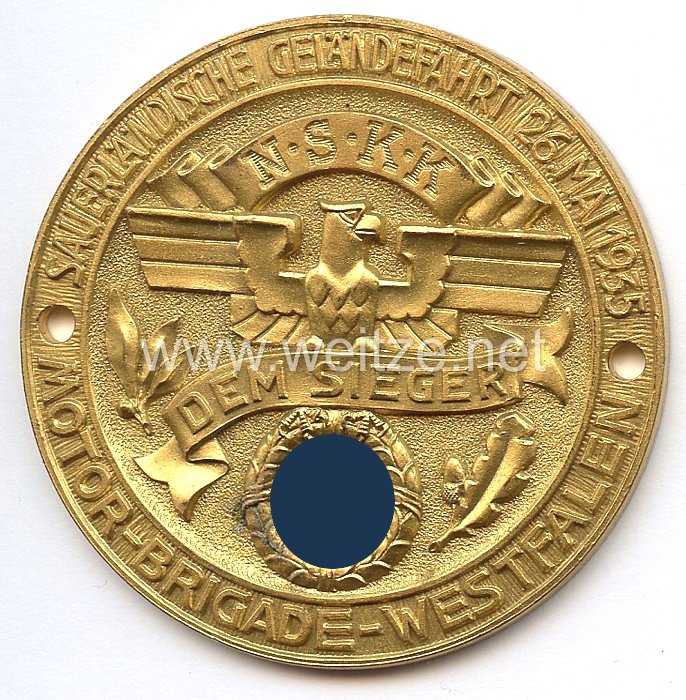
NSKK - Non-Wearable Winner's Plaque - “Sauerländische Geländefahrt 26. Mai 1935 - Motorbrigade Westfalen - Dem Sieger”

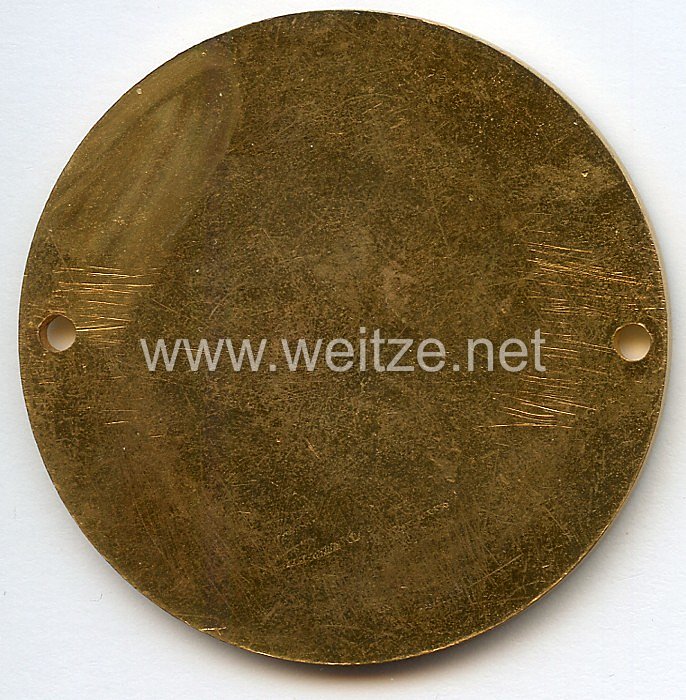
Silver-plated base metal, 55 mm, with 2 holes, condition 2.
338926
260,00

NSKK - Non-Wearable Winner's Plaque - “Sauerländische Geländefahrt 26. Mai 1935 - Motorbrigade Westfalen - Dem Sieger”

This NSKK winner's plaque documents a significant motorsport event from the Nazi era: the Sauerland Cross-Country Drive of May 26, 1935, organized by the Motor Brigade Westphalia of the National Socialist Motor Corps (NSKK).

The National Socialist Motor Corps (Nationalsozialistisches Kraftfahrkorps - NSKK) was founded on April 1, 1930, as a paramilitary organization of the NSDAP and developed into a significant formation within the Nazi state apparatus. Under the leadership of Corps Leader Adolf Hühnlein from 1931 onwards, the NSKK grew into an organization with over 500,000 members. Its main tasks consisted of promoting motor vehicle affairs, pre-military training, and organizing motorsports in the German Reich.

The Motor Brigade Westphalia was one of the regional divisions of the NSKK and encompassed the Westphalia region including the Sauerland area. These brigades were structured according to military models and subdivided into motor standards, storm units, and troops. They organized not only pre-military training but also numerous motorsport events that served both propaganda and practical purposes.

The cross-country drive as an event format held special significance within the NSKK. These competitions served not merely for entertainment but primarily for testing vehicles and training drivers under difficult conditions. The mountainous terrain of the Sauerland provided ideal conditions for such demanding orientation and skill drives. Participants had to maneuver their vehicles through rough terrain, requiring both technical understanding and driving skill.

The year 1935 marks a phase of consolidation and expansion of the NSKK. After the seizure of power in 1933, the organization had experienced enormous membership growth. The motorsport events served multiple purposes: they demonstrated the “efficiency” of the new regime, promoted motorization of the population, and simultaneously prepared personnel for military purposes. The cross-country drives were part of a comprehensive system of training events ranging from simple orientation drives to complex military exercises.

This non-wearable winner's plaque made of silver-plated non-ferrous metal with a diameter of 55 mm and two holes for attachment represents the typical award practice of the NSKK. Unlike wearable decorations that could be worn on the body, such plaques were intended for safekeeping or attachment to vehicles or display cases. The inscription “To the Winner” (Dem Sieger) indicates that this was the award for the overall winner of the event.

The production of such plaques was usually carried out by specialized manufacturers who collaborated with the NSKK. The use of silver-plated non-ferrous metal corresponded to the standards of the time for sporting awards and offered a cost-effective alternative to precious metals while maintaining a representative appearance.

The Motor Brigade Westphalia organized numerous such events throughout the 1930s. They were embedded in a dense network of NSKK activities, which also included traffic education, technical training, and cooperation with the Wehrmacht. After the beginning of World War II in 1939, many NSKK members were drafted into military transport and supply units, where their motorized training proved useful.

From a historical perspective, such objects are important witnesses to the Nazi era. They document the penetration of all areas of life by National Socialist organizations and the instrumentalization of sports for political and military purposes. At the same time, they provide insight into regional history and the everyday culture of the period.

Today, such NSKK objects are significant contemporary historical sources for researching the NS organization, the history of motorization, and the paramilitary structures of the Third Reich. They are found in museums, archives, and private collections and serve historical education and enlightenment about this dark epoch of German history.