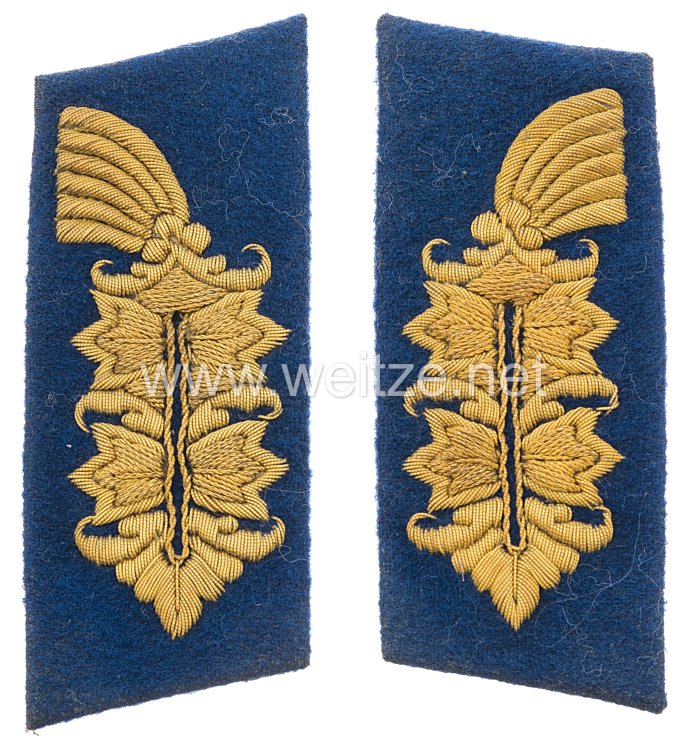
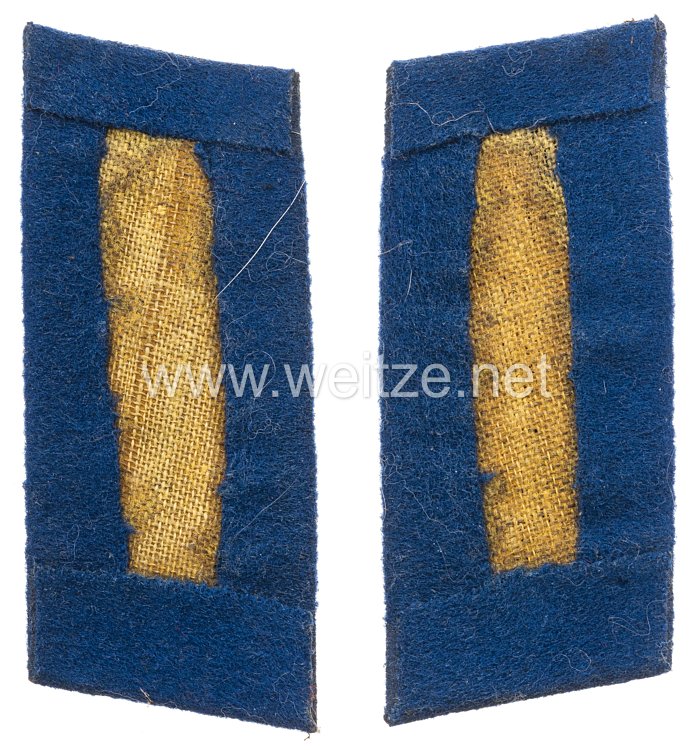
Kriegsmarine Pair of Collar Tabs for Admirals of the Naval Ground Forces and Coastal Artillery
Extremely rare, in over 30 years this is only the 3rd pair we have been able to offer.
These collar patches for Admirals of the Naval Ground Forces and Coastal Artillery of the Kriegsmarine represent an extraordinarily rare example of rank insignia for the highest-ranking naval officers during World War II. Manufactured around 1943, these insignia were designed for the field tunic and document the complex organizational structure of German naval forces during the later war period.
The Kriegsmarine, which emerged from the Reichsmarine in 1935, developed a sophisticated system of rank insignia and uniform components throughout its existence. While traditional naval officers conducted their duties aboard ships and at naval bases, the increasing importance of coastal defense and land-based naval operations required special uniform elements for admirals serving in these capacities.
The Naval Ground Forces and Coastal Artillery formed essential components of German naval warfare. The coastal artillery was responsible for defending strategically important coastal sectors, harbors, and naval bases. As the war progressed, this area gained increasing significance, particularly within the framework of the Atlantic Wall and the defense of occupied coastal territories in Norway, France, and the Netherlands.
The technical execution of these collar patches is remarkable: they are hand-embroidered in Cellon, a technique in which the base material was treated with a celluloid-like substance to achieve a glossy, water-repellent surface. This manufacturing method was elaborate and labor-intensive, underscoring the high status of the wearers. The cornflower blue base color corresponded to the traditional service color of naval artillery and distinguished these units from other naval branches.
The use on the field tunic is of particular historical significance. While admirals at sea and in ceremonial contexts wore the traditional dark blue naval uniform, land-based deployments, particularly during inspections of coastal fortifications or service at forward command posts, required more practical uniforms. The field tunic offered greater functionality under combat conditions and in adverse weather.
The rarity of these collar patches can be explained by several factors. First, the number of admirals in the Kriegsmarine was fundamentally limited. The rank structure comprised only a few dozen officers at admiral rank, and even fewer were specifically assigned to Naval Ground Forces or Coastal Artillery. Second, these special collar patches were only needed for certain uniform variants, further reducing production numbers.
The dating to approximately 1943 is historically significant. At this time, the strategic situation of the Kriegsmarine had fundamentally changed. After losses in the Battle of the Atlantic and increasing Allied air superiority, the focus partially shifted from offensive fleet operations to defense. Coastal artillery played an increasingly important role in repelling Allied landing operations and protecting strategically vital harbors.
The Army and Navy Regulation Gazettes regulated uniform regulations and rank insignia in detail. Collar patches had to meet precise specifications regarding size, embroidery pattern, and coloring. The quality of hand embroidery and use of high-quality materials even in the late war phase demonstrate the importance attributed to military tradition and hierarchy.
The unworn condition of these collar patches is exceptional. Many military insignia from this period were either worn and show corresponding signs of use, or they were destroyed after the war's end. The survival of a complete pair in nearly mint condition over almost eight decades is remarkable and significantly increases their historical and documentary value.
These collar patches are not merely military rank insignia but also testimonies to German craftsmanship and the complex organizational structure of a modern navy. They document specialization within the armed forces and the adaptation of traditional naval uniforms to the requirements of land warfare. For collectors and historians, they offer a rare insight into an often-overlooked aspect of Kriegsmarine history—the role of admirals in land-based maritime operations.
The hand-embroidered execution in Cellon represents a manufacturing technique that required considerable expertise. Specialized craftsmen, often working in established military tailoring firms or naval workshops, created these insignia. The precision of the embroidery and the durability of the materials testify to the high standards maintained even as Germany's war economy faced increasing strain. These collar patches thus represent not only military hierarchy but also the persistence of traditional craftsmanship in wartime production.