Luftwaffe Civil Pilot Badge
The Civil Pilot's Badge of the Luftwaffe represents a fascinating document of German aviation history between 1933 and 1945. This award embodies the close connection between civil aviation and military flying in National Socialist Germany, a relationship that is central to understanding German rearmament policy in the 1930s.
Following the Treaty of Versailles in 1919, Germany was prohibited from maintaining a military air force. Civil aviation nevertheless continued to develop, and many pilots received their training in civil flight schools and sport flying associations. These organizations often served as cover for the secret training of future military pilots. With the Nazi seizure of power in 1933 and the official establishment of the Luftwaffe in March 1935 under Hermann Göring, this covert military preparation was transformed into open rearmament.
The Civil Pilot's Badge was introduced to honor pilots who held civil flight licenses but simultaneously belonged to or were connected with the Luftwaffe. It symbolized the recognition of flying skills that were significant in both civil and military contexts. The badge was typically worn on uniforms and served as a visible sign of qualified pilot training.
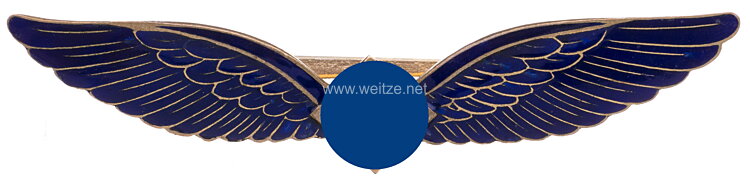
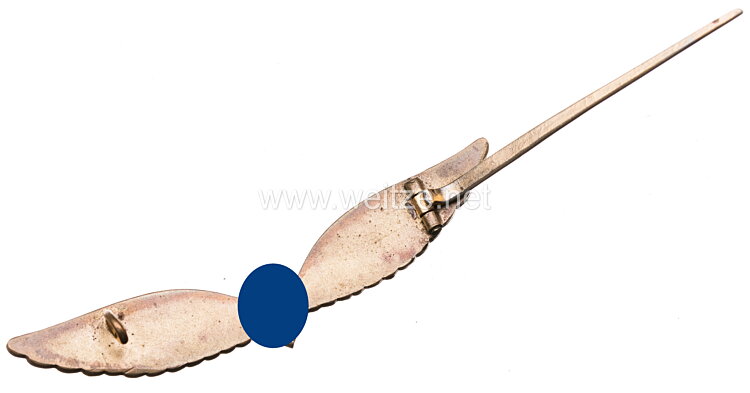
The design of the badge follows the classic German aviation tradition: a central motif framed by curved wings. The present example shows wings in blue enamel, indicating the higher-quality variants of this award. The use of gilded base metal and enamel work was characteristic of high-quality badges from this era. The broad pin on the reverse allowed secure attachment to the uniform.
The manufacturer C.E. Juncker Berlin SW was among the most prestigious producers of military awards in the Third Reich. The company, based in Berlin-Southwest, manufactured numerous orders, decorations, and badges for the Wehrmacht and Luftwaffe. Juncker products were known for their excellent craftsmanship and faithful execution of detail. Interestingly, the described piece bears no maker's mark, although the production is attributed to Juncker. This was not unusual, as not all badges were required to be marked, and experts can often identify Juncker work by characteristic manufacturing features, materials, and construction details.
The blue enameling of the wings is a special feature that distinguishes this badge from purely military pilot badges. While military versions were often silver-colored or white enameled, the blue coloring indicated the civil component. This color differentiation helped to distinguish at first glance between different qualifications and areas of use.
The historical context of these badges is closely linked to the mobilization of German air forces. Many wearers of such awards were initially civil pilots who were later transferred to military service. Deutsche Lufthansa and other civil aviation companies served as recruitment and training reservoirs for the expanding Luftwaffe. Pilots who possessed both qualifications were particularly valuable, as they could be used for both transport and liaison flights as well as military operations.
The stated condition 2 (lightly worn) indicates that this badge was actually used but shows no significant signs of wear. Traces of wear can provide valuable clues to authentic use and are often more interesting to collectors and historians than unworn pieces, as they establish a direct connection to historical persons and events.
After World War II, all National Socialist decorations were banned by the Allies. The wearing of such badges was initially completely prohibited in Germany. Today, these objects are important witnesses to military and aviation history and are preserved in museums, collections, and for research purposes. They serve historical education and help to understand the complex structures and developments of German aviation during the Nazi period.
For the scientific evaluation of such objects, material science investigations, comparisons with documented examples, and knowledge of historical manufacturing processes are essential. Attribution to specific manufacturers such as Juncker is made through analysis of construction features, material composition, and craftsmanship characteristics that were typical of individual manufacturers.
These badges remain significant artifacts for understanding the interplay between civil and military aviation in Nazi Germany, the circumvention of Versailles Treaty restrictions, and the systematic preparation for war that characterized the 1930s. They represent a unique category of award that reflected the dual nature of German aviation policy during this period.