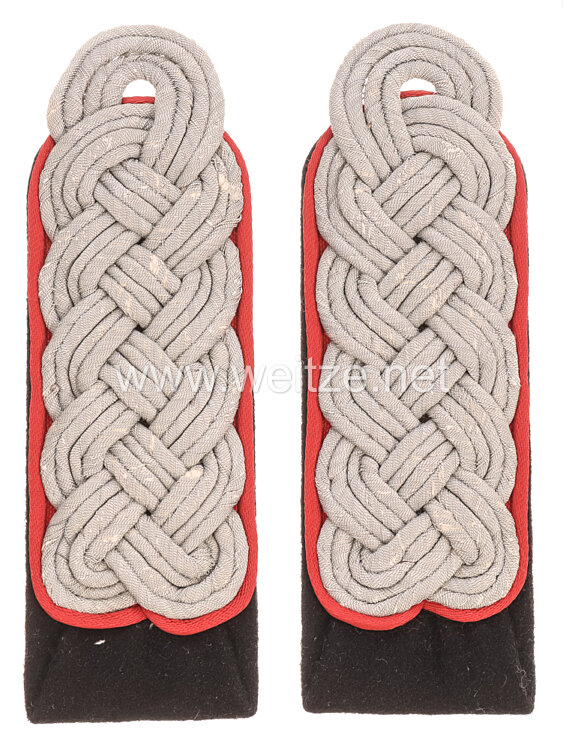
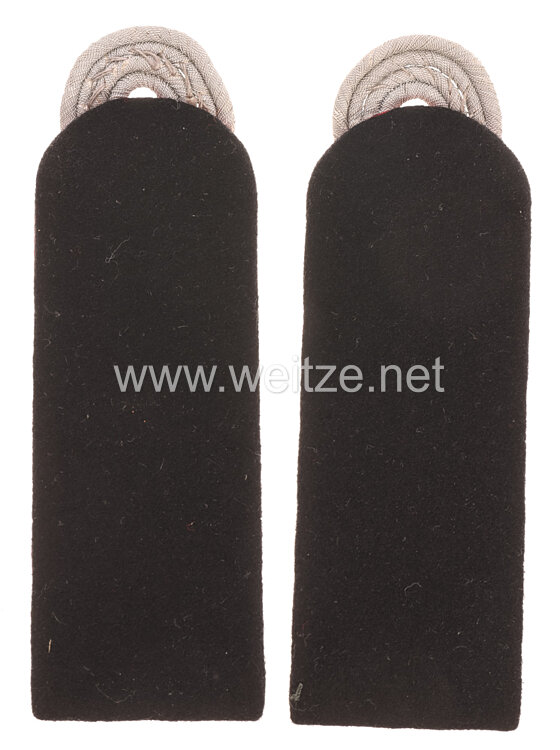
Waffen-SS Pair of Shoulder Boards for an SS-Sturmbannführer of the Artillery
The shoulder boards described here for an SS-Sturmbannführer of the Artillery in the Waffen-SS represent a characteristic example of the rank insignia used during World War II by the armed formation of the Schutzstaffel. These shoulder boards in matte finish were designed for the field tunic and display the typical branch color red, which was assigned to the artillery.
The rank of SS-Sturmbannführer corresponded to a major in the Wehrmacht military hierarchy. This officer rank was introduced in 1934 and remained in use until the end of the war in 1945. Holders of this rank typically commanded a battalion or assumed staff functions in higher formations. In the artillery, SS-Sturmbannführer were frequently deployed as battalion commanders or in leading positions within artillery regiments.
The rank insignia of the Waffen-SS differed significantly from those of the Wehrmacht, although both organizations had comparable rank structures. The Waffen-SS shoulder boards were designed to be sewn in and were attached to the M40 field tunic and later models. The matte finish was particularly intended for front-line use, as shiny insignia posed a security risk in combat and could mark officers as preferred targets for enemy snipers.
The branch colors within the Waffen-SS followed a sophisticated system for identifying different troop types. The color red was exclusively reserved for artillery, as was also customary in the Wehrmacht. This tradition of branch colors dated back to the 19th century and was practiced by most European armies. Other branch colors of the Waffen-SS included white for infantry, pink for armored reconnaissance, and golden yellow for cavalry and mounted units.
The artillery of the Waffen-SS played an important role in the various SS divisions. Each complete SS division had an artillery regiment, typically consisting of several battalions. These units were equipped with various calibers, from light 10.5 cm field howitzers to heavy 15 cm guns. Artillery officers required specialized training, which was conducted in SS-run schools, although Wehrmacht artillery schools could also be utilized.
The shoulder boards presented here are in unworn condition, suggesting they were never taken into active service. This was not unusual, as large quantities of uniform parts and insignia were produced toward the end of the war that could no longer be issued due to the course of the war. The production of uniform effects was carried out by various manufacturers who worked according to strict specifications from the SS leadership.
Authenticating such pieces requires detailed knowledge of manufacturing methods, materials, and construction features. Original Waffen-SS shoulder boards were made from cloth backing on which aluminum braids or trims were attached in specific patterns. For an SS-Sturmbannführer, these typically consisted of four pipings or cords that indicated officer rank. The base color was field gray or dark green, with the corresponding red branch color as backing.
The historical significance of such objects today lies primarily in their documentary value for military history. They enable researchers and historians to reconstruct and understand the organizational structure, hierarchy, and uniform regulations of the Waffen-SS. At the same time, they require sensitive and critical engagement with the history of the SS as part of the National Socialist apparatus of violence.
The Waffen-SS was formed in 1939/40 from various armed SS units and grew to approximately 38 divisions by the end of the war. Despite its nominal independence, it was subject to the operational command of the Wehrmacht in combat operations, while administrative and personnel control remained with the SS leadership under Heinrich Himmler. The organization was involved in numerous war crimes and was classified as a criminal organization at the Nuremberg Trials.
Understanding these artifacts requires placing them within their proper historical context, recognizing both their material characteristics and the dark chapter of history they represent. They serve as tangible reminders of the military structure of one of the most notorious organizations of the Third Reich.