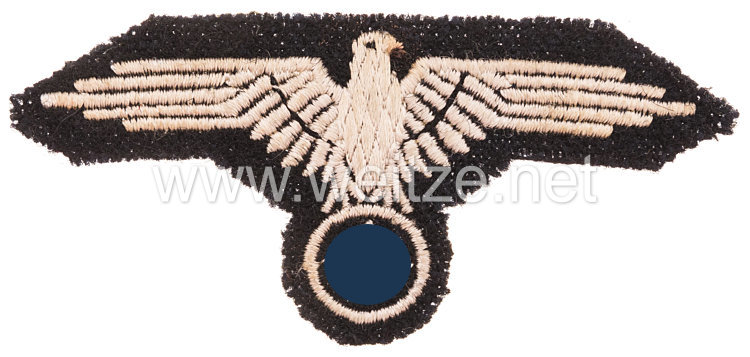
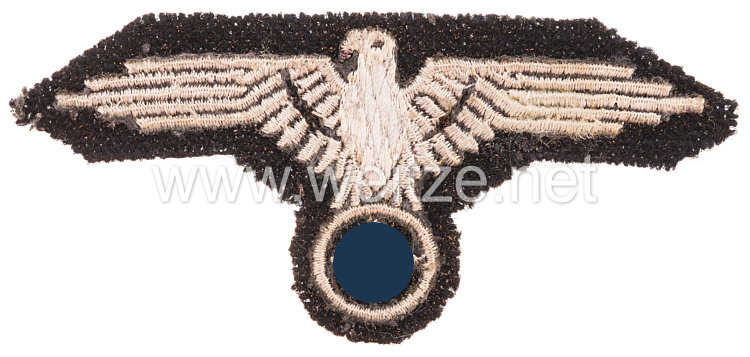
Waffen-SS Enlisted Ranks Sleeve Eagle
The Waffen-SS sleeve eagle for enlisted men represents a characteristic insignia of the National Socialist military organization, worn as part of the uniform between 1940 and 1945. This machine-embroidered version from around 1942 represents a specific production period during which manufacturing processes were increasingly rationalized due to wartime resource shortages.
The Waffen-SS was formally established in 1940 as the armed wing of the Schutzstaffel (Protection Squadron), after its predecessor units had already been deployed in the campaigns of 1939 and 1940. The uniforming and insignia regulations of this formation differed in essential details from the regular Wehrmacht. The sleeve eagle was one of the characteristic identifying features, worn on the right upper arm and symbolizing membership in the SS.
Machine embroidery as a manufacturing technique gained increasing importance during the course of the war. While early sleeve eagles were often produced in more elaborate hand embroidery or better material quality, wartime circumstances from 1941/42 onward led to simplified production methods. Machine manufacturing allowed for faster and more cost-effective production while maintaining standardized quality. These specimens were typically embroidered on cloth backing and displayed the traditional national emblem with spread wings and swastika.
The designation “for enlisted men” refers to the rank hierarchy within the Waffen-SS. The insignia system was strictly organized according to ranks. While enlisted men wore sleeve eagles on field-gray or black cloth, non-commissioned officers and officers sometimes used versions with silver-colored thread or on different base materials. This differentiation served the immediate recognition of rank structure.
The dating “around 1942” falls within a significant phase of World War II. At this time, the Waffen-SS expanded considerably, both numerically and in its operational significance. The increasing size of the formation required correspondingly large quantities of uniform components and insignia. Various manufacturers, both in Reich territory and in occupied areas, produced these insignia, leading to different execution variants.
The “unworn” condition is noteworthy for such objects, as most sleeve eagles were sewn onto uniforms and worn. Unworn specimens either remained as warehouse stock, were no longer needed, or came from remaining inventory after the war's end. They offer collectors and researchers the opportunity to study the original manufacturing quality and coloration without the alterations caused by wear, weather exposure, or cleaning.
The mentioned “interesting variant” suggests peculiarities in execution that could certainly occur in standardized mass production. Differences could manifest in details such as thread quality, stitch density, exact formation of the eagle, size, or cloth backing. Such variations resulted from different manufacturers, production periods, or specific order series.
From a historical perspective, such uniform components today are testimonies to a dark epoch of German history. The Waffen-SS was not only a military formation but an integral part of the National Socialist apparatus of oppression and extermination. Its units were involved in numerous war crimes and crimes against humanity. The scientific examination of such objects serves historical reappraisal and documentation, not glorification.
For military historical research, such insignia offer important insights into production methods, resource allocation, uniforming regulations, and the material culture of World War II. They also document the systematic symbolic politics of the Nazi regime, which visualized affiliation and hierarchy through uniform identification.
The preservation and study of these artifacts in museums, archives, and research institutions serves educational purposes, helping contemporary and future generations understand the mechanisms of totalitarian systems and the importance of defending democratic values and human rights.