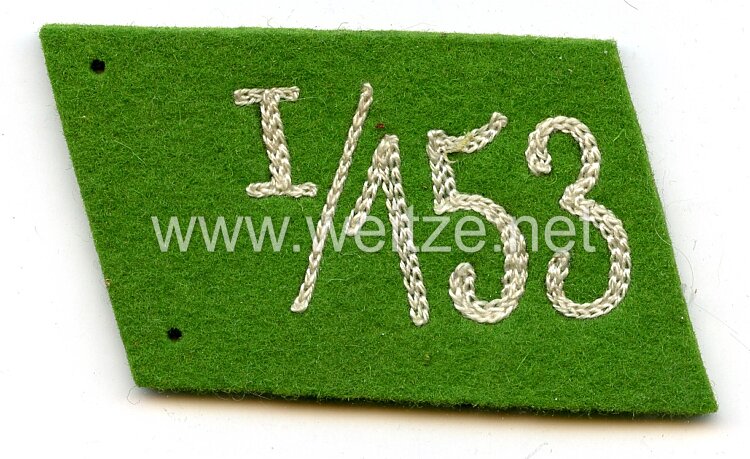
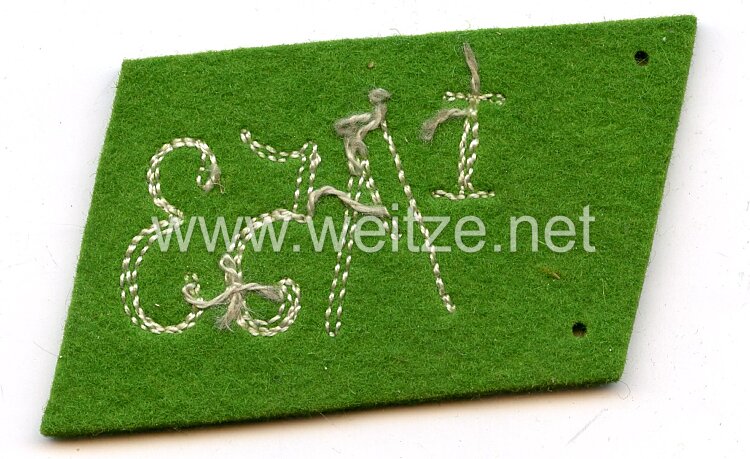
SA Single Collar Tab for Enlisted Men SA-Gruppe Thüringen Sturmbahn I of Standarte 153
This SA collar tab (Kragenspiegel) for enlisted men of SA-Gruppe Thüringen, Sturmbahn I of Standarte 153, represents a significant document of the uniform history of the Sturmabteilung (SA) during the National Socialist era. This piece of equipment in the characteristic color apple green (Apfelgrün) belonged to the standard uniform of SA members in the Gera area of Thuringia.
The Sturmabteilung was founded in 1920/21 as the paramilitary combat organization of the NSDAP and developed into a mass organization with several million members by 1934. The SA played a central role in the Nazis' rise to power, particularly through street fighting, intimidation of political opponents, and enforcement of National Socialist claims to power. After the so-called “Röhm Affair” in June 1934, however, the SA lost considerable political significance.
The organization of the SA followed a strictly hierarchical structure modeled on military formations. The Reich territory was divided into various SA-Gruppen (SA Groups), which were further subdivided into brigades, standards (Standarten), storm battalions (Sturmbanne), and storms (Stürme). The SA-Gruppe Thüringen was established as an independent administrative unit in 1931 and comprised several standards in the Thuringian region. Standarte 153, based in Gera, was among the local units of this group.
The SA uniform developed from the early 1920s and was characterized by the distinctive brown shirt, which gave the organization the nickname “Brownshirts.” Among the most important uniform components were the collar tabs, which served to identify membership in specific units. These insignia were worn in pairs on the shirt collar and enabled quick identification of rank and unit affiliation.
The coloring of the collar tabs followed a precisely defined system established in the SA uniform regulations. Each SA-Gruppe had its own group color worn on the collar tabs. For SA-Gruppe Thüringen, this was apple green, a light yellowish-green that distinguished this group from other SA formations. Other SA groups wore different colors such as bright red, light blue, dark blue, orange, or white.
The present collar tab is intended for enlisted men (Mannschaften), meaning SA members without leadership rank. This is evident from the simple design without additional rank insignia. The perforation served to attach the actual collar tab insignia, which in the SA typically consisted of a stylized wolf's hook or other symbols referring to the standard.
The designation Sturmbahn I of Standarte 153 indicates a specific subdivision. A Standarte roughly corresponded to a regiment and comprised several Sturmbanne. A Sturmbann, in turn, consisted of several Stürme (companies) and was commanded by a Sturmbannführer. The Roman numeral I identifies the first Sturmbahn within Standarte 153.
The specified location of Gera in Thuringia was an important center of SA activities in the region. Gera, as a significant industrial city, provided the SA with a recruitment field among workers and formed a focal point of National Socialist power expansion in Thuringia, which was regarded early on as a National Socialist model state.
The unworn condition of this collar tab is noteworthy and suggests that the piece was either produced as a reserve or never came to be issued. Many SA uniform items were produced in large quantities, particularly during the phase of rapid growth of the organization between 1930 and 1934.
After World War II, SA uniforms and insignia were treated by the Allies as symbols of National Socialism. In Germany today, the public display of SA symbols is generally prohibited under the Criminal Code (§86a StGB), with exceptions for scientific, historical, and educational purposes.
Such objects today possess primarily historical documentary value for researching the Nazi era, uniform studies, and the history of paramilitary organizations. They serve as material witnesses to a dark epoch of German history and serve as reminders for critical examination of the past.