Prussia Single Shoulder Strap for a Military Building Registrar
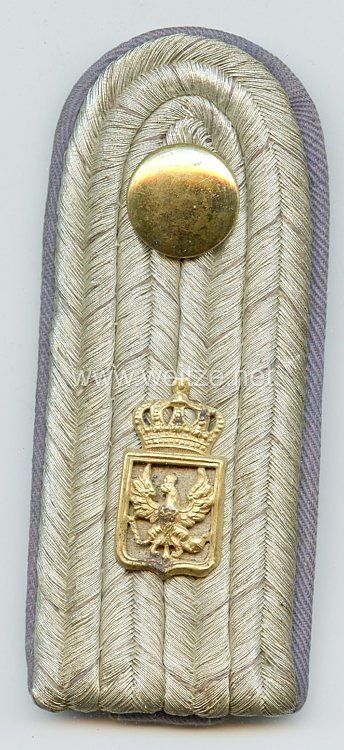
This Prussian single shoulder strap for a Military Construction Registrar from around 1914 represents a fascinating category of military rank insignia from the German Empire. This specialized form of service insignia was part of the complex system used to identify various ranks and functions within the Prussian military administration.
Military construction officials formed an important, though often overlooked, group within the Prussian armed forces. They were responsible for planning, supervising, and administering all military construction projects, from barracks to fortifications, training grounds, and military infrastructure projects. The Construction Registrar (Bauregistrator) was a mid-level administrative official who maintained registers, managed files, and performed administrative duties in the construction sector. This position required both technical understanding and bureaucratic competence.
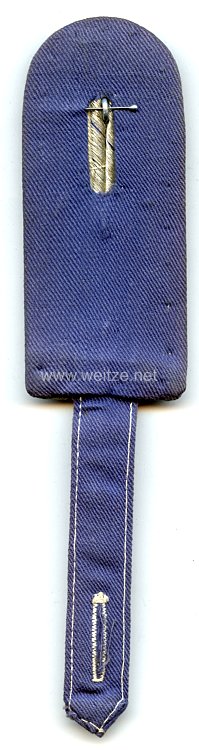
The shoulder strap is distinguished by its silver braid with blue threads, a color combination typical of middle-ranking officials. The cornflower blue base color held particular significance in Prussia – cornflower blue was considered one of the traditional Prussian colors and was frequently used on tunics and uniform parts. The choice of this color for the cloth backing signified membership in the Prussian state service.
The applied civil service eagle was the central identifying feature that distinguished officials from active officers and soldiers. The Prussian civil service eagle typically displayed the eagle in a specific design that differentiated it from eagles of other Imperial territories and from military eagle representations. This symbolism referenced the authority of the Prussian state and the special status of civil servants, even when serving in a military context.
The epaulette or shoulder strap as a rank insignia had a long tradition in the Prussian army dating back to the 18th century. Originally, shoulder straps had a practical function: they prevented shoulder straps of rifles and knapsacks from slipping off the shoulder. Over time, however, they evolved into pure rank insignia whose material, color, and design were precisely regulated by military clothing regulations.
Around 1914, on the eve of World War I, the Prussian military system was at the height of its organizational complexity. The army comprised not only combat troops but an enormous administrative system with numerous specialized categories of officials. The Royal Prussian Army Administration employed thousands of civilian and military officials responsible for supply, construction, medicine, veterinary services, justice, and many other areas.
The production of such shoulder straps was carried out by specialized military equipment manufacturers who had to maintain strict quality standards. The silver braid was crafted in elaborate handwork using genuine silver or silver-plated material. The processing required considerable craftsmanship, and the quality of the braiding was a sign of the piece's value.
The condition described in the object as “somewhat faded” is typical for textile militaria of this period. While cornflower blue dye was relatively lightfast, color changes are inevitable after more than a century. This does not diminish the historical value of the object but rather confirms its authenticity and age.
The period around 1914 also marks the end of an era. With the outbreak of World War I, German military uniforms changed fundamentally. The colorful, detailed uniforms of the pre-war period gave way to more practical field-gray versions. Many of the elaborate rank insignia were simplified or replaced by more discreet variants. Shoulder straps like the present one were increasingly worn only with parade uniforms or for garrison duty.
After the November Revolution of 1918 and the end of the monarchy, these Prussian rank insignia lost their official function. The new Reichswehr developed its own system of rank insignia that, while drawing on traditions, was designed much more simply. Today, such shoulder straps are valuable historical documents providing insight into the complex hierarchy and organization of Imperial military affairs.
For collectors and historians, such objects offer important information about the social structure and administrative organization of the German Empire. They demonstrate that the military was far more than just a combat organization – it was a comprehensive administrative apparatus requiring numerous specialized professionals whose status was made visible through precisely defined rank insignia.