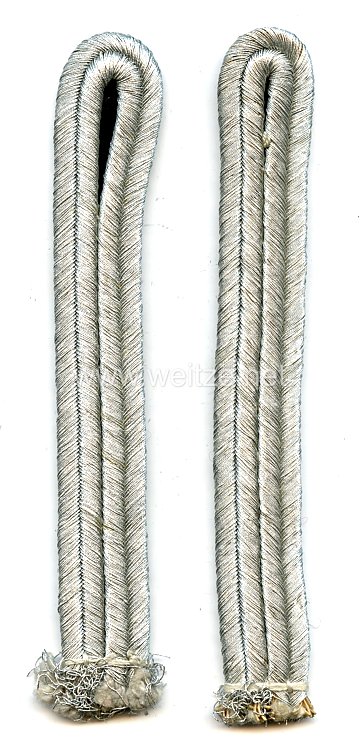
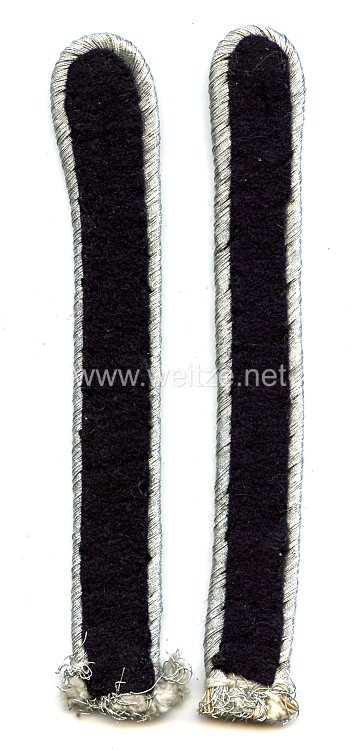
Kriegsmarine Pair of Shoulder Boards for a Fähnrich (Officer Candidate)
The shoulder boards for a Fähnrich of the Kriegsmarine described here represent an important element of the rank insignia of the German Navy during World War II. These sew-in shoulder straps bear witness to the complex hierarchy and uniform regulations of the Kriegsmarine between 1935 and 1945.
The rank of Fähnrich (Officer Candidate) formed a significant intermediate stage in the officer career path of the Kriegsmarine. Fähnriche were officer candidates who had already completed their basic training and were on the path to becoming Leutnant zur See (Lieutenant Junior Grade). This position roughly corresponded to today's officer candidate and typically involved a training period of approximately two to three years.
The uniform regulations of the Kriegsmarine were governed by the “Anzugsordnung für die Kriegsmarine” (Naval Dress Regulations, M.Dv. Nr. 100), which was first published in 1936 and updated several times. These regulations specified in detail how rank insignia were to be worn and from what materials they were to be made. Shoulder boards for Fähnriche were characteristically distinguished by their specific design: they consisted of dark blue cloth as a base and featured gold trim and a gold button.
The sew-in design of these shoulder boards indicates that they were intended for regular service uniforms. Unlike the removable shoulder straps used on certain uniform types, sewn-in shoulder boards were permanently attached to the uniform tunic. This was particularly common on the dress tunics of the Kriegsmarine, which were worn for parades and formal occasions.
The production of such rank insignia was typically carried out by specialized military equipment manufacturers. Well-known manufacturers included companies such as Erel in Berlin, Wilhelm Deumer in Lüdenscheid, and C. E. Juncker in Berlin. The quality of workmanship varied depending on the manufacturer and the time of production. Toward the end of the war, material shortages became increasingly apparent, which was reflected in the quality of rank insignia.
The path to Fähnrich typically began with acceptance as a Seekadett (Naval Cadet). After successful basic training and passing examinations, promotion to Fähnrich zur See followed. This promotion was associated with the award of the characteristic dagger, the Fähnrich's dirk. Training included both theoretical knowledge in navigation, weapons technology, and seamanship, as well as practical experience on training vessels.
The Kriegsmarine as a branch of the Wehrmacht was founded in 1935 and replaced the Reichsmarine of the Weimar Republic. Under the leadership of Grand Admiral Erich Raeder and later Karl Dönitz, it grew into a significant naval power. The uniforms and rank insignia followed traditional maritime conventions, some of which dated back to the Imperial Navy.
The dark blue color for the basic uniform was a long tradition in the German Navy. The gold insignia for officers and officer candidates were intended to distinguish them from enlisted ranks, who wore silver or white insignia. This color scheme had both practical and representative reasons and followed international maritime customs.
After 1945, such Kriegsmarine uniform items were frequently confiscated or destroyed by the Allied occupation forces. Surviving examples were often kept by former soldiers as mementos or later found their way into collections. Today, authentic Kriegsmarine rank insignia are sought-after military-historical objects that represent important testimonies of German naval history.
The condition of such historical objects is typically evaluated according to a scale, with various factors such as preservation, completeness, and authenticity playing a role. Military-historical research uses such artifacts to reconstruct uniform regulations and document the material culture of the Kriegsmarine.