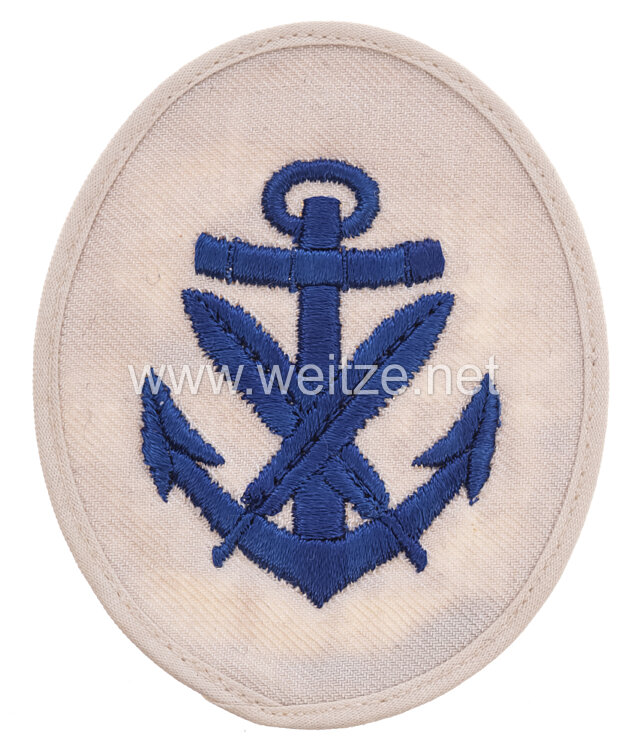
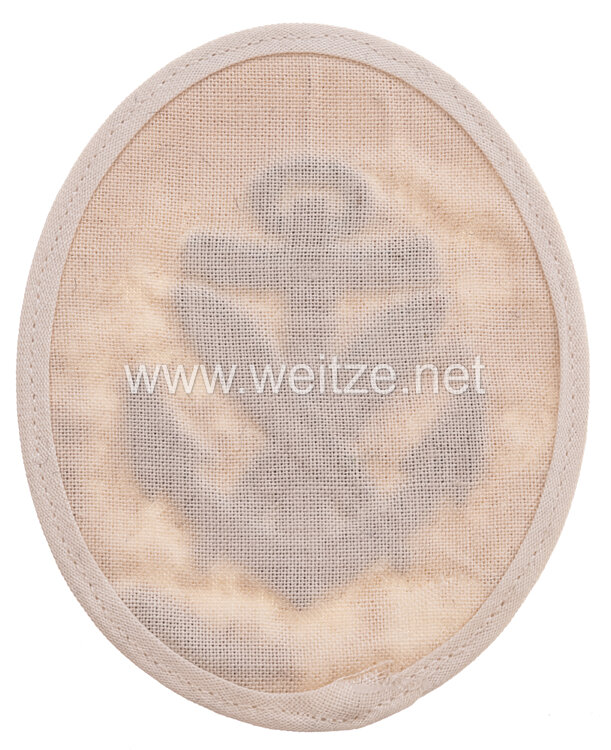
Kriegsmarine Sleeve Insignia Career Path Yeoman Petty Officer

for the white blouse. Machine embroidered. Condition 2.
466325
10,00

Kriegsmarine Sleeve Insignia Career Path Yeoman Petty Officer

The Kriegsmarine sleeve insignia for Schreibermaat (writer's mate) represents a fascinating testament to the complex rank structure and career path designations of the German Kriegsmarine during World War II. This particular insignia, designed for the white summer blouse, embodies the maritime tradition of marking specialized career paths within naval forces.

The Kriegsmarine, which existed as the official naval force of National Socialist Germany from 1935 to 1945, developed a sophisticated system for distinguishing various ranks and specializations. The rank of Maat corresponded to a petty officer without sword knot and formed an important intermediate level in the military hierarchy. Maate were experienced sailors who assumed leadership responsibilities but had not yet attained the status of staff sergeant equivalent.

The career path of the Schreiber (writer/clerk) belonged to the administrative and clerical specializations within the Kriegsmarine. Writers were responsible for the extensive documentation, correspondence, and administrative work essential for operating warships and naval bases. This function required specialized training in office organization, military administration, and often knowledge of stenography and typewriting.

The sleeve insignia of the Kriegsmarine followed a precise system established in dress regulations and uniform specifications. For the white blouse, worn primarily during summer months or in warmer climates, these insignia were machine-embroidered on dark blue backing material. Machine embroidery enabled standardized production and ensured uniform quality while maintaining cost efficiency compared to hand-embroidered variants.

The design of such career path insignia was based on a symbolic system that represented various professional specializations through specific motifs. For writers, a writing quill was typically used as the main symbol, often combined with additional elements indicating the specific rank. This symbolism had its roots in long maritime tradition and was adopted and further developed from the Imperial Navy.

The wearing of these insignia was precisely regulated. They were worn on the left upper arm, above any rank insignia. The position and execution had to comply exactly with the specifications of the Naval Service Regulations, which were regularly updated and refined through directives. Inspections of correct uniforming were part of military discipline.

The production of such sleeve insignia was carried out by specialized manufacturers and suppliers certified by the Kriegsmarine. Quality standards were high, as these insignia served not only for identification but also represented the military pride and professionalism of the service. Machine-embroidered variants became increasingly standard from the 1930s onward, while hand-embroidered versions became rarer.

Condition 2 in the description corresponds to a common grading scale for military collectibles, where this preservation grade indicates a well-preserved specimen with possibly slight signs of use, but which has retained its essential features and details.

In historical context, it must be emphasized that such objects today are exclusively of scientific, historical, and collecting interest. They document the material culture and organizational structure of the Kriegsmarine and help historians understand the functioning and internal order of this military organization. The preservation of such artifacts in museums and collections serves historical education and research.

The career path insignia of the Kriegsmarine also reflect the importance that specialized functions had in modern naval warfare. Administrative personnel such as writers were indispensable for the logistics, supply, and coordination of complex fleet operations. Without their work, the operational functioning of capital ships, submarines, and naval bases would not have been possible.

These insignia represent a material link to a specific period in naval history and illustrate how military organizations used visual markers to create identity, hierarchy, and functional clarity. The systematic categorization of career paths through distinctive insignia was a characteristic feature of German military tradition that reached its most elaborate form in the Wehrmacht and Kriegsmarine.