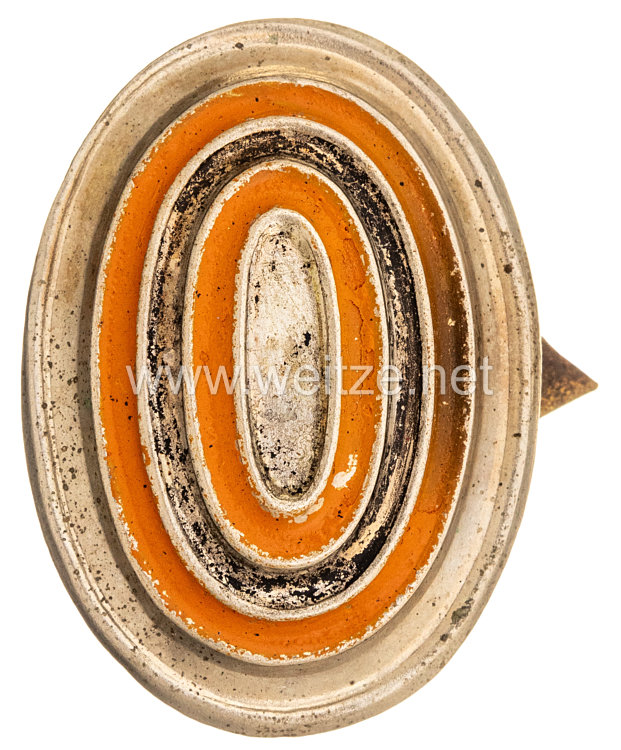
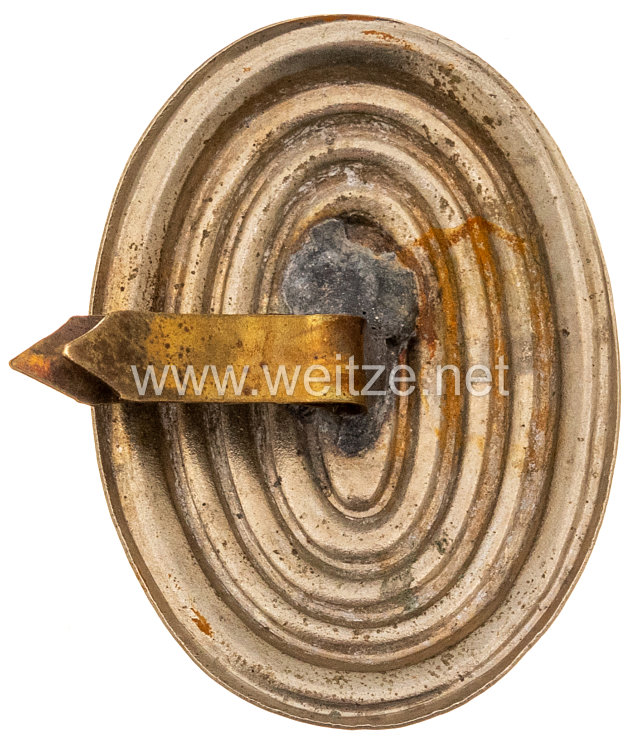
Tsarist Russia - Single Cockade for Enlisted Men's Visor Cap

Aluminum, with split pin fastener on reverse. Height 3.8 cm. Condition 2
389424
75,00

Tsarist Russia - Single Cockade for Enlisted Men's Visor Cap

The described single cockade for the visor cap of enlisted men from Tsarist Russia represents a characteristic element of military headgear in the Imperial Russian Army. Measuring 3.8 cm in height and manufactured from aluminum, this badge represents the standardized equipment of ordinary soldiers in the period before the collapse of the Romanov Dynasty in 1917.

The cockade, derived from the French word “cocarde,” evolved during the 18th century into a universal military identification symbol. In the Russian Empire, the cockade was introduced under Tsar Peter the Great (1682-1725) as part of his comprehensive military reforms following Western European models. The Russian cockade evolved into a two-color system in black and orange, later black-orange-white, representing the imperial colors.

The use of aluminum as a material is particularly revealing for dating such objects. Aluminum only became available in larger quantities and at affordable prices from the 1880s onwards through the Hall-Héroult process. Before this time, aluminum was considered a precious metal, more valuable than silver. The use of this material for enlisted men's cockades therefore indicates manufacture in the late 19th or early 20th century, probably between 1890 and 1917.

The visor cap (Russian: фуражка, furazhka) became the standard headgear of the Russian Army during the reign of Tsar Alexander II (1855-1881). It increasingly replaced older forms of headgear and was standardized through various uniform regulations. The cockade was attached centrally to the front part of the cap and served as an immediate sign of belonging to the imperial army.

The pin fastening on the reverse was the standard attachment method for metal cockades. This pin was inserted through the cap's fabric and bent over on the inside, providing a secure yet removable fastening when necessary. This practical construction allowed damaged cockades to be replaced or the badges to be used on different uniform pieces.

For enlisted men, meaning ordinary soldiers without officer rank, cockades were typically manufactured from less expensive materials than those of officers. While officer cockades were often made of gilt bronze or decorated with enamel inlays, enlisted men received simpler versions made of aluminum, white metal, or lacquered tin. This distinction reflected the strict social hierarchy of the tsarist military system.

The design of the Russian cockade varied according to branch of service and period. The classic form showed concentric circles in the imperial colors black-orange-white. Some cockades additionally bore the imperial monogram or coat of arms. The single aluminum cockade described here indicates standardized mass production, as was necessary for the large army of the Tsarist Empire.

During the reign of Tsar Nicholas II (1894-1917), the last Russian Emperor, the standardization of army uniforms reached its peak. The uniform regulations of 1907 and 1912 specified in detail how cockades and other badges were to be worn. Millions of such cockades were produced for the Russian Army, particularly during World War I (1914-1918), when Russia mobilized enormous armies.

After the February Revolution of 1917 and the overthrow of the Tsar, the imperial cockades lost their official significance. The Provisional Government introduced new badges, and after the October Revolution, the Red Army replaced all tsarist symbols with Soviet emblems. Many cockades were removed, destroyed, or kept as souvenirs during this period.

Today, such enlisted men's cockades are important military-historical artifacts. They document the material culture of the Imperial Russian Army and provide insights into manufacturing techniques, organizational structures, and the social order of the Tsarist Empire. The indicated condition 2 (on a scale where 1 is excellent) suggests a well-preserved example with only minor signs of use, which is remarkable for objects over a hundred years old.